Saint Maurice
Died about 287, by the usual reckoning
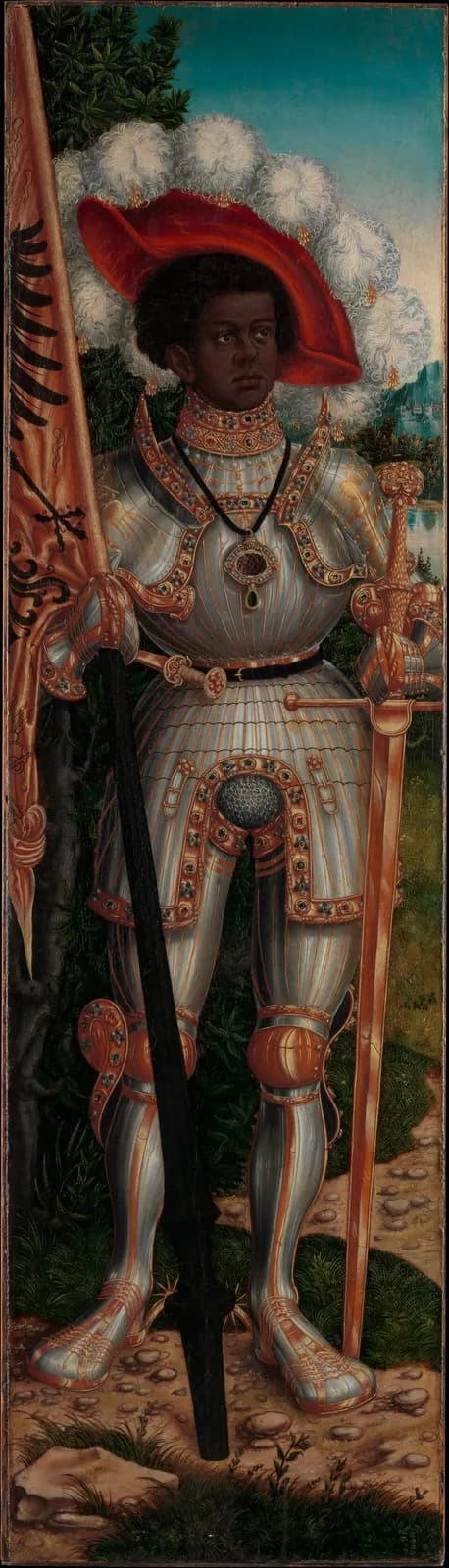
- Known as
- Leader (primicerius) of the Theban Legion 1
- Martyred
- At Agaunum, now Saint-Maurice in the Swiss canton of Valais, by order of the emperor Maximian Herculius 13
- When
- About 287; the encyclopedia also records 286, 297, 302 and 303, and one scholar's date before 292 12
- Earliest account
- A letter of Saint Eucherius, Bishop of Lyons, written about a century and a half after the event 2
- Patron saint of
- Soldiers, dyers, clothmakers and swordsmiths, and many places in Switzerland, Piedmont, France and Germany; invoked against gout and cramps 13
- Shown as
- A knight in full armor, sometimes as a Moor, with a standard and a palm 1
Saint Maurice was the leader of the Theban Legion, a body of Christian soldiers in the Roman army who, by the account handed down, were cut down at Agaunum, in what is now Switzerland, for refusing an order of the emperor Maximian. 14 The earliest witness is a bishop writing about a hundred and fifty years later, and the Catholic Encyclopedia, which defends the core of the story, also calls the detailed version a legend. 12 His feast is September 22. 134
The story as it is told
The Catholic Encyclopedia gives the outline in a few lines and labels it "the legend." A legion made up entirely of Christians had been called from Africa to put down a revolt in Gaul. Afterward the soldiers were ordered to sacrifice to the gods in thanksgiving, and refused. Every tenth man was killed. A second order met a second refusal and a second decimation, and then the whole legion was massacred. 1 Maurice was its primicerius, its leader, and the emperor who gave the order was Maximian Herculius. 1
Catholic Culture, drawing on a Tan Books saints calendar, fills in the places. The legion came from Upper Egypt. Maximian gave the order to sacrifice at Octodurum, now Martigny in Switzerland, and Maurice and two other officers led the legion in refusing and withdrew with it to Agaunum, now Saint-Maurice in the canton of Valais. 3 The martyrs, it adds, are buried under the basilica there. 3
The same page excerpts the 1894 edition of Butler's Lives of the Saints, which has the legion camped near the Lake of Geneva and gives Maurice a speech to the emperor: "we are your soldiers, but we are servants also of the true God. In all things lawful we will most readily obey, but we cannot stain our hands in this innocent blood." It ends, "We have arms, but we resist not, for we had rather die without shame than live by sin." 3 When the killing began, Butler says, the soldiers "flung down their arms" and offered their necks to the sword. 3
Where the accounts differ
The accounts do not agree on what the soldiers were asked to do. In the encyclopedia's summary it was a sacrifice of thanksgiving after a campaign. 1 In the Tan excerpt and on Vatican News it was a sacrifice "ahead of an important battle," in the Vatican News wording. 34 In Butler it was something else: the legion "got orders to turn their swords against the Christian population, and refused to obey." 3
Nor do they agree on the year. The encyclopedia's article on Maurice says about 287 and then lists four other years in parentheses: 286, 297, 302 and 303. 1 Its article on Agaunum says 303 was the date generally received and that the historian Paul Allard placed the event before 292. 2 Catholic Culture says around 287. 3
The number of the dead is the least certain thing of all. Butler says the legion "numbered more than six thousand men." 3 The Tan excerpt gives about 6,600 and then adds, "but the actual number killed remains unclear." 3
What the encyclopedia makes of it
Henri Leclercq weighed the evidence in the encyclopedia's article on Agaunum. For centuries, he writes, the martyrdom "was accepted as an historical fact, but since the Reformation it has been the subject of long and violent controversies." 2 The sources are few: two editions of the martyrs' Acts, some entries in calendars and martyrologies, and a letter of Saint Eucherius, Bishop of Lyons, which Leclercq dates to the year 450. 2
The letter is the document that matters. Attention was first drawn to the massacre under Theodore, Bishop of Octodurum from 369 to 391, "a long time after the occurrence," when a basilica was built for martyrs whose presence had been made known to the bishop by a revelation. 2 Eucherius names the chain of witnesses through whom the tradition reached him across about a hundred and fifty years, and says he traveled to the place, where pilgrims were coming in great numbers, and questioned those able to tell him the truth. 2 Leclercq credits him with relating certain facts exactly and with having "refrained from all miraculous additions." He also notes that Eucherius does not seem to have seen a written account, and that the speeches he gives the martyrs "were probably of the Bishop's Own composition." 2
On the central question Leclercq sides, with reservations, with the martyrdom. Attempts to shrink the event to the death of six men "do not seem to merit attention," and "there is nothing incredible in the massacre of a legion," though he thinks it quite possible that the unit at Agaunum was a detachment, a vexillatio, and no full legion. 2 The silence of contemporary historians, he argues, weighs less than critics have claimed. 2 He then quotes the judgment of Ruinart, Allard and the Bollandists, that the martyrdom "cannot be called in question by any honest mind," and adds his own dry sentence: "This optimistic view, however, does not seem to have convinced all the critics." 2
The abbey at Agaunum
Whatever happened there, the shrine is real and very old. Sigismund, King of the Burgundians, refounded the community that served the basilica, and its abbot Enemodus died on January 3, 516. 2 A few years later, in 522 or 523 at the latest, Abbot Ambrosius began something then unknown in the West, the laus perennis or perpetual psalmody: several choirs relieved one another day and night so that the Divine Office never stopped. 2
What came to be called the "custom of Agaunum" was copied at Lyons, at Saint-Denis, at Luxeuil and elsewhere in Gaul, and the abbey itself kept it up until the beginning of the ninth century. 2 The Tan excerpt notes that Eucherius already recorded many miracles at the martyrs' shrine. 3 Leclercq says Agaunum "had gained a world-wide fame by its martyrs and its psalmody," and that its treasury held some of the richest and best preserved goldsmith's work in the West. 2
In art
Painters show Maurice as a knight in full armor carrying a standard and a palm, and "sometimes as a Moor," the encyclopedia says. In Italian paintings he wears a red cross on his breast, the badge of the Sardinian Order of Saint Maurice. 1 Catholic Culture notes that some accounts say he was black, and points to the panel by Lucas Cranach the Elder and his workshop in the Metropolitan Museum of Art, painted about 1520 to 1525, which is the picture on this page. 3
What is Saint Maurice the patron saint of?
Saint Maurice is a patron of soldiers. The encyclopedia lists soldiers, dyers, clothmakers and swordsmiths among those who chose him, along with "many places in Switzerland, Piedmont, France, and Germany," and says he is invoked against gout and cramps. 1 Catholic Culture's longer list adds armies, infantrymen, weavers and the Pontifical Swiss Guards, names Austria, Piedmont and Sardinia among the places, and says he was proclaimed patron of Alpine troops on September 22, 1941, and again on February 16, 1961, under John XXIII. 3
Saint Maurice's feast day
Praying with Saint Maurice
The words given to Maurice were probably written by a bishop long after his death, and the encyclopedia says so. 2 They have lasted anyway, because they draw a line that soldiers and everyone else under orders still have to find: "In all things lawful we will most readily obey." 3 The legion in the story does not mutiny and does not defend itself. It declines one thing and accepts what follows. 13
The detail the tellings share is that these were armed men who chose not to fight back. "We have arms in our hands, but we do not resist," runs the line in the Tan excerpt. 3 In Butler they throw their weapons down. 3 The refusal is told as something done by a whole company together, with Maurice urging the rest to hold. 3
How much of this happened as told cannot be settled, and Leclercq, who believed in the martyrdom, did not pretend otherwise. 2 What the encyclopedia does record is that before the fourth century was out a basilica had been built for the martyrs at Agaunum, and that by the 520s monks were singing there around the clock. 2
Saint Maurice, pray for us.
Sources
- 1.Francis Mershman, "St. Maurice," The Catholic Encyclopedia, vol. 10 (New York: Robert Appleton Company, 1911).
- 2.Henri Leclercq, "Agaunum," The Catholic Encyclopedia, vol. 1 (New York: Robert Appleton Company, 1907).
- 3."Sts. Maurice and Companions, Martyrs," Liturgical Year, September 22, Catholic Culture; with excerpts from a Tan Books saints calendar and Alban Butler, Lives of the Saints (Benziger Bros., 1894).
- 4."Sts. Maurice and Companions, soldiers and Martyrs," Saint of the Day, 22 September, Vatican News.
Saints to turn to next
Others in this collection who are turned to for some of the same things.