Saint Mary of Egypt
c. 344 - c. 421, or a century later
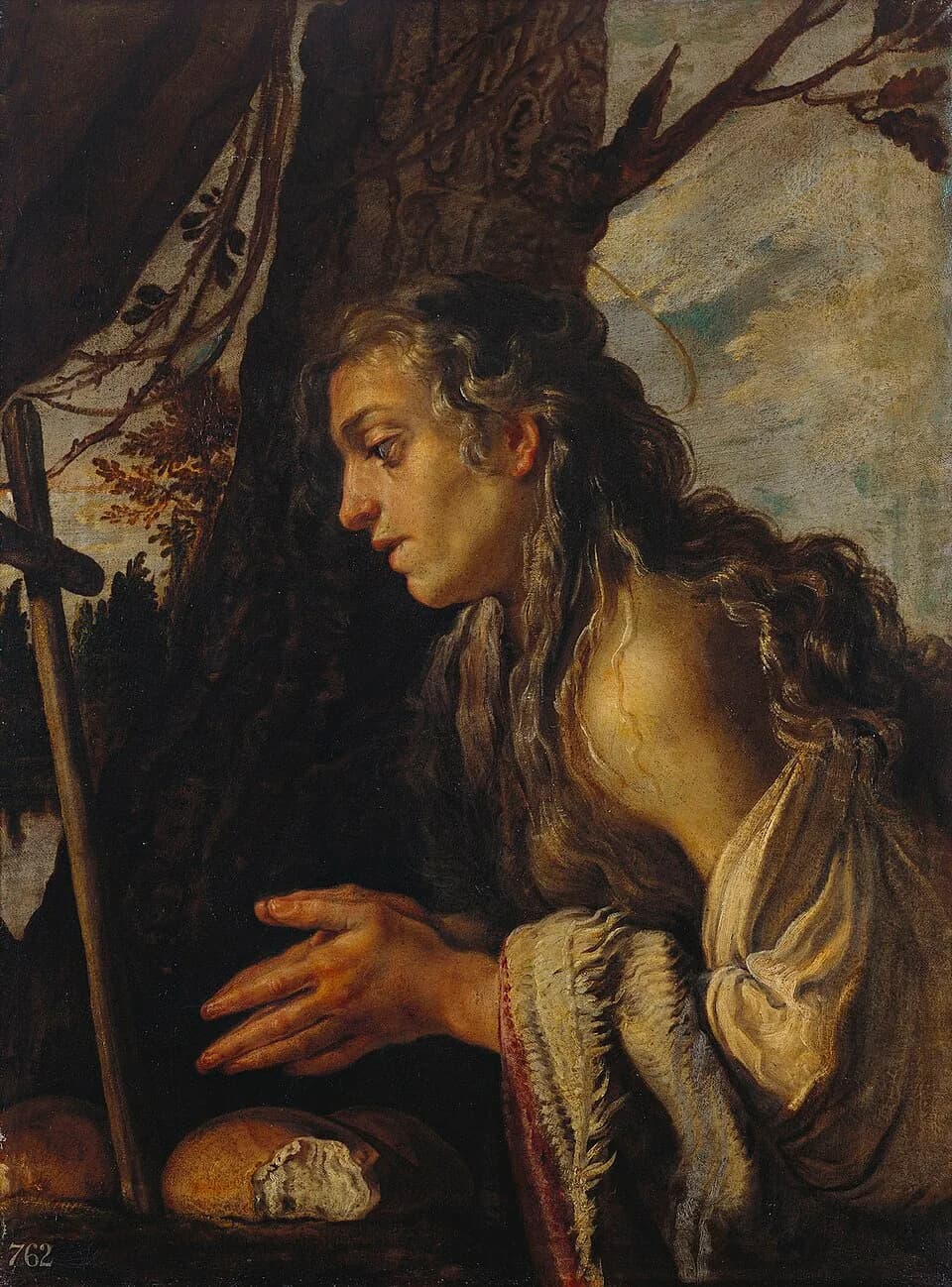
- Feast day
- April 2 in the Roman Martyrology and the Vatican News calendar 23; April 1 in the Greek Church 1; the Fifth Sunday of Lent in the Byzantine Rite 56
- Born
- Probably about 344, according to the 1910 Catholic Encyclopedia 1; in Egypt according to her Life 4, in Alexandria according to Vatican News 2
- Died
- April 1, 421, according to the Bollandists; "many other authorities put it a century later" 1. The translation of her Life used here gives 522 4
- Source of her story
- A Life traditionally ascribed to Sophronius of Jerusalem, which the Bollandists date before 500 14
- Relics
- Rome, Naples, Cremona, Antwerp and other places 1
Saint Mary of Egypt was a woman of Alexandria who, by her own account, spent some seventeen years in sexual excess, and then the next forty-seven alone in the desert beyond the Jordan. 14 Her turning point came at the door of a church in Jerusalem on the feast of the Holy Cross, when she could not get in. 12 Almost everything known of her comes from a single early Life, which tells how a monk named Zosimus met her near the end of her days and heard her story from her own lips. 14 The Roman Martyrology remembers her on April 2 as "St. Mary of Egypt, surnamed the sinner." 3
Alexandria
She tells the story herself in the Life, speaking to Zosimus: "My native land, holy father, was Egypt." 4 At twelve, while her parents were still alive, she left them and went to Alexandria. 4 Vatican News gives Alexandria as her birthplace rather than her destination. 2
The 1910 Catholic Encyclopedia says that for "upwards of seventeen years she led a life of public prostitution." 1 Her own account in the Life is a little different on one point. She says she often refused money when men offered it, because she wanted as many as possible to come to her, and that she was not rich: "I lived by begging, often by spinning flax." 4 She does not dwell on the details. "It is more becoming to speak of this briefly," she tells him. 4
One summer she saw a crowd heading for the harbor and learned they were sailing to Jerusalem for the feast of the Exaltation of the Cross. 4 She had no fare and went anyway. The encyclopedia is blunt that she went not as a pilgrim but in the hope of more lovers on the voyage, and that in Jerusalem she carried on as she had in Alexandria. 1
At the church door
On the feast she followed the crowd to the church where the relic of the Cross was being shown. 1 At the threshold something stopped her. She was pushed aside, tried again, and was stopped again, while everyone around her walked in. 4 After three or four attempts she gave up and stood in a corner of the porch. 14 Vatican News describes it as "an inner voice"; in the Life she speaks of "some force which prevented my entering." 24
There, she says, she understood for the first time that her own life was what barred the way, and she began to weep. 14 Above her was an image of the Mother of God. In the Life it is an icon; the encyclopedia calls it a statue. 14 She prayed to be let in to see the Cross, and promised that afterward she would give up the world and go wherever Our Lady led her. 14
This time she walked in without difficulty. 1 She venerated the Cross and kissed the floor of the church, then went back to the image to keep her promise, and heard a voice saying that if she crossed the Jordan she would find rest. 14 As she left, a stranger gave her three coins, and she spent them on three loaves. 4 By sunset she had reached the church of John the Baptist on the Jordan, where she received Communion. The next morning she crossed the river into the desert. 14
Forty-seven years beyond the Jordan
She lived there alone for forty-seven years, the encyclopedia says, "subsisting apparently on herbs." 1 In the Life she tells Zosimus that her loaves dried "hard as rock" and lasted a few years, and that the first seventeen years were a fight against the old desires: for meat and wine, for the songs she used to sing, and above all for the life she had left. 4 When they came, she says, she threw herself on the ground and wept, and called to mind the icon and her vow, until light came and the storm passed. 4 She also tells him she had never learned from books. 4
Zosimus was a priest and monk who had lived in monasteries since childhood. 4 In the Life, he was tempted at fifty-three to think he had nothing left to learn, and was sent by an angel to a monastery near the Jordan whose monks spent each Lent scattered alone in the desert. 4 It was on one of those Lenten journeys that he met her. 14 She knew his name and that he was a priest before he told her, which frightened him. 14 She asked for his cloak to cover herself, told him her story, and asked him to come back to the Jordan on Holy Thursday the following year and bring her Communion. 14
The last Communion and her burial
He came as she asked. She appeared on the far bank, made the sign of the cross over the water, and walked across it to him. 14 Having received Communion, she raised her hands and prayed the words of Simeon, "Now lettest Thou Thy servant depart in peace." 14 She told him to come back the next year to the place where they had first met. 1
When he did, he found her body. Beside it, the Life says, words were traced on the ground: "Abba Zosimas, bury on this spot the body of humble Mary." 4 The writing also said she had died a year before, on the same night she had received Communion. 14 The Life dates that night to the first day of April. 4 The encyclopedia says, with a characteristic "we are told," that a lion helped him dig the grave; the Life has the lion dig it with its paws while the old man watches. 14 Zosimus went home and told the brothers, and in the Life the story passed by word of mouth among the monks until its author heard it and wrote it down. 14
Who wrote the Life, and when she lived
The Life opens in the voice of Sophronios, who says he is setting down what reached him, "putting truth above all else." 4 Many authorities, the encyclopedia notes, have named Sophronius, who became Patriarch of Jerusalem in 635, as the author. But the Bollandists gave good reasons to think the Life was written before 500, and Joseph MacRory concluded in 1910 that "it is from some other hand." 1
Her dates are just as uncertain. The Bollandists place her death on April 1, 421, and "many other authorities put it a century later." 1 The translation of the Life used here says 522, and the Metropolitan Cantor Institute of the Byzantine Catholic Archeparchy of Pittsburgh calls her a saint "of the 4th century." 45
What is Saint Mary of Egypt the patron saint of?
None of the sources used here names a patronage for her, so this page does not assign one. What the Church calls her is something else. Vatican News lists her as "Penitent," and the Roman Martyrology of 1897 records her as "surnamed the sinner." 23 A Ukrainian Catholic parish explains that she is commemorated near the end of Lent "encouraging all who have neglected their salvation that repentance can return them to God even at the eleventh hour." 6
Saint Mary of Egypt's feast day
In the Latin Church she is kept on April 2. The Roman Martyrology of 1897 records "the decease of St. Mary of Egypt, surnamed the sinner" on that day, and the Vatican News Saint of the Day calendar lists her there today. 23
The older sources disagree among themselves. The 1910 Catholic Encyclopedia says the Greek Church keeps her on April 1, the Roman Martyrology on April 2, and the Roman Calendar on April 3, and considers the Greek date "more likely to be correct," suggesting the others may mark the days portions of her relics reached the West. 1 The Catholic Answers printing of the same article adds that "the Latin" Church keeps her on April 9. 7
The Byzantine Churches add a second commemoration. The Metropolitan Cantor Institute lists the Fifth Sunday of the Great Fast, as Eastern Christians call Lent, as the Sunday of Saint Mary of Egypt. 5 The Saskatoon parish adds that she is remembered again on the Thursday before that Sunday, when her Life is read with the Great Canon of Saint Andrew of Crete. 6
Praying with Saint Mary of Egypt
Her story begins with a door that would not open. She had come to Jerusalem for anything but prayer, and the Life does not soften that. 14 What changed was small and physical: she could not cross a threshold that everyone else crossed, and standing in the corner of the porch she finally understood why. 4 She wept, she asked for help, and she made a promise before she knew what it would cost. 14
The cost was not paid in a day. In her own telling, the first seventeen years in the desert were a struggle against the desires of her old life, and what she held onto through them was the memory of the icon and the vow she had made in front of it. 4 According to the Saskatoon parish, the Holy Fathers placed her commemoration near the end of the Great Fast for the sake of those who have put off repentance, and the Byzantine calendar still keeps her there. 56
Her end is also worth noticing. After nearly half a century alone, what she asked of Zosimus was Communion, the Creed and the Our Father, and his prayers. 4 She calls herself "a miserable wretch" and asks him to pray for her, and yet in the Life it was a monk who thought he had mastered the spiritual life who was sent to learn from her. 4
Much of what the Life tells cannot be checked, and the Church's own historians have said plainly that its author and its dates are uncertain. 1 What the Church has kept is the outline the Martyrology gives in a single line: a woman known as the sinner, who died in the desert, and is remembered as a saint. 3
Saint Mary of Egypt, pray for us.
Sources
- 1.Joseph MacRory, "St. Mary of Egypt," The Catholic Encyclopedia, Vol. 9 (New York: Robert Appleton Company, 1910).
- 2."2 April," Saint of the Day, Vatican News.
- 3.The Roman Martyrology, April 2 (Baltimore: John Murphy Company, 1897), and its index, "Mary of Egypt, St., 'the Sinner' Apr. 2".
- 4."The Life of Our Holy Mother Mary of Egypt," attributed to St. Sophronius of Jerusalem, from The Great Canon, the Work of St. Andrew of Crete (Jordanville, NY: Holy Trinity Monastery), as published by the Metropolitan Cantor Institute, Byzantine Catholic Archeparchy of Pittsburgh.
- 5."The Great Fast," Metropolitan Cantor Institute, Byzantine Catholic Archeparchy of Pittsburgh.
- 6."The Fifth Sunday - St. Mary of Egypt," Saints Peter & Paul Ukrainian Catholic Church, Saskatoon.
- 7.J. MacRory, "Mary of Egypt, Saint," Catholic Answers Encyclopedia (reprinting the original Catholic Encyclopedia).
Saints to turn to next
Others in this collection who are turned to for some of the same things.