Saint Mary Domenica Mazzarello
May 9, 1837 - May 14, 1881
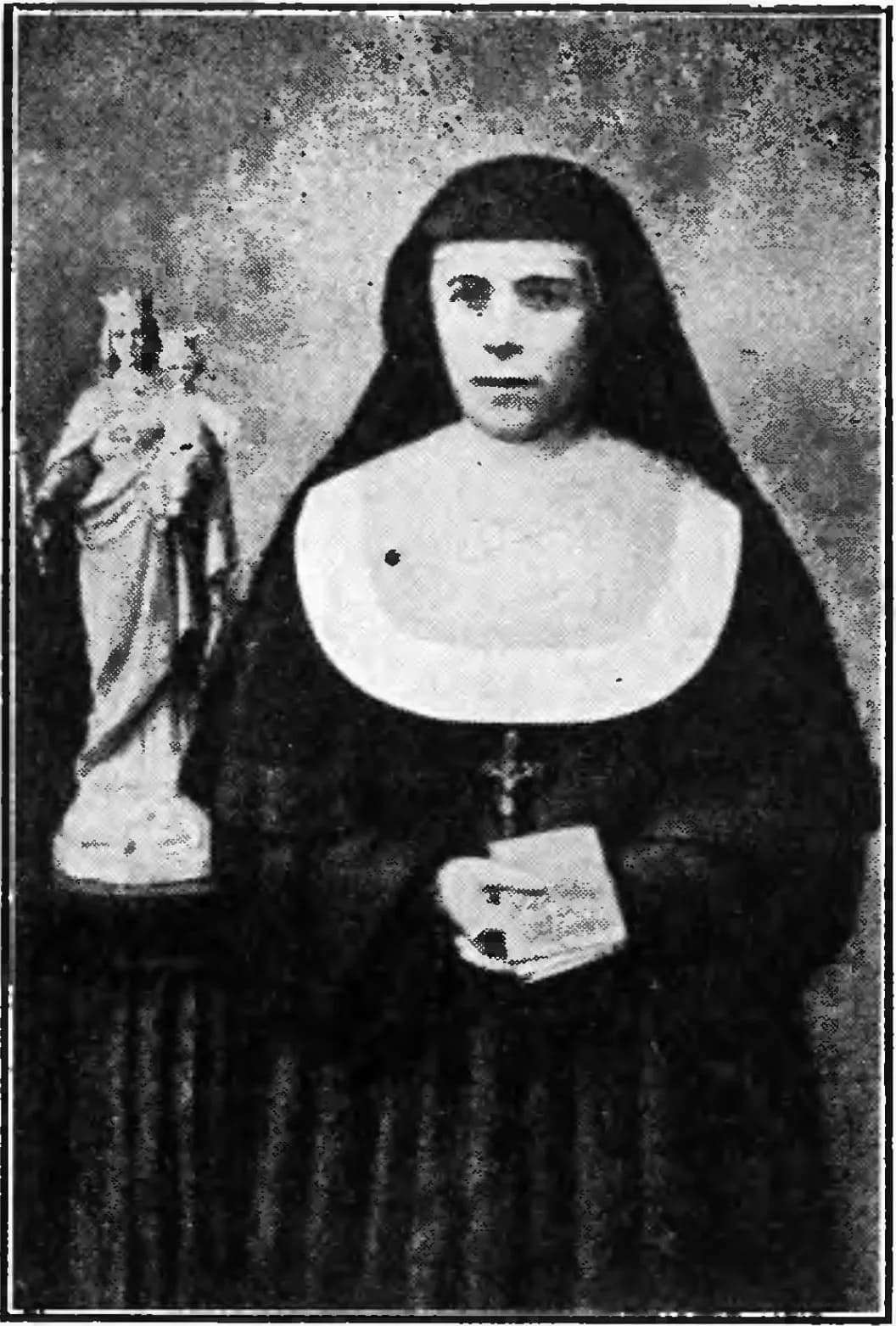
- Founded
- The Institute of the Daughters of Mary Help of Christians, with Saint John Bosco, on August 5, 1872 13
- Beatified
- November 20, 1938, by Pius XI 1
Saint Mary Domenica Mazzarello was a peasant girl from Mornese, in northern Italy, who with Saint John Bosco founded the Daughters of Mary Help of Christians, the congregation now known as the Salesian Sisters. 13 She had little schooling and said so gladly; Pius XII, a few days after canonizing her, observed that she did not seek the role of foundress and tried in vain to escape it. 1 When she died at 44 the institute she led was nine years old and already working on two continents. 36
A farm in the Monferrato
She was born at Mornese, in the province of Alessandria, on May 9, 1837, the eldest of seven children in a family of farmers. 1 The Institute that grew from her work describes a girl of uncommon physical strength who worked in the fields beside her father, Joseph, and who learned at home the sense of God, the tireless industry and the practical judgment she later brought to governing a congregation. 3 Pius XII put her upbringing in a phrase: she grew up piously, placidly, in the work of the house and the fields. 1
Book learning was another matter. In the same address the Pope said that in the sciences and letters she was, and always would remain, poorly educated, and that she was pleased to proclaim it. 1 ACI Prensa preserves one of her sayings from those years: for God not to let us go without bread, it is necessary to pray and to work. 7
At some point in her youth she joined the Daughters of the Immaculate, a pious association of young women in the village. The Institute dates her enrollment to 1855. 3 The Dicastery for the Causes of Saints tells it later, after the sewing workshop described below, and says that it came about through the parish priest. 1
The typhus of 1860
In 1860 typhus reached Mornese. Mary was asked to go and nurse relatives who had fallen ill - at the suggestion of her confessor, Father Domenico Pestarino, according to the Institute, and at the request of the parish priest, according to the Dicastery. 13 She went knowing she might catch it, and she did. The Dicastery gives the date she fell ill as August 15. 13
She recovered, but not her strength, and she could no longer work the fields. 13 The Institute says something else came out of the illness as well: a clear intuition, which she took to be a call from God, that her life was to go to the girls of the town. 3 With her friend Petronilla she opened a small dressmaking workshop. 13 She learned the trade properly so as to teach poor girls not only to sew but, above all, to know and love God, and the work grew into a Sunday oratory and then a home for girls who had no family. 3
The Institute records a vision from this time. She saw a large building with a great many girls running about its courtyard, and heard a voice say, "I entrust them to you." 3 The first orphans came, and she looked after them, the Institute says, tenderly, like a mother, helped by other young women from the Daughters of the Immaculate. 3 In October 1867 the group began to live together as a community. 1
Don Bosco comes to Mornese
In October 1864 Don Bosco walked into Mornese with a crowd of his boys from Turin on one of their autumn outings. 34 Father Pestarino had joined his Salesians the year before and wanted a school for the boys of the district. 3 Mary met the priest from Turin and is remembered for one sentence about him: "Don Bosco is a saint, and I feel it." 34
Don Bosco had long wanted to do for girls what he was doing for boys, and the Institute says it was Pius IX who encouraged him to act on it. 3 With Father Pestarino's help he chose the first members of the new congregation from among the Daughters of the Immaculate, and gave them the school newly built at Mornese as their home. 13 On August 5, 1872, the first eleven young women made their religious profession before the Bishop of Acqui, with Don Bosco present. 3 The Institute was called the Daughters of Mary Help of Christians, and Mary Mazzarello was its superior. 34
Pius XII stressed how little she had sought the post. She was made superior, he said, almost by divine inspiration, before she or her companions had any precise idea of what religious life was. 1 ACI Prensa adds that she asked to be called "vicar" instead, because the true superior was the Virgin. 7 John Paul II recalled that she told her sisters, in an almost paradoxical phrase, "Let us live in the presence of God and of... Don Bosco!" 4
Superior of a growing institute
The congregation grew quickly, and the Institute's own history describes her as a skilled teacher of the spiritual life who stood in deep harmony with Don Bosco. 3 She had a gift for education, a calm and cheerful manner that reassured people, and a knack for drawing other young women into the work of helping girls become, in Don Bosco's phrase, good Christians and honest citizens. 3 Don Bosco himself told his collaborator Don Cagliero: "Their Congregation is equal to ours; it has the same end and the same means." 14
In 1877 the first six sisters left for the missions and founded a community in Uruguay; houses in Argentina followed a year later. 3 Pius XII described how news of the Salesians' work in Latin America fired her and her daughters and set off departure after departure, to Argentina and Uruguay and soon to the native peoples of Patagonia. 1 In his canonization homily he praised the way schools, workshops and homes for orphan girls were opened in many places, especially for girls of poorer families. 2
Two years before her death the community moved its center from Mornese to Nizza Monferrato, where the motherhouse has been ever since. 3 Her sayings that survive are short and practical. The Dicastery heads its page with one of them: "Love one another. Always keep united. You have left the world; do not build yourselves another one in here. Remember why you entered the Congregation." 1
Her death
At 44 she contracted a severe pleurisy, and she died at Nizza Monferrato on May 14, 1881. 13 She had led the institute for nine years. L'Osservatore Romano reports that she left 26 houses, 156 professed sisters and 50 novices, and that the institute was already present in four countries in Europe and America. 6 Her successor, Caterina Daghero, was well short of 35, the age the rule required of a superior general, and Don Bosco granted a dispensation. 6
One more of her sayings, which ACI Prensa quotes, could stand over her last years: "Courage, for after a few days of combat we will have paradise forever." 7 Pius XI beatified her on November 20, 1938, and Pius XII canonized her on June 24, 1951, together with Emily de Vialar. 12
What is Saint Mary Mazzarello the patron saint of?
Saint Mary Mazzarello's feast day
Saint Mary Mazzarello's feast day is May 14, the day of her death. Pius XII fixed it in the act of canonization itself, decreeing that the universal Church keep her memory every year on her heavenly birthday, May 14. 2 The Dicastery for the Causes of Saints lists May 14 as her liturgical memorial, and the Roman Martyrology enters her that day, at Nizza Monferrato, as one who shone with humility, prudence and charity. 15 The Salesian Family keeps her a day earlier, on May 13, as the calendar of the Salesians of Don Bosco in the United States and ACI Prensa's saint of the day both show. 78
Praying with Saint Mary Mazzarello
Her life turns on an illness. Before 1860 she was strong, and her future was the farm; afterward she could not do the work she knew, and the Institute says that out of that loss came the conviction that God wanted her elsewhere. 3 Nothing in the sources suggests she welcomed the weakness. She took up a needle because she could no longer take up a hoe, and taught girls with it. 13
Pius XII, in the homily of her canonization, singled out one thing he found remarkable in her and in Emily de Vialar: burdened with so many cares and dangers, they never lost a serene, gentle tranquility. 2 It looked like a natural gift, he said, and it was not. It came from heaven and was fed by grace and by their love of God and neighbor. 2 Her own sayings carry the same note without the Latin. Pray and work. Love one another. Courage, it is only a few days. 17
Pope Francis, speaking to her sisters in 2021, asked them to draw on the family spirit that marked the first community at Mornese. 9 That community began as a handful of village women with a dressmaker's room and some orphans, led by someone who wanted to be called the vicar and not the superior. 137 A life like hers is a fair answer to anyone who feels too ordinary, or too unschooled, to be of use.
Saint Mary Domenica Mazzarello, pray for us.
Sources
- 1."Maria Domenica Mazzarello (1837-1881)," Dicastery for the Causes of Saints, with the biography and Pius XII's address to the pilgrims for the canonization, June 27, 1951 (in Italian).
- 2.Pius XII, homily for the canonization of Emily de Vialar and Mary Domenica Mazzarello, Vatican Basilica, June 24, 1951 (in Latin).
- 3."Mary Domenica Mazzarello," Institute of the Daughters of Mary Help of Christians.
- 4.John Paul II, address to the students of the Daughters of Mary Help of Christians for the centenary of the death of Saint Mary Domenica Mazzarello, St. Peter's Square, April 25, 1981 (in Italian).
- 5.Roman Martyrology, entry for May 14, "Santa Maria Domenica Mazzarello," as printed in "Santo del giorno," Conferenza Episcopale Italiana (in Italian).
- 6."The great Salesian," on Mother Caterina Daghero, Women Church World, L'Osservatore Romano, February 2024.
- 7."Santo del día 13 de mayo: Santa María Mazzarello," ACI Prensa, May 13, 2025 (in Spanish).
- 8."St. Mary Mazzarello," calendar of the Salesians of Don Bosco, USA.
- 9.Francis, address to the participants in the General Chapter of the Daughters of Mary Help of Christians, October 22, 2021 (in Italian).
Saints to turn to next
Others in this collection who are turned to for some of the same things.
- Saint Aelred of Rievaulx1109 - January 12, 1166 (or 1167)Work and vocationStudy and teaching
- Saint Albert the Greatc. 1206 - November 15, 1280Study and teachingWork and vocation
- Saint Alexander Sauli1533 or 1534 - October 11, 1592Work and vocationStudy and teaching
- Saint Angela MericiMarch 21, 1474 - January 27, 1540Study and teachingWork and vocation