Saint Mary Magdalene
First century
- Patron saint of
- Penitents and perfumers 2
- Died
- Franciscan Media gives about the year 63 2
- Named for
- Magdala, near Tiberias on the west shore of Galilee 1
- In the Gospels
- The first recorded witness of the Resurrection 1
Saint Mary Magdalene stood at the cross, watched where the body was put, and was the first person recorded as seeing Jesus alive again. 1 She is also the most misidentified woman in the New Testament, and the two sources behind this page disagree with each other about who exactly she was - a 1910 encyclopedia arguing that she is the same woman as Mary of Bethany and the sinner of Luke 7, and a modern reading that says there is no scriptural basis for that at all.
What the Gospels say about her
She is called Magdalene either from Magdala, near Tiberias on the west shore of Galilee, or possibly from a Talmudic expression about curling women's hair. 1 She appears among the women who accompanied Jesus and supported the work out of their own means, and it is said that seven devils had been cast out of her. She stands at the foot of the cross in all four Gospels. She saw him laid in the tomb. She was the first recorded witness of the Resurrection. 1
Franciscan Media puts the weight where it belongs: "of all the 'official' witnesses who might have been chosen for the first awareness of the Resurrection, she was the one to whom that privilege was given." 2 The seven demons, it adds, are "an indication at the worst, of extreme demonic possession or possibly, severe illness." 2
The identification that has never settled
Three women appear in the Gospels who have been read as one: the unnamed "sinner" who anointed Jesus' feet in Luke 7, the sister of Martha and Lazarus in Luke 10 and John 11, and Mary Magdalene. The 1910 encyclopedia sets out the positions frankly. "The Greek Fathers, as a whole, distinguish the three persons." "On the other hand most of the Latins hold that these three were one and the same." Protestant critics of the day held that there were two or three. 1
That article then argues the Latin case, and it does not hide that it is arguing. "It is impossible to demonstrate the identity of the three," it concedes, before making its own reading of John's Gospel and concluding: "If the foregoing argument holds good, Mary of Bethany and the 'sinner' are one and the same." 1 It is a careful piece of work by a scholar who believed it.
Franciscan Media, writing much later, reports the other outcome. "Most Scripture scholars today point out that there is no scriptural basis for confusing the two women." It quotes Father Wilfrid Harrington that the seven demons phrase "does not mean that Mary had lived an immoral life - a conclusion reached only by means of a mistaken identification with the anonymous woman of Luke 7:36," and Father Edward Mally that she "is not...the same as the sinner of Luke 7:37, despite the later Western romantic tradition about her." 2
Both readings are on this page because both are held by sources this library trusts, a century apart. Franciscan Media adds the observation that gets least attention: given how the tradition has treated her, "she could well be the patron of the slandered." 2 Note what neither source says. Neither one calls her a prostitute. That claim is the single most repeated thing about her and it is in none of the material behind this profile.
Apostle to the Apostles
On 10 June 2016 the Holy See Press Office announced a decree, issued at the express wish of Pope Francis, raising her 22 July celebration from a memorial to a feast - the rank the apostles are kept at. 3 The bulletin is headed "The liturgical memory of Mary Magdalene becomes a feast, like that of the other apostles." 3
The decree gave the Mass a preface of its own, entitled de apostolorum apostola, "Apostle of the apostles." Its Latin describes a woman who had loved Christ living, seen him dying on the cross, sought him lying in the tomb, and was the first to adore him risen from the dead - and says that he honored her with the office of an apostle before the apostles, so that the good news of new life should reach the ends of the earth. 3 Franciscan Media notes that the title itself is not new: "She is known as the 'Apostle to the Apostles.'" 2
The word "first" is doing the work in both texts. Whatever is unresolved about her identity, the sequence in the Gospels is not in dispute, and the 2016 decree is the Church treating that sequence as the thing about her that ranks. 13
Where she went afterward
Two traditions survive and they cannot both be right. The Greek Church holds that she retired to Ephesus with the Blessed Virgin, died there, and that her relics were taken to Constantinople in 886; Gregory of Tours supports the Ephesus account. 1
The French tradition has her arriving at Marseilles with Lazarus and companions and converting the whole of Provence, then withdrawing to a hill, La Sainte-Baume, for thirty years of penance, and being carried by angels to Aix at the end. 1 The encyclopedia handles the relics that follow with visible care: "History is silent about these relics till 745," when they were moved to Vézelay for fear of the Saracens; no record survives of their return, but when Charles II of Naples built a convent at La Sainte-Baume in 1279 the shrine was found intact with an inscription explaining why it had been hidden. Clement VIII sent a sarcophagus in 1600. The church, wrecked in the Revolution, was restored in 1814 and the grotto consecrated again in 1822. 1
The article reports both without choosing, and this page does the same.
What is Saint Mary Magdalene the patron saint of?
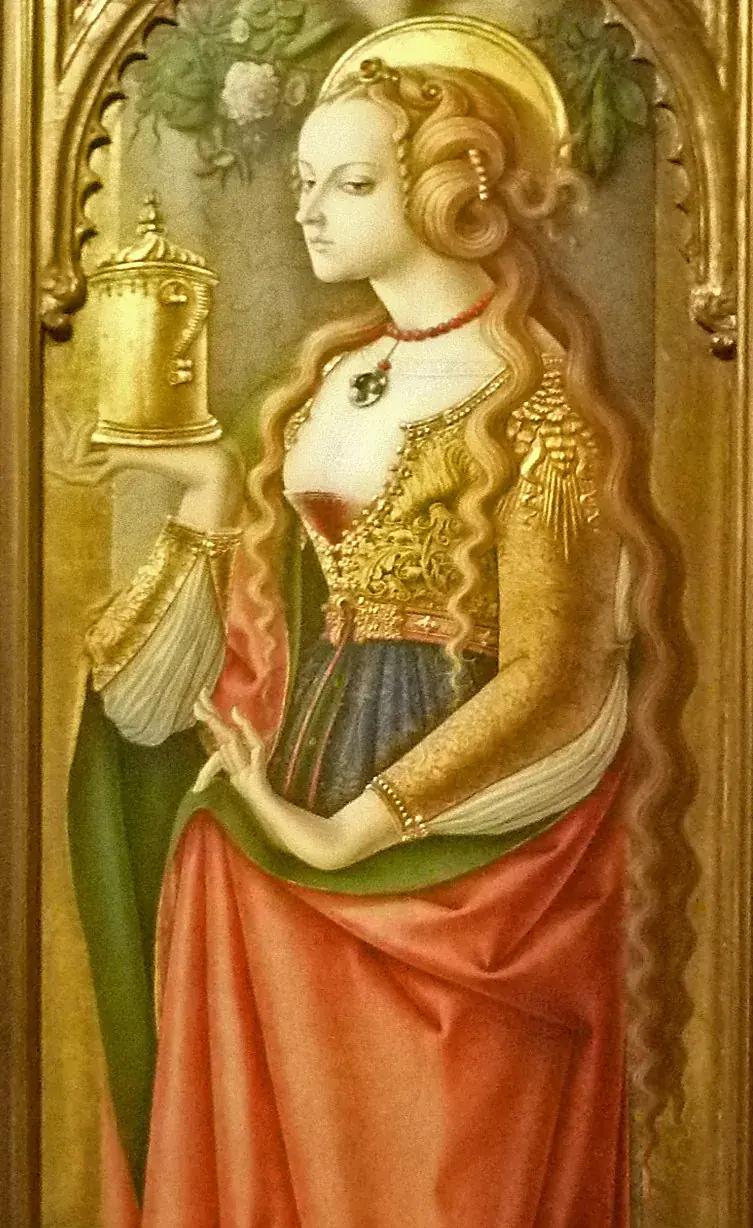
Franciscan Media lists her as the patron saint of penitents and of perfumers. 2 Both come from the anointing: the jar she is holding in the painting on this page is the attribute painters gave her for it. And both therefore rest on the identification with the woman of Luke 7 that the same source says has no scriptural basis. 2 The patronage and the scholarship pull against each other, and each is recorded here as it stands.
Saint Mary Magdalene's feast day
Praying with Saint Mary Magdalene
Being remembered wrongly is the thing that has actually happened to this woman, for centuries, in good faith, by people who loved her. Franciscan Media's line about the patron of the slandered is not a joke. 2 Anyone who has been fixed in other people's minds as one bad chapter, and has watched the correction fail to travel as far as the story did, is standing where she stands.
The encyclopedia's reading and the modern one part company over whether she is the woman who wept over Jesus' feet. 12 They agree completely about the tomb. She was there when there was nothing to be gained by being there, on the Friday and again at first light, and she was the one sent to tell the others. 13
Seven devils had been cast out of her, and the Gospel gives no detail at all beyond that phrase. 1 Franciscan Media reads it as possession or serious illness rather than a moral history. 2 Whatever it was, she was in a bad enough state that the Gospel writers thought it worth recording, and afterward she is simply one of the people who stayed.
The 2016 decree gives the reason the Church keeps her day at the rank it does: Christ honored her with the office of an apostle in the presence of the apostles, so that the news of new life would reach the ends of the earth. 3 A message is only as good as the person carrying it, and the first one was given to a woman whose reputation the next twenty centuries would spend arguing about. 12
Saint Mary Magdalene, pray for us.
Sources
- 1.Hugh Pope, "St. Mary Magdalen," The Catholic Encyclopedia, Vol. 9 (New York: Robert Appleton Company, 1910).
- 2."Saint Mary Magdalene," Saint of the Day, Franciscan Media.
- 3."The liturgical memory of Mary Magdalene becomes a feast, like that of the other apostles," Holy See Press Office bulletin, 10 June 2016.
Saints to turn to next
Others in this collection who are turned to for some of the same things.