Saint Mary Euphrasia Pelletier
July 31, 1796 - April 24, 1868
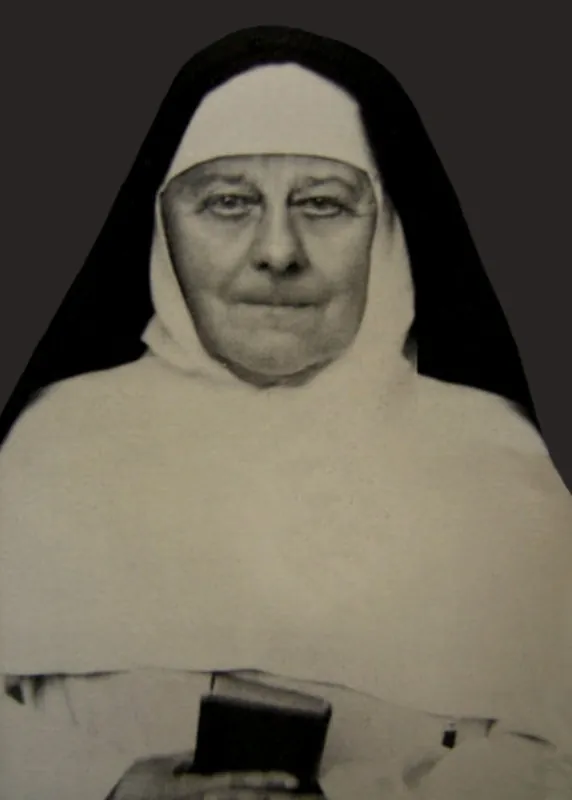
Saint Mary Euphrasia Pelletier was a French sister of Our Lady of Charity of the Refuge who, in 1835, won papal approval to unite its houses under one motherhouse at Angers, founding the Good Shepherd Sisters. 12 In the thirty-three years she led them they opened one hundred and ten houses, from Ireland to Chile to Louisville, Kentucky, all to shelter women and girls in difficulty. 16 The 1909 Catholic Encyclopedia records that her opponents called her "an innovator, an ambitious person, impatient of authority." 1
Noirmoutier and Tours
She was born Rose Virginie Pelletier on July 31, 1796, on Noirmoutier, an island off the Atlantic coast of France. 12 The congregation's international site says her parents had been imprisoned on the island during the Revolution, and that her father, a doctor, treated the other islanders and their captors alike while her mother fed the hungry and cared for the sick. 4 The US region of the congregation adds that her schooling brought loss, loneliness and a sense of exclusion, which it credits with deepening her compassion. 5
She was sent to boarding school at Tours, where she came to know the Sisters of Our Lady of Charity of the Refuge. 24 That order was Saint John Eudes's, founded at Caen in 1641 to take in women who wanted to begin their lives again. 1 The international site describes the girls in its care: some abandoned or orphaned, some forced into prostitution in order to survive, all offered shelter, food and training for work. 4 She entered at Tours in 1814, at eighteen, made her profession in 1816 and took the name Mary of Saint Euphrasia. 124
Soon after her profession she was put in charge of the penitents, and she became superior of the house in 1825. 12 The US region site puts her age then at twenty-nine. 5 The New Catholic Encyclopedia says the Tours community had been struggling to recover from its suppression in the Revolution, and that it flourished under her. 2
The US region site tells one story of her as superior in its own voice: when the bishop would not let the sisters leave the convent without his permission, she had a tunnel built so that they could reach the people who needed them. 5
A contemplative house for the women themselves
At Tours she made room for something the Refuge had not had. Some of the women who had come to the sisters for shelter wanted to stay for life and to pray. 14 She gave them a contemplative community of their own. The international site calls them the Sisters of Saint Magdalen; the New Catholic Encyclopedia calls them the Sisters Magdalens, says they were cloistered and dedicated to reparation, and records that they became a branch of the Good Shepherd Sisters in 1950 and were renamed Contemplatives of the Cross in 1964. 24 The US region site gives their present name as the Contemplative Sisters of the Good Shepherd. 5
The 1909 encyclopedia describes them as they were in its day: "an austere contemplative community" under the Rule of the Third Order of Mount Carmel, for whom "Prayer, penance and manual labour are their principal occupations." 1
Angers, and the fight over a motherhouse
In 1829 she went to Angers at the bishop's request to found a house there, and became its superior in 1831. 24 The 1909 encyclopedia says she arrived with five sisters. 1 Other bishops began asking for communities of their own. 4
Here she ran into the structure Eudes had left. Following the custom of his time, he had given the Refuge no motherhouse: every house was its own community, joined to the others "only by bonds of fraternal charity." 1 She wanted sisters and resources shared wherever they were needed, and that meant a central government. 15
It was not welcome. "Like many of God's elect," the encyclopedia says, "she was treated by her adversaries as an innovator, an ambitious person, impatient of authority. Only after incessant labours and formidable opposition did her cause triumph." 1 The brief approving the motherhouse at Angers was signed on April 3, 1835, and published by Gregory XVI. 1 The institute became Our Lady of Charity of the Good Shepherd of Angers, directly subject to the Holy See and authorized to send its sisters "to the extremities of the earth." 1 She was its first superior general. 24
One hundred and ten houses
She led the congregation for thirty-three years. 14 The encyclopedia says every house was founded at the request of the Church authorities in the place, and lists where they went: France, Belgium, Holland, Rome and Italy, Germany, Austria, England, Scotland, Ireland, Asia, Africa, the United States and Chile, one hundred and ten convents in sixteen provinces. 1 The US region site remembers the green doors of the motherhouse at Angers, through which she sent the sisters out. 5
The first American house began at Louisville, Kentucky, on December 1, 1842. A Good Shepherd ministry in San Francisco records that she chose five sisters, aged twenty-four to twenty-nine and speaking three languages among them, who crossed on the emigrant ship Utica, were processed at Castle Garden in New York, and went on to Kentucky. 6
Writing for Vatican News in 2019, Sister Catherine Aubin says that she sent sisters to countries where she knew women and children were being sold, to free them from slavery and give them a new life, and that one benefactor, the Countess d'Andigné, called her "Madame de l'Espérance," the lady of hope. 3
She died at Angers in 1868: on April 24 by the New Catholic Encyclopedia's date, on April 29 by the 1909 encyclopedia's. 12 The 1909 article counts what she left: 2,067 professed sisters, 384 novices, 309 Touriere sisters, 962 Magdalens, 6,372 penitents and 8,483 children. 1 Leo XIII declared her Venerable on December 11, 1897; Pius XI beatified her on April 30, 1933, and Pius XII canonized her on May 2, 1940. 12
The work, as the sources describe it
The 1909 encyclopedia states the congregation's aim in the language of its day: "to provide a shelter for girls and women of dissolute habits, who wish to do penance for their iniquities and to lead a truly Christian life." It adds that "Not only voluntary penitents but also those consigned by civil or parental authority are admitted," and that children were taken in too, kept in a separate class from the penitents and the Magdalens. 1 Besides the three usual vows, the sisters took a fourth, to work for the conversion and instruction of penitents. 1
In Ireland, the Good Shepherd Sisters were among the congregations that operated Ireland's Magdalene laundries. Catholic Ireland reported in February 2013 that they were one of four congregations that took part in the Irish government inquiry chaired by Senator Martin McAleese, and in June 2013 that they welcomed the redress scheme that followed and planned to continue caring for women who had stayed on with them after leaving the laundries. 78
The congregation today describes its mission as serving women, children and families wounded by violence, poverty and social segregation. 9 Vatican News reported in 2026 on its sisters taking in women escaping domestic violence in Malta and Portugal. 9
What is Saint Mary Euphrasia Pelletier the patron saint of?
Saint Mary Euphrasia Pelletier's feast day
Her feast is April 24. The New Catholic Encyclopedia prints it, and so do the congregation's international and US sites; Sister Catherine Aubin's Vatican News piece says she is commemorated on that day. 2345 It is the day of her death by the New Catholic Encyclopedia's reckoning. 2
The 1909 Catholic Encyclopedia gives no feast, because when it was written she had been declared Venerable and was not yet beatified. 1
Praying with Saint Mary Euphrasia Pelletier
Her novices were given one line about the people in their care, and both of her congregation's sites still quote it: "It is not enough that you love them; they must know that you love them." 45 It is practical advice, and it puts the burden on the one doing the loving.
The encyclopedia does not pretend the founding was peaceful. She was called ambitious, an innovator and disobedient, and the motherhouse was approved only after what it calls formidable opposition. 1 Its own judgment is that "Her sole ambition was to extend God's kingdom," and that her innovations were approved by the Church. 1 The brief of 1835 settled the question of the motherhouse in her favor.
What the sources describe is a woman who started with five sisters in a provincial town and, within her lifetime, had houses on several continents, many of them opened because a bishop somewhere asked for one. 1 Vatican News recalls the name a benefactor gave her, the lady of hope. 3
Saint Mary Euphrasia Pelletier, pray for us.
Sources
- 1.Charles Le Brun, "Our Lady of Charity of the Good Shepherd," The Catholic Encyclopedia, vol. 6 (New York: Robert Appleton Company, 1909).
- 2.M. Andreoli, "Pelletier, Maria Euphrasia, St.," New Catholic Encyclopedia, 2nd ed. (Gale, 2003), via Encyclopedia.com.
- 3.Sr. Catherine Aubin, "Histoire de sainteté : sainte Marie-Euphrasie Pelletier," Vatican News (French edition), April 21, 2019.
- 4."St Mary Euphrasia," Congregation of Our Lady of Charity of the Good Shepherd (international site).
- 5."St. Mary Euphrasia," History & Heritage, Congregation of Our Lady of Charity of the Good Shepherd, U.S. | Toronto Region.
- 6."Historic Overview: Good Shepherd History in U.S.," Good Shepherd Gracenter, San Francisco.
- 7.Ann Marie Foley, "Religious respond to report on Magdalene Laundries," CatholicIreland.net, February 5, 2013.
- 8."Sisters welcome Magdalene report," CatholicIreland.net, June 29, 2013.
- 9.Sr. Christine Masivo, "Good Shepherd Sisters offer healing to victims of domestic violence," Vatican News, January 12, 2026.
Saints to turn to next
Others in this collection who are turned to for some of the same things.
- Saint Ansgar801 - February 865CourageConversionWork and vocation
- Saint Bonifacec. 675 - June 5, 754CourageWork and vocationConversion
- Saint Francis SolanoMarch 10, 1549 - July 14, 1610Work and vocationCourageConversion
- Saint Gaspar del BufaloJanuary 6, 1786 - December 28, 1837CourageConversionWork and vocation