Saint Maruthas
Died about 415, or at any rate before 420
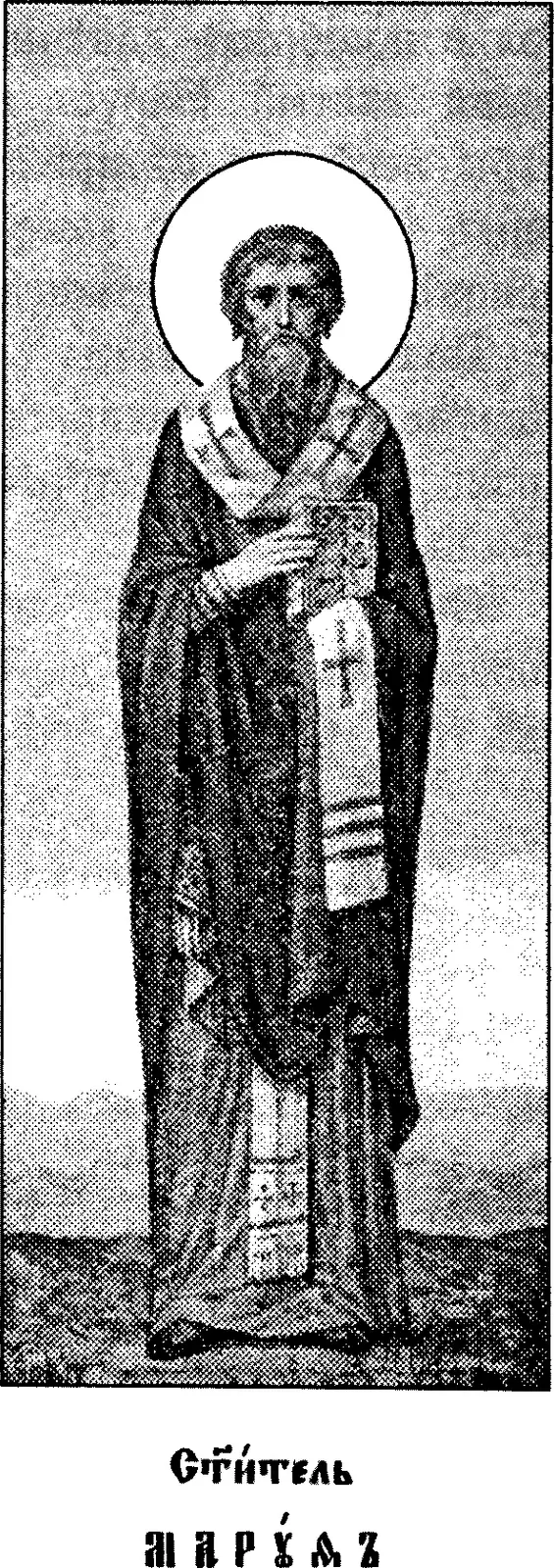
- Also called
- Marúta, in the Italian text of the Martyrology 7
Saint Maruthas was a bishop of Mesopotamia who went as the emperor's envoy to the Persian king, won his trust, and won freedom of worship for the Christians of Persia, whose Church had been through forty years of persecution. 1235 He gathered the relics of the Persian martyrs into his own city, which took the name Martyropolis, and wrote down what was remembered of how they died. 1257 His feast is February 16. 7
A bishop of Mesopotamia
Maruthas was bishop of a small town in Mesopotamia called Maipherqat. 26 The Catholic Encyclopedia names his see as "Tagrit or Maypherkat"; Socrates, who tells most of his story, calls him simply "bishop of Mesopotamia." 13 The encyclopedia warns against confusing him with a later Maruthas of Tagrit, a Monophysite bishop who died in 649. 1
He was a churchman of the Greek councils as well as of the Syriac-speaking East. The Catholic Encyclopedia places him at the Council of Constantinople in 381, and at a council of Antioch in 383, or perhaps 390, which condemned the Messalians. 1 The Norwegian bishops' saints database (katolsk.no) calls him one of the learned men of the Syrian Church. 6
Forty years of persecution
The Christians across the border had suffered through one of the longest persecutions in the history of the Church. Butler, drawing on Maruthas's own account, says the persecution of King Shapur II "raged without intermission during forty years." 5 Maruthas wrote it down. Butler says he lived in the neighborhood and "had carefully informed himself of the several circumstances of their combats from those who were eye-witnesses." 5
Butler quotes the opening of the last part of his history: "Be propitious to me, O Lord, through the prayers of these martyrs." The remembrance of their sufferings, Maruthas wrote, "covers me with shame, confusion, and tears, for myself and my sins." 5 Of the countless martyrs of the worst years, Butler says, Maruthas "was not able to recover their names, but has left us a copious panegyric on their heroic deeds." 5
Several of Butler's entries for Persian martyrs, among them Sadoth of Seleucia and the priest Daniel and the virgin Verda, rest on these Acts. 5 In the account of Sadoth Butler quotes Maruthas: "A man that is guided by the Spirit fears not death." 5 katolsk.no says he compiled the list of martyrs under Shapur and wrote hymns in their honor; the Catholic Encyclopedia lists hymns of his on the Eucharist, on the Cross and on the saints. 16
At Constantinople
His concern for the Church of Persia brought him to Constantinople. The Catholic Encyclopedia says he came to ask help for the Persian Christians, but found the emperor Arcadius "too busily engaged in the affairs of St. John Chrysostom." 1
Socrates mentions him in the middle of those affairs. When the bishops summoned against Chrysostom gathered at Chalcedon, Maruthas "having involuntarily trod on Cyrinus' foot," the bishop of Chalcedon was badly hurt and stayed behind. 8 Cyrinus had been denouncing John to the other bishops, and when the foot later mortified and had to be amputated, Socrates says, many took it for a judgment. 8
Chrysostom himself counted Maruthas a friend. Writing from exile to the deaconess Olympias, he asked her: "Do not cease to pay attention to Maruthas the Bishop, as far as it concerns you, so as to lift him up out of the pit. For I have special need of him on account of the affairs in Persia." 4 He wanted to know what had been accomplished in Persia, whether Maruthas would go back, and whether his two letters to him had been delivered. "By all means therefore make friends with him as far as it is possible." 4
At the court of Yazdegerd
Later the emperor sent him as ambassador to the Persian king, whom Socrates calls Isdigerdes, Yazdegerd I. 13 "The king discovering great piety in the man treated him with great honor." 3 Maruthas, Socrates says, had cured him by prayer of a violent headache that the magi could not relieve. 3 The Catholic Encyclopedia says he won the king's esteem by his affability, his holy life and, "as is claimed," his knowledge of medicine. 1
The magi, afraid the king would become a Christian, hid a man under the sacred hearth of the fire temple to cry out that the king should be thrown from his throne for honoring a Christian priest. 3 Maruthas told the king: "Be not deluded, O king, but when you again enter that edifice and hear the same voice, explore the ground below, and you will discover the fraud." 3 The king had the hearth dug up and found the man, and, according to Socrates, then gave Maruthas leave to build churches wherever he wished. "From that time the Christian religion was diffused among the Persians." 3
Socrates says Maruthas went home to Constantinople and was soon sent back as ambassador, that the magi tried again and were caught again, and that Maruthas and Abdas, bishop of Persia, freed the king's son from a demon by fasting and prayer. 3 The king, Socrates writes, almost became a Christian himself, but died first. 3
Martyropolis
The Catholic Encyclopedia's article on his city says he "succeeded in obtaining religious liberty for the Persian Christians in 410." 2 For the Persian Church, adds F. Mershman, who wrote the encyclopedia's article on Maruthas himself, "he is said to have held two synods at Ctesiphon," and one of his writings is the Acts of the Council of Seleucia-Ctesiphon. 1 The current Roman Martyrology says he presided at the Council of Seleucia and restored the churches that had fallen in Shapur's persecution. 7 katolsk.no says his organization of the Persian Church lasted until the Muslim conquest, and that Chrysostom praised him for it. 6
From one of his journeys he brought back to Maipherqat so many relics of the martyrs that, both encyclopedia articles say, the town became known as Martyropolis, the city of the martyrs. 12 The emperor Theodosius II helped him rebuild and adorn it. 2 The Martyrology tells the same story: he laid the relics of the martyrs of Persia in the city of his see, "from then on called Martyropolis." 7
He died, the Catholic Encyclopedia says, before 420; katolsk.no says about 415. 16 Besides the Acts of the martyrs and of the Persian council, the encyclopedia credits him with a history of the Council of Nicaea. 1 He is honored, Mershman says, by Latins, Greeks, Copts and Syrians alike. 1
What is Saint Maruthas the patron saint of?
Saint Maruthas's feast day
Saint Maruthas's feast day is February 16. The current Roman Martyrology, as the Italian bishops publish it, commemorates him that day in the kingdom of Persia. 7
Older sources give December 4. The Catholic Encyclopedia, writing in 1910, gives his feast as December 4, and katolsk.no also keeps him on that day. 16
Praying with Saint Maruthas
Maruthas spent his life on the line between two empires, and his work was carrying things across it: letters, embassies, the needs of a persecuted Church, and in the end the bones of its martyrs. 123
He was also the one who wrote the martyrs down. He went to people who had seen them die, and said that their memory left him ashamed and in tears for his own sins. 5
His success at the Persian court came through a cure and an exposed trick, as Socrates tells it, and through courtesy and a holy life, as the encyclopedia puts it. 13 It did not make the king a Christian. It did open the churches. 3
Chrysostom, in exile and losing nearly everything, still asked after him and his work in Persia. 4 The relics Maruthas carried home gave his town a new name, the city of the martyrs. 127
Saint Maruthas, pray for us.
Sources
- 1.F. Mershman, "St. Maruthas," The Catholic Encyclopedia, Vol. 9 (New York: Robert Appleton Company, 1910).
- 2.S. Vailhé, "Martyropolis," The Catholic Encyclopedia, Vol. 9 (New York: Robert Appleton Company, 1910).
- 3.Socrates Scholasticus, Ecclesiastical History, Book VII, chapter 8, trans. A. C. Zenos, Nicene and Post-Nicene Fathers, Second Series, Vol. 2 (1890).
- 4.John Chrysostom, Letters to Olympias, the letter written after his arrival at Caesarea, section 5, trans. W. R. W. Stephens, Nicene and Post-Nicene Fathers, First Series, Vol. 9 (1889).
- 5.Alban Butler, The Lives of the Fathers, Martyrs, and Other Principal Saints, Vol. I (New York, 1895), entries for St. Barbasceminus (January 14), St. Sadoth (February 20), SS. Daniel and Verda (February 21) and SS. Acepsimas, Joseph and Aithilahas (March 14), Project Gutenberg eBook #20450.
- 6."Den hellige Maruthas," Den katolske kirke, the saints database of the Catholic Church in Norway, katolsk.no (in Norwegian).
- 7.Roman Martyrology, entry for February 16, "San Marúta, vescovo," Santo del giorno, Conferenza Episcopale Italiana (in Italian).
- 8.Socrates Scholasticus, Ecclesiastical History, Book VI, chapters 15 and 19, trans. A. C. Zenos, Nicene and Post-Nicene Fathers, Second Series, Vol. 2 (1890).
Saints to turn to next
Others in this collection who are turned to for some of the same things.