Saint Martin I
Birth unknown - September 16, 655
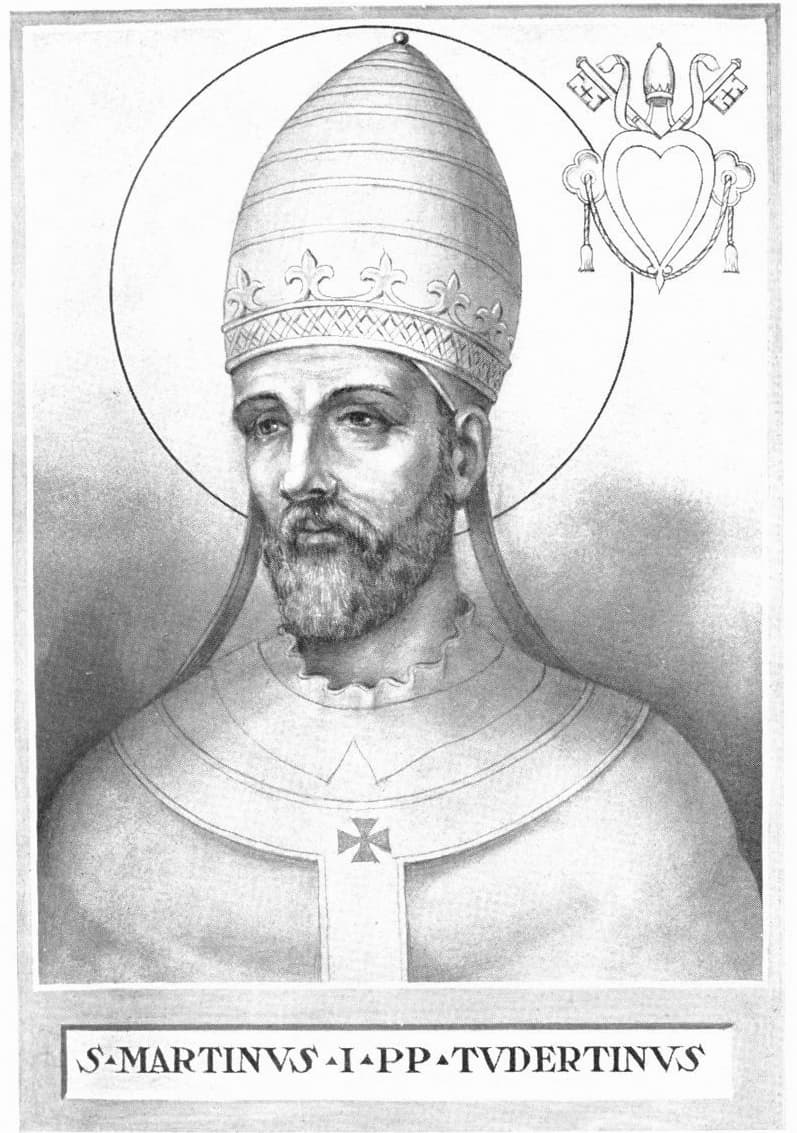
- Feast day
- April 13. The 1910 encyclopedia gives November 12, and notes the Greeks kept April 13 1
- Born
- At Todi on the Tiber, son of Fabricius 1
- Pope
- Elected July 649, for six years, one month and twenty-six days 1
- Died
- In exile at Cherson in the Crimea, September 16, 655, during a famine 1
- Is
- The last of the early popes venerated as a martyr 2
Saint Martin I was elected pope in 649 and had himself consecrated without waiting for the emperor's permission, which set the terms for everything that followed. 12 He held a council that rejected two imperial documents by name, survived an assassination attempt at his own Communion rail, and was arrested, shipped to Constantinople, kept in a cell for ninety-three days, stripped, chained and dragged through the streets. 1 He was exiled to a famine in the Crimea and died there. 1 He is the last pope of the early Church honored as a martyr. 2
One will or two
Franciscan Media sets out the politics before the theology, which is the right order. "Constantinople was the capital of the Byzantine empire and the patriarch of Constantinople was the most influential Church leader in the eastern Christian world. The struggles that existed within the Church at that time were magnified by the close cooperation of emperor and patriarch." 2
The disputed question was whether Christ had a human will of his own. "A teaching, strongly supported in the East, held that Jesus Christ had no human will. Twice, emperors had officially favored this position: Heraclius by publishing a formula of faith, and Constans II by silencing the issue." 2 Mershman names the documents - the "Ecthesis" of Heraclius and the "Typus" of Constans II - and notes that the Typus did not argue the case; it forbade discussing it. 1
Martin knew the ground. Before his own election his predecessor had sent him to Constantinople as envoy "to make arrangements for canonical deposition of the heretical patriarch, Pyrrhus." 1 He had already been the man Rome sent when it wanted a patriarch removed.
Consecrated without permission
The first act of his pontificate was a refusal. "After his election, Martin had himself consecrated without waiting for the imperial confirmation." 1 Franciscan Media flags the same thing as the opening move: he assumed the papacy "which he did without first being confirmed by the emperor." 2
Then he convened the Lateran council: one hundred and five bishops, five sessions across October 649. 1 It rejected both imperial documents, excommunicated five named eastern bishops including three patriarchs of Constantinople, and "twenty canons were enacted defining the Catholic doctrine on the two wills of Christ." 1 Franciscan Media's summary is the same: the imperial documents were censured, "and the patriarch of Constantinople and two of his predecessors were condemned." 2
He then published it as widely as he could. The decrees went out to the bishops and faithful of the world with an encyclical of his own, and the acts were sent to the emperor with a Greek translation attached. 1 He was not leaving room for a claim that Constantinople had not understood.
The exarch at the Communion rail
The emperor's first response was to try to split the council. Olympius arrived as exarch while it was still sitting "and tried to create a faction among the fathers to favor the views of the emperor, but without success." 1
The second response is the one that stays with you. "Then upon pretense of reconciliation he wished to receive Holy Communion from the hands of the pontiff with the intention of slaying him." 1 Franciscan Media records the same attempt in one clause - the emperor failed "in an attempt to kill the pope" - and Mershman says the plan simply did not happen, crediting providence; Olympius left for Sicily to fight the Saracens and died there. 12
The third response worked. Theodore Calliopas arrived in Rome on June 15, 653, walked into the Lateran Basilica two days later and informed the clergy "that Martin had been deposed as an unworthy intruder, that he must be brought to Constantinople and that another was to be chosen in his place." 1
Martin did not let anyone fight. "The pope, wishing to avoid the shedding of human blood, forbade resistance and declared himself willing to be brought before the emperor." 1 Franciscan Media: "Already in poor health, Martin offered no resistance." 2
Ninety-three days, then eighty-five
The voyage took over a year, or did not, depending on which scholar Mershman is citing - the letters suggest a year held at Naxos, and he lays out the disagreement between Jaffé and Ewald, who think the phrase is an interpolation, and Duchesne and Hefele, who "can see no reason for abandoning the original account." 1 The page leaves it where he left it.
What is not in dispute is the arrival. Messengers went ahead to announce a prisoner "branded as a heretic and rebel, an enemy of God and of the State", and when the ship docked Martin "was left for several hours on deck exposed to the jests and insults of a curious crowd of spectators." 1 Then a prison called Prandearia, and "close and cruel confinement for ninety-three days, suffering from hunger, cold and thirst." 1
On December 19 he was brought before the senate, with the imperial treasurer acting as judge. Mershman states what the proceedings were for: "Various political charges were made, but the true and only charge was the pope's refusal to sign the 'Typus'." 1
Then the public part. He was taken to an open space in full view of the emperor and a large crowd, who were invited to pronounce anathema on him - "to which but few responded." 1 He was stripped of nearly all his clothing, loaded with chains and dragged through the streets, and put in the prison of Diomede for another eighty-five days. 1
Saved by a dying man
He was condemned to death, and did not die. Both sources credit the same intervention and Franciscan Media is the more explicit: "Although condemned to death and with some of the imposed torture already carried out, Martin was saved from execution by the pleas of a repentant Paul, patriarch of Constantinople, who was himself gravely ill." 2
Paul was the patriarch Martin's own council had excommunicated by name, and the man who had urged the emperor "to use drastic means" against him in the first place. 1 He was dying, and he spent part of what was left asking that the pope he had helped destroy be spared. Mershman is more cautious about the causation - "Perhaps influenced by the death of Paul, Patriarch of Constantinople, Constans did not sentence the pope to death, but to exile" - and both versions are given here. 1
He was put on a ship in March and landed at Cherson on May 15. 1 "Cherson was at the time suffering from a great famine. The venerable pontiff here passed the remaining days of his life." 1 He died on September 16, 655, and was buried nearby in a church of Our Lady. 1
Seventeen of his letters survive. 1
What is Saint Martin I the patron saint of?
Neither source cited here gives him a patronage. 12 Mershman ends with his relics and his letters; Franciscan Media ends with his death. Neither raises the question, and this page does not answer it for them.
What his own sources give instead is an estimate of the man. Mershman quotes Hodgkin calling him "one of the noblest figures in a long line of Roman pontiffs", and notes that the Greeks - whose emperor had killed him - style him in their Office "infallibilis fidei magister", a teacher of unfailing faith. 1
Saint Martin I's feast day
The feast of Saint Martin I is April 13.
The 1910 encyclopedia gives a different date - "his feast is on 12 November" - and that was correct when it was printed. 1 The same sentence continues with the piece that explains the modern one: "The Greeks honor him on 13 April and 15 September, the Muscovites on 14 April." 1 April 13 was already his day in the East when the West was keeping November 12, and the modern Roman calendar now keeps it too.
Both dates are printed rather than one being quietly replaced. A reader who finds November 12 in an older book has not found a mistake.
Praying with Saint Martin I
He is the saint for refusing to sign something. That is the whole of it. There were political charges at the trial and the encyclopedia says plainly they were not the reason: "the true and only charge was the pope's refusal to sign the 'Typus'." 1 And the Typus was not even a heresy he was being asked to affirm. It was an order to stop discussing the question. He would not agree to be quiet.
What he would not do and what he would are both instructive. He would not wait for imperial permission to be consecrated, would not soften the council's findings, would not sign. But when the soldiers came he forbade his own people to resist, "wishing to avoid the shedding of human blood", and went with them. 1 The resistance was total on the point at issue and absent everywhere else.
The crowd is worth remembering. He was displayed in front of the emperor and a mass of people who were asked to curse him, and "but few responded." 1 Not a rescue, not a riot - just most of a crowd declining to join in. Sometimes that is the whole of the support available, and it is not nothing.
And the man who saved his life was the patriarch his own council had excommunicated, pleading for him from a deathbed. 2 Martin died in a famine on the Black Sea a few months later, having been pope for six years, one month and twenty-six days. 1
Saint Martin I, pray for us.
Sources
Saints to turn to next
Others in this collection who are turned to for some of the same things.