Saint Martial of Limoges
Third century
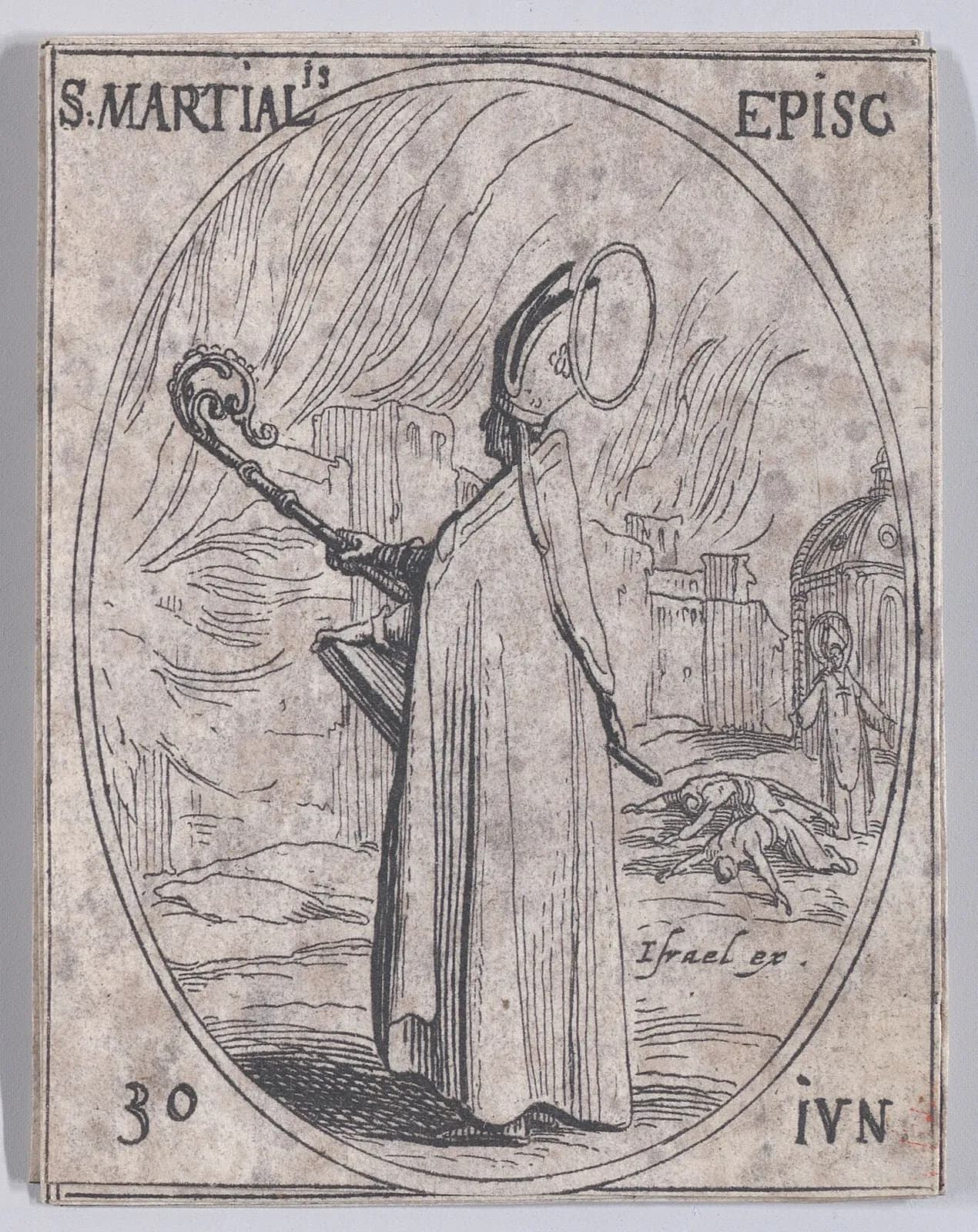
- Historical record
- The 1910 Catholic Encyclopedia: "We have no accurate information as to the origin, dates of birth and death, or the acts of this bishop" 1
- The legend
- One of the seventy-two disciples of Christ; Pius IX refused him that title in 1854 1
- Patron saint of
- The Diocese of Limoges and the Limousin 4
Saint Martial was the first bishop of Limoges, one of seven bishops whom Gregory of Tours says were sent from Rome to preach in Gaul around the year 250. 13 Almost nothing else about him is known. For centuries he was honored instead as one of the seventy-two disciples of Christ, a story that the 1910 Catholic Encyclopedia calls "this tissue of fables," and in 1854 Rome refused to give him the title. 1 The man himself, as the encyclopedia puts it, is to be honored as "the first preacher of the Christian faith in the Province of Limoges." 1
What is known
Léon Clugnet, who wrote the encyclopedia's article, begins with a warning: "We have no accurate information as to the origin, dates of birth and death, or the acts of this bishop." 1 Everything certain, he says, comes from Gregory of Tours. 1
Gregory's account is short. Under the emperor Decius, seven men were ordained bishops and sent to preach in Gaul: Catianus to Tours, Trophimus to Arles, Paul to Narbonne, Saturninus to Toulouse, Dionisius to Paris, Stremonius to Clermont, "bishop Martial to Limoges." 3 Two of them were martyred. Of Martial and four others Gregory says that they "lived in the greatest sanctity, winning people to the church and spreading the faith of Christ among all, and died in peace, confessing the faith." 3
Clugnet adds what can be inferred. Martial seems to have brought two priests with him from the East, so he may have been born there himself. He converted the people of Limoges, and his memory has always been venerated there. 1 The Roman Martyrology, which records so much about some saints, gives him a single line: at Limoges in Aquitaine, Saint Martial, bishop. 5
What the Diocese of Limoges says
The Diocese of Limoges, quoted on the French bishops' Nominis site, fills in a little more, carefully. Very little is known about him, it says. Probably from the East and sent by a Roman pontiff, he came to the Limousin and preached at Toulx-Sainte-Croix and at Ahun. At Limoges he settled, founded a Christian center, converted a number of the inhabitants, many of them from the upper classes, and set up a sanctuary outside the town. He made a few missionary journeys but did not reach far into the countryside, which stayed pagan. He died at Limoges and was buried in a tomb outside the town. 4
Archaeology has backed Gregory up. A text from the Diocese of Bordeaux, also on Nominis, reports excavations at Limoges in 1960 and 1961 that uncovered the crypt of Saint Martial with two granite sarcophagi, dated by the archaeologists to between the third and fifth centuries. One is thought to be Martial's, the other that of one of his priests. The finds, it says, agree with the chronology in Gregory's History. 4
The legend
The other Martial is much better known. Clugnet says that "very early, the popular imagination, which so easily creates legends, transformed Martial into an apostle of the first century," sent into Gaul by Saint Peter, preaching through all of Aquitaine and raising a dead man by touching him with a staff Peter had given him. 1
The fullest version is a Life that claims to be by Aurelian, Martial's successor as bishop, and which Clugnet calls "in reality the work of an eleventh-century forger." 1 In it Martial is born in Palestine, is one of the seventy-two disciples, is present at the raising of Lazarus and at the Last Supper, and is baptized by Peter. 1 Goyau's article on the diocese adds the rest: he witnessed the Passion and Ascension, was there at Pentecost and at the stoning of Stephen, followed Peter to Antioch and Rome, and was sent to Gaul with two companions, Austriclinian and Alpinian. 2
In this telling the three were welcomed at Tulle and turned away from Ahun. At Limoges Martial built a shrine to Saint Stephen where the cathedral now stands. A pagan priest named Aurelian who tried to imprison him was struck dead, raised to life, baptized and eventually made bishop by him; Aurelian, Goyau notes, is the patron of the butchers' guild of Limoges. Forty years after the Ascension Christ appeared to Martial and told him he was about to die, an apparition the churches of Limoges were still celebrating on June 16 when he wrote. 2
Nominis, summing up the tradition, mentions two more details: that he was a cousin of Saint Peter, and that he was the child Jesus set in the midst of the apostles as a model. It calls both biographies "as fanciful as each other." 4
Who made it, and when
Scholars have argued over the dates of the two lives for a long time, and Goyau lays the argument out. An earlier Life, the Vita primitiva, already had Martial sent by Peter. A copy written at Reichenau by a monk who died in 846 proves it is older than that, but its exact age is disputed: Mgr Bellet put it in the seventh century, Mgr Duchesne and Père de Smedt much later than Gregory, and M. de Lasteyrie about 800. 2
The later Life is the one that claims Aurelian as its author. Duchesne thought this "apocryphal and lying" work might be by the chronicler Adhémar de Chabannes, "noted for his fabrications"; de Lasteyrie dated it about 955, before Adhémar was born. 2 The Diocese of Limoges says the legend was put together in the tenth century by the monks of the Abbey of Saint-Martial, to raise the prestige of their patron. 4
It worked for a long time. At the start of the eleventh century Abbot Hugh of Saint-Martial brought the question of Martial's apostolic rank before several councils. 2 The story faded and came back in the seventeenth century through a Carmelite, Bonaventure de Saint-Amable, and his "Histoire de St. Martial." 2 Clugnet observes that it was "received with favour not only by the unlettered but also by the learned of past centuries and even of modern times." 1
Rome decides
In 1853 Bishop Buissas of Limoges asked the Holy See not to take from his oldest predecessor the honors long given him as one of the seventy-two disciples. 1 The answer was no. The Sacred Congregation decided unanimously on April 8, 1854, and Pius IX by decree on May 8 following, "refused absolutely to bestow on St. Martial the title of disciple of Christ," saying only that the veneration given him was of very ancient origin. 1
Clugnet's own conclusion: "it has been clearly proved that we must honour in him not one of the seventy-two disciples of Christ but the first preacher of the Christian faith in the Province of Limoges, and that we should not go beyond this." 1 Two letters printed under his name in the Bibliotheca Patrum, he adds, are apocryphal. 1 The Diocese of Limoges reaches the same place: the legend was challenged in the seventeenth and nineteenth centuries, but Martial is truly one of the first missionaries of Gaul and the founder of the Church of Limoges. 4
The abbey of Saint-Martial
The clergy who served his crypt formed a monastery in 848 and built a church beside it. 2 The abbey grew powerful. Its abbots for a time ruled part of the town, and in the thirteenth century it held, by Goyau's count, the finest library in France after Cluny's, 450 volumes against Cluny's 570. 2 Louis XV bought two hundred of its manuscripts in 1730, and they are now among the treasures of the Bibliothèque nationale in Paris. 2 The abbey became a collegiate church in 1535, was suppressed in 1791, and by the early nineteenth century even its buildings were gone. 2
The devotion outlasted it. The Bordeaux text counts twenty-three villages that still carry his name, and notes that the basilica of Saint-Seurin in Bordeaux kept a staff said to be his, carried in procession in times of epidemic. 4
What is Saint Martial the patron saint of?
Saint Martial's feast day
Praying with Saint Martial
The legend gave Martial everything: a place at the Last Supper, a staff from Saint Peter, a vision of Christ at the end. 12 The history gives him one line in Gregory and two stone coffins in a crypt. 34 Rome, asked to choose, chose the line and the coffins. 1
There is something steadying in that. A bishop who came a long way, preached in a town where most people did not believe, converted some of them, left the countryside mostly unconverted, and died in peace. 34 Most of the people who have carried the faith anywhere were like that. Nobody wrote their lives either.
The Diocese of Bordeaux says that his story, cleared of the legends that had gathered around it, now appears more clearly. 4 It is a smaller story than the one Limoges told for centuries, and the diocese still keeps him as its founder. 4
Saint Martial of Limoges, pray for us.
Sources
- 1.Léon Clugnet, "St. Martial," The Catholic Encyclopedia, Vol. 9 (New York: Robert Appleton Company, 1910).
- 2.Georges Goyau, "Limoges," The Catholic Encyclopedia, Vol. 9 (New York: Robert Appleton Company, 1910).
- 3.Gregory of Tours, History of the Franks, Book I, chapter 30, translated by Ernest Brehaut (New York: Columbia University Press, 1916), Internet Medieval Sourcebook, Fordham University.
- 4."Saint Martial de Limoges," Nominis, Conférence des évêques de France, quoting the Dioceses of Limoges and Bordeaux (in French).
- 5.Roman Martyrology, entry for June 30, "San Marziale, vescovo," as printed in "Santo del giorno," Conferenza Episcopale Italiana (in Italian).
Saints to turn to next
Others in this collection who are turned to for some of the same things.