Saint Marie-Eugénie de Jésus
1817 - March 10, 1898
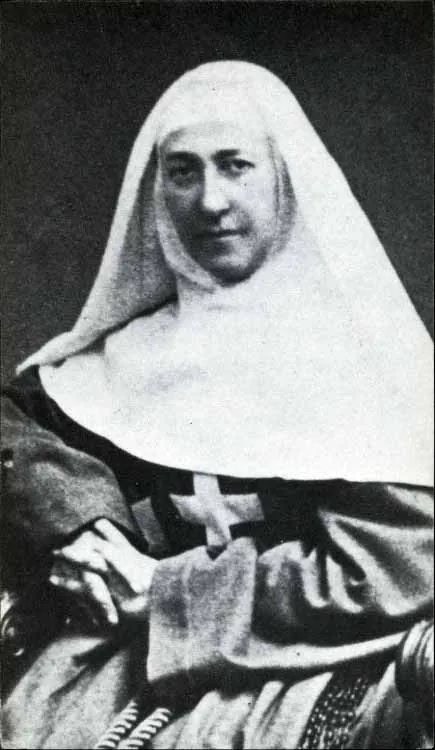
Saint Marie-Eugénie de Jésus was a banker's daughter from a family without faith who, after hearing Lacordaire preach at Notre-Dame de Paris at nineteen, founded the Religious of the Assumption to educate girls. 23 She started in 1839, at twenty-two, with two companions in a flat near Saint-Sulpice, and spent the rest of a life that covered almost the whole nineteenth century extending it. 2 Benedict XVI, canonizing her in 2007, said she saw how important it was to give young people, "especially young girls, an intellectual, moral and spiritual training." 1
A household without faith in Metz
Anne-Eugénie Milleret was born at Metz in 1817, after Napoleon's final defeat and the restoration of the monarchy. 2 The Holy See biography describes a family that was comfortable and did not believe: her father, a follower of Voltaire and a liberal, was making his fortune in banking and in politics. 2 Her congregation describes him as a member of Parliament and a banker, and says his work taught her to take an interest in the social and political questions of the day. 3 From her mother, the congregation says, she received a sense of courage, freedom and service. 3
She went to Mass on feast days and received the sacraments as custom required, the Holy See biography says, "but without any real commitment." 2 The exception was her First Communion, on Christmas Day 1829. 3 She later wrote that God "had… first touched my soul at my first Communion, but I did not understand it." 5 Benedict XVI made the same point in his canonization homily: it was "an important moment, even if she was unaware of it at the time." 1
Alone at fifteen
Her childhood had its losses. An elder brother and a baby sister died, her health was delicate, and a fall from a horse left lasting effects. 2 Then her father's banks failed. Her parents separated, and the family lost all its security. 23 Her brother Louis, closest to her in age, went to live with their father, and she went to Paris with her mother. 2
Her mother died of cholera there, after a few hours of illness. 23 The Holy See biography says this left Eugénie alone at fifteen "in a society that was worldly and superficial," and describes the years that followed as a search for truth carried on "in anguish and almost desperate." 2 Her congregation puts her question simply: what project could make her life worth living? Neither the superficial life around her nor a piety that never turned into action satisfied her. 3
Lacordaire at Notre-Dame
In Lent of 1836, at nineteen, she went to the conferences preached at Notre-Dame by the young Abbé Lacordaire. 23 The Holy See biography describes him as a former disciple of Lamennais who understood young people, "their idealism and their ignorance of both Christ and the Church." 2 His words, it says, touched her heart and answered her many questions, and she came to see Christ as the universal liberator and his kingdom on earth as a peaceful and just society. 2
Years later, in a letter to Lacordaire dated December 13, 1841, she described what happened: "Your words answered all my thoughts, explained my instincts, completed my understanding of things, rekindled in me the idea of duty and the desire for good which were ready to wither in my soul." 5 In the same letter she wrote that she "was truly converted and had conceived the desire to give all my strength, or rather all my weakness, to this Church." 5 To another correspondent she put the two moments side by side: God had touched her at her First Communion, but "it was at Notre-Dame that I began to hear His voice." 5
The Religious of the Assumption
The idea of a congregation came from someone else. Father Combalot, another former disciple of Lamennais, heard her confession and, according to the Holy See biography, recognized in her the foundress of a congregation he had long dreamed of. 2 He insisted that God had chosen her for it, and convinced her that only by education could she evangelize minds, make families truly Christian and so transform society. 2 She accepted it as God's will and let him guide her. 2 The congregation dates the beginning of the project to April 30, 1839. 3
That year, at twenty-two, she and two other young women began a life of prayer and study in a flat on the rue Férou, near the church of Saint-Sulpice in Paris. 2 In 1841 they opened their first school, with the backing of Madame de Chateaubriand, Lacordaire, Montalembert and their friends. 2 Within a relatively short time, the Holy See biography says, there were sixteen sisters of four nationalities. 2
The aim, as the Holy See biography puts it, was to "link the ancient and the new": to join the Church's traditional spirituality and learning to a kind of religious life and education that could satisfy modern minds in a new industrial and scientific age. 2 It describes the spirituality as centered on Christ and the Incarnation, "both deeply contemplative and dedicated to apostolic action." 2
Friends and fellow founders
She did not do it alone, and the sources dwell on the friendships. One of the first sisters was an Irishwoman, Kate O'Neill, known in religion as Mother Thérèse Emmanuel, whom the Holy See biography calls a mystic and her intimate friend. 2 At the end of her life Marie-Eugénie called her "half of myself," and the congregation counts her as co-foundress. 23
Father Emmanuel d'Alzon became her spiritual director soon after the foundation. 2 In 1845 he founded the Augustinians of the Assumption, and the Holy See biography says the two founders helped each other "in a multitude of ways over a period of forty years." 2 Both, it adds, had a gift for friendship, and drew many lay people into the work. 2
Her last years
Her congregation counts fifty-nine years of religious life. 3 In her last years her body gradually weakened, and the Holy See biography says she lived that decline "in silence and humility." 2 The congregation records something she liked to say once she could no longer do much: "Now all I have to do is be good." 3 She received the Eucharist for the last time on March 9, 1898, and died the next day. 2 By then, the congregation says, it had already grown considerably. 3
Paul VI beatified her in St. Peter's Basilica on February 9, 1975. 26 Benedict XVI canonized her on June 3, 2007, in St. Peter's Square, with George Preca, Simon of Lipnica and Charles of Mount Argus. 1 At that time the Holy See counted almost 1,200 Religious of the Assumption in 170 communities across 34 countries. 2 On December 8, 2024, when the restored cathedral of Notre-Dame de Paris consecrated its new altar, her relics were among those of five saints placed inside it. 7
What is Saint Marie-Eugénie de Jésus the patron saint of?
None of the sources consulted for this profile names a patronage for her, so this page does not claim one. 123 She is honored as the foundress of the Religious of the Assumption, and Benedict XVI presented her example to anyone who passes on values to the young, asking that it "invite men and women today to pass on to young people values that will help them to become strong adults and joyful witnesses of the Risen One." 1 That is an invitation, not a formal patronage.
Saint Marie-Eugénie de Jésus's feast day
Her feast is March 10, the day she died in 1898. 24 Her congregation keeps it under that name: "On 10 March, we celebrate the feast day of our foundress, Saint Marie Eugénie." 4 In 2026 the Sister General marked it with a letter on the 190th anniversary of her conversion, noting that the sisters in France would celebrate the Mass of the feast in Notre-Dame itself. 5
None of the sources consulted places her on the General Roman Calendar or the calendar of the dioceses of the United States, or says where else the day is kept, so this page gives it as the congregation's feast.
Praying with Saint Marie-Eugénie de Jésus
Her conversion did not come out of a devout childhood. She grew up in a house that did not believe, lost her mother at fifteen, and spent the next years, in the Holy See's words, searching "in anguish and almost desperate for the truth." 2 What she later saw in her First Communion she did not see at the time. 15 The sources treat the years between as part of the story rather than a detour from it.
The congregation was not her idea. Combalot proposed it and pressed it on her, and she accepted it as God's will while still very young. 2 What followed was decades of ordinary work: a flat, a first school, a growing number of sisters, and friendships that lasted forty years. 2 Benedict XVI said she drew the strength for it from prayer, "ceaselessly combining contemplation and action." 1
Her own description of her conversion offers God "all my strength, or rather all my weakness." 5 She was saying it about the start of her religious life, not the end. At the end, when her strength really had gone, the saying her congregation records is "Now all I have to do is be good." 3
Saint Marie-Eugénie de Jésus, pray for us.
Sources
- 1.Benedict XVI, Homily for the Canonization of George Preca, Simon of Lipnica, Charles of St Andrew Houben and Marie Eugenie of Jesus Milleret, St Peter's Square, June 3, 2007.
- 2."Blessed Marie Eugenie of Jesus (1817 - 1898) - Biography," Office for the Liturgical Celebrations of the Supreme Pontiff, The Holy See, 2007.
- 3."Saint Marie Eugénie: Her Life," Religious of the Assumption (international site).
- 4."10 March: Feast of Saint Marie Eugénie," Religious of the Assumption.
- 5.Sr. Rekha M. Chennattu, RA, Sister General, "Chapter - 10 March 2026 - Marie Eugenie's Experience at Notre-Dame," Religious of the Assumption, March 5, 2026 (quoting Saint Marie-Eugénie's letters to Father Lacordaire, December 13, 1841, and to Father Picard, November 8, 1862).
- 6.Almudena de la Torre, "The Beatification of Mother Marie Eugénie of Jesus: a gift for the Church and for the world," Religious of the Assumption.
- 7."First Mass celebrated in restored Notre Dame Cathedral," Catholic News Agency, December 9, 2024.
Saints to turn to next
Others in this collection who are turned to for some of the same things.
- Saint John of AvilaJanuary 6, 1499 or 1500 - May 10, 1569PrayerStudy and teachingConversion
- Saint Teresa Benedicta of the CrossOctober 12, 1891 - August 9, 1942ConversionStudy and teachingPrayer
- Saint Aelred of Rievaulx1109 - January 12, 1166 (or 1167)PrayerStudy and teaching
- Saint Aidan of Lindisfarnec. 590 - August 31, 651PrayerConversion