Saint John of Avila
January 6, 1499 or 1500 - May 10, 1569
- Ordained
- 1526 1
- Beatified
- By Pope Leo XIII; April 6, 1894 according to Benedict XVI, November 12, 1893 according to the Catholic Encyclopedia 12
- Canonized
- May 31, 1970, by Pope Paul VI 1
- Patron saint of
- The diocesan clergy of Spain, named by Pius XII in 1946 1
- Feast day
- May 10, an optional memorial in the General Roman Calendar since 2021 3
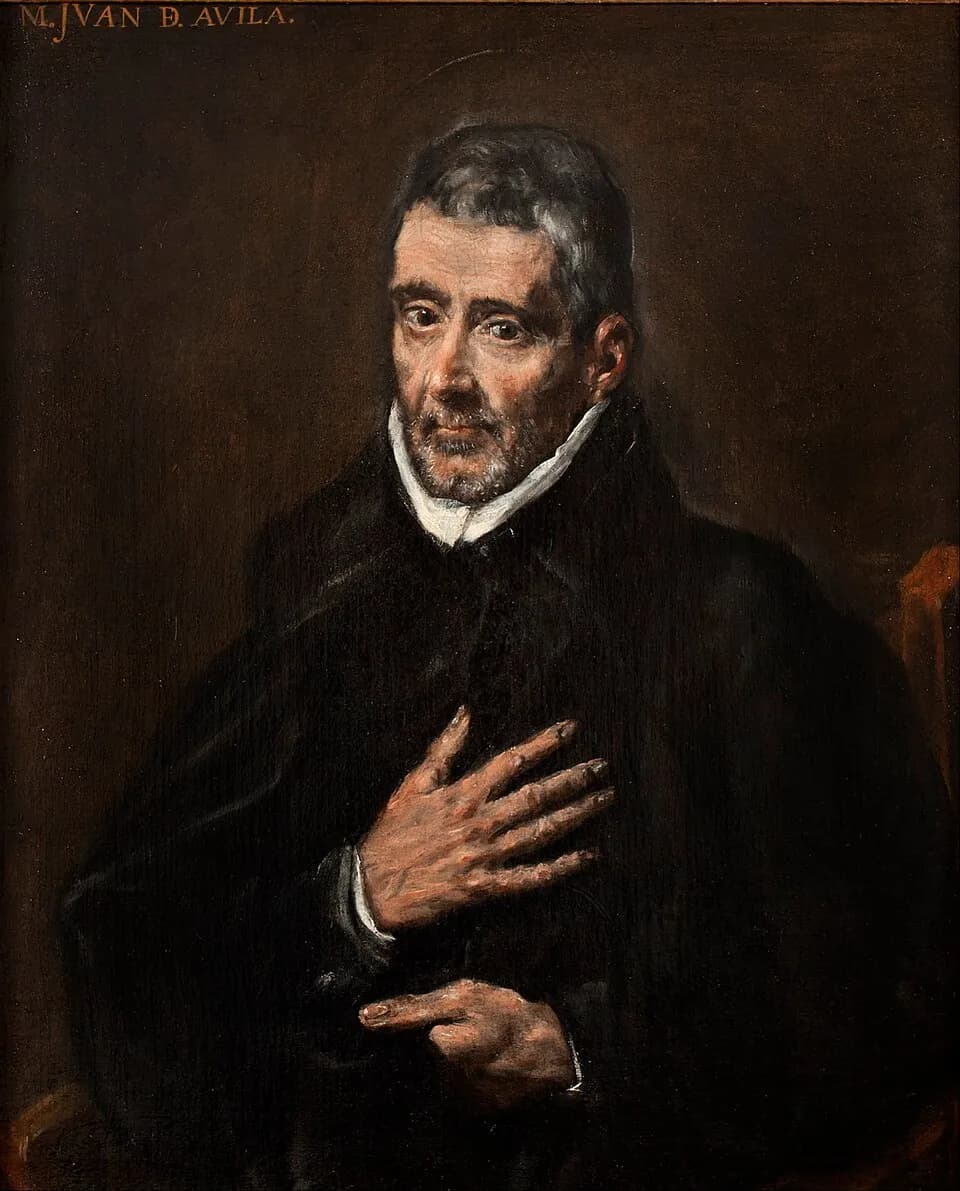
Saint John of Avila was a Spanish diocesan priest of the sixteenth century, a preacher who meant to sail for Mexico and was talked into staying in Andalusia, where he spent some forty years preaching, founding colleges and directing saints. 12 Benedict XVI proclaimed him a Doctor of the Church on October 7, 2012, calling him an "evangelical preacher" and "an outstanding precursor of the new evangelization." 1 His feast is May 10, the day he died in 1569. 13
Salamanca, a conversion and Alcalá
He was born at Almodóvar del Campo, in the Archdiocese of Toledo, on 6 January, in 1499 or 1500 as Benedict XVI gives it, or 1500 in the Catholic Encyclopedia. 12 He was the only son of Alonso Ávila and Catalina Gijón, a devout and wealthy couple. 1
At fourteen he was sent to study law at Salamanca. 12 He left after what Benedict calls "a profound experience of conversion" and went home to pray; the encyclopedia says he had taken a distaste for law and spent three years in "the practice of most austere piety." 12 A passing Franciscan, the encyclopedia says, advised him to study philosophy and theology at Alcalá, which he began in 1520. 12
He was ordained in 1526 and said his first Mass in his home parish. 1 His parents had died while he was a student, the encyclopedia says, and he gave his large inheritance away to the poor. 12
The missionary who stayed
He meant to go to the New World as a missionary, and went to Seville to wait for a ship. 12 While he waited he preached in the city. 1 A priest of Seville, Fernando de Contreras (the encyclopedia calls him Hernando), noticed him and persuaded the Archbishop of Seville to keep him in Andalusia. 12 The encyclopedia dates this to 1527 and says it was his devotion in celebrating Mass that first caught Contreras's eye. 2
The encyclopedia dates his first sermon to 22 July 1529 and says crowds filled the churches whenever he preached. 2
Prison and Audi, Filia
His success made enemies. 2 Benedict says he was imprisoned in 1531 "because of a misunderstanding about a homily he had given," and acquitted in 1533. 1 The encyclopedia gives the charge: that he exaggerated the dangers of wealth and closed the gates of heaven to the rich. 2 Once he was cleared, it says, he was invited to preach on the next great feast at the church of San Salvador in Seville, and his appearance was a cause of public rejoicing. 2
In prison he began Audi, Filia, the book that became his major work. 1 Benedict says it was there that he received "an unusually profound insight into the mystery of God's love," which became the center of his preaching from then on. 1
Preacher, founder, counselor
After his acquittal he moved to the Diocese of Córdoba, and in 1536 the Archbishop of Granada sent for him as an adviser. 1 He preached across Andalusia and in central and eastern Spain, lived in great poverty, and took particular trouble over the education of boys and young men, especially those preparing to be priests. 1 He founded several colleges that later became seminaries on the pattern the Council of Trent laid down, and in 1538 Pope Paul III authorized him to found the University of Baeza, where he was the first rector. 1
Benedict adds two details that sit oddly beside the rest: he proposed an international court of arbitration to prevent wars, and he invented and patented several engineering devices. 1
Saints went to him for advice. 1 Benedict says Ignatius of Loyola wanted him in the new Society of Jesus; he did not join, but sent some thirty of his best students to it. 1 John of God was converted by hearing him preach and kept him as his spiritual director, and Francis Borgia was another convert. 12 Teresa of Jesus, Benedict writes, "underwent great trials" before she was able to send him the manuscript of her Autobiography. 1 The encyclopedia counts Teresa, John of God, Francis Borgia and Louis of Granada among his disciples. 2
Montilla
From 1554, already ill, he lived in a simple house at Montilla, near Córdoba, and worked by letter. 1 The encyclopedia says he suffered constant illness for the last eighteen years of his life. 2 The Archbishop of Granada wanted to bring him to the Council of Trent as his theologian; too sick to travel, he wrote memorials for the council instead, which Benedict says had considerable influence on it. 1
He died there on the morning of 10 May 1569, "surrounded by disciples and friends, clinging to a crucifix." 1
Doctor of the Church
Benedict's letter traces the long road to the altar: a cause opened in Toledo in 1623, his writings approved by Benedict XIV in 1742, heroic virtue declared by Clement XIII on 8 February 1759, beatification by Leo XIII, and canonization by Paul VI on 31 May 1970. 1 It dates the beatification to 6 April 1894; the encyclopedia gives 12 November 1893. 12
The Spanish bishops asked for him to be named a Doctor in 1970, and Benedict announced at World Youth Day in Madrid in 2011 that he would do it. 1 He did so in St. Peter's Square on October 7, 2012, together with Hildegard of Bingen, at the opening of the Synod of Bishops on the new evangelization. 14 In his homily that day Benedict described him as "a profound expert on the sacred Scriptures" who "united constant prayer to apostolic action." 4
The letter names the core of his teaching as the primacy of grace, a spirituality of trust, and the universal call to holiness. 1 It quotes his letters: "The proof of perfect love of our Lord is seen in the perfect love of our neighbour." 1 And it singles out his teaching on the priesthood, built on his conviction that priests at Mass "place ourselves on the altar in the person of Christ to carry out the office of the Redeemer himself." 1
What is Saint John of Avila the patron saint of?
Saint John of Avila's feast day
Saint John of Avila's feast day is May 10, the day he died. 13 By a decree of January 25, 2021, the Congregation for Divine Worship, at Pope Francis's direction, inscribed "Saint John De Avila, Priest and Doctor of the Church" in the General Roman Calendar on that date with the rank of optional memorial, alongside Gregory of Narek and Hildegard of Bingen. 3
Praying with Saint John of Avila
He meant to be a missionary across the ocean and was asked to stay where he was. 12 He stayed, and the forty-year apostolate the encyclopedia describes came out of that change of plan. 2
The book most associated with him was begun in a cell, during an imprisonment over a sermon somebody misunderstood. 1 Benedict places his deepest insight into God's love in those same years. 1
His letters, as Benedict quotes them, keep returning the love of God to the neighbor: "Your neighbour is a concern of Jesus Christ." 1 Much of his life was spent on other people's vocations, the young men he trained and the saints who wrote to him for counsel. 1
He was not a professor and held no chair, Benedict notes, and he never set out his teaching as a system. 1 His theology, the letter says, was "prayerful and sapiential," worked out in sermons, letters and conversations with whoever came to Montilla. 1
Saint John of Avila, pray for us.
Sources
- 1.Pope Benedict XVI, Apostolic Letter proclaiming Saint John of Avila, diocesan priest, a Doctor of the Universal Church, October 7, 2012.
- 2."Blessed John of Avila," The Catholic Encyclopedia, vol. 8 (New York: Robert Appleton Company, 1910).
- 3.Congregation for Divine Worship and the Discipline of the Sacraments, Decree on the inscription of the celebrations of Saint Gregory of Narek, Saint John De Avila and Saint Hildegard of Bingen in the General Roman Calendar, Prot. N. 40/21, January 25, 2021.
- 4.Pope Benedict XVI, Homily at the Mass for the opening of the Synod of Bishops and proclamation of St. John of Avila and St. Hildegard of Bingen as Doctors of the Church, October 7, 2012.
Saints to turn to next
Others in this collection who are turned to for some of the same things.
- Saint John EudesNovember 14, 1601 - August 19, 1680PrayerWork and vocationConversion
- Saint Norbertc. 1080 - June 6, 1134ConversionPrayerWork and vocation
- Saint Peter CanisiusMay 8, 1521 - December 21, 1597Study and teachingWork and vocationConversion
- Saint Aelred of Rievaulx1109 - January 12, 1166 (or 1167)PrayerWork and vocationStudy and teaching