Saint Maria Goretti
October 16, 1890 - July 6, 1902
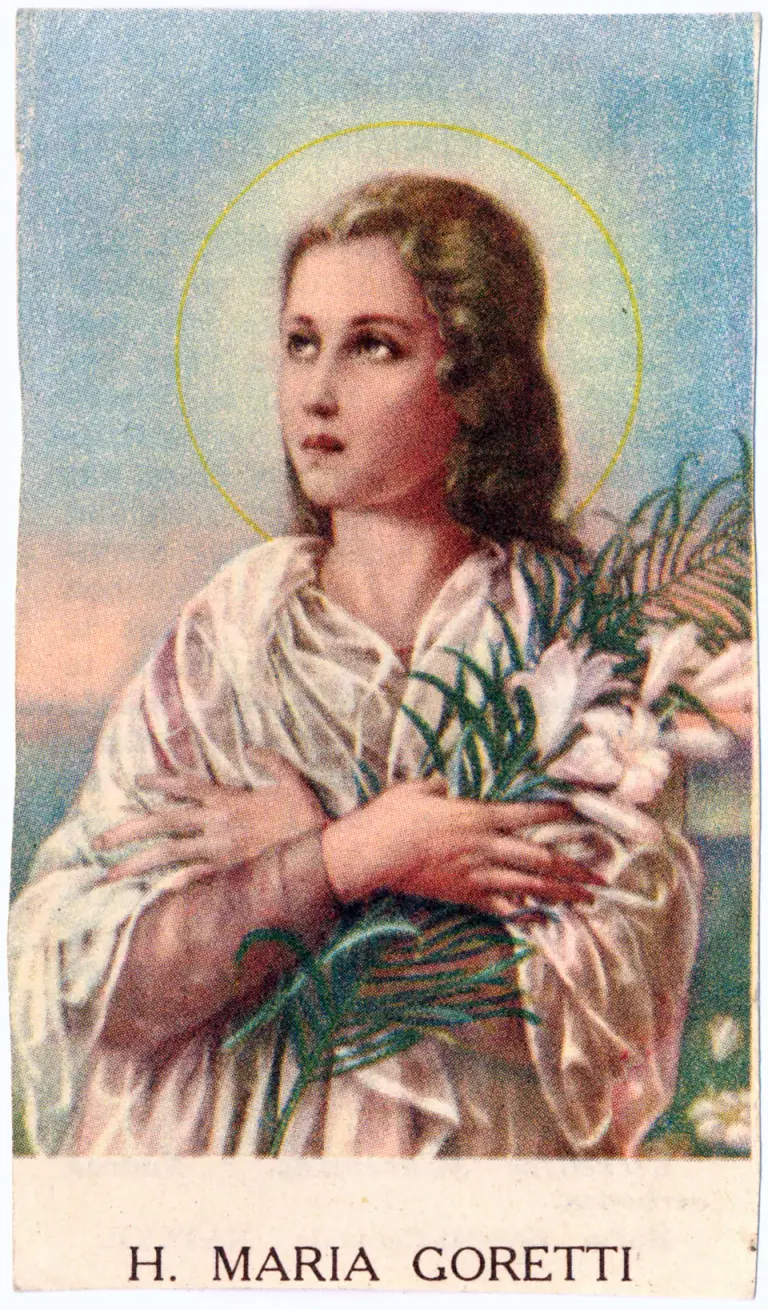
- Patron saint of
- Catholic youth and teenagers 4
- Known at home as
- "Marietta", as her family called her 5
- Home
- Le Ferriere di Conca, in the Pontine Marshes, by John Paul II's account; near Nettuno, not far from Rome, by Vatican News's 13
- Beatified
- By Pius XII in 1947 4
Saint Maria Goretti, the daughter of a poor Italian tenant farmer, never learned to read. In 1902 a young neighbor stabbed her when she refused him, and she forgave him before she died the next day, a few months short of her twelfth birthday. 134 The man who killed her served twenty-seven years in prison, came out asking her mother's pardon, and knelt in the crowd when Pius XII canonized her in 1950. 34 John Paul II wrote that her faith and her ability to forgive her murderer had made her one of the best-loved saints of the twentieth century. 1
A poor family in the Pontine Marshes
Maria Goretti was born at Corinaldo, in the Marches region of Italy, on October 16, 1890. 14 Vatican News says she was the third of seven children in a poor family, and that by the time she was five her parents had lost their farm and were hiring themselves out to work other people's land. 3 The family moved more than once. John Paul II says they emigrated and eventually reached Le Ferriere di Conca in the Pontine Marshes; Vatican News places them near Nettuno, not far from Rome. 13 At home she was called Marietta. 5
Her father died of malaria when she was nine. 13 Her mother and the older children went out to work to feed the family, and Maria kept house, cooked and looked after her baby sister. 3 There was no money and no time for school, and she never learned to read or write. 34
John Paul II describes the household as poor but serene and united, a family where the children were treated as a gift and taught respect for themselves and others. 1 Sayings of hers were remembered from that time. John Paul II gives one, from the hard months after her father's death, as "Mother, be brave, God will help us". 1 Cardinal Sodano quotes a similar one, "Mother, do not be distressed, God will never leave us", and says that after her father died she told her mother, "I'll take care of the house now". 5
She was eager for her First Communion; Sodano quotes her asking, "Mother, when can I make my First Communion?" 5 She made it not long before she died, as one of the larger and somewhat backward members of her class, according to Franciscan Media. 4 Vatican News says she was a bit behind the other children in catechism. 3
July 5, 1902
The Gorettis could not afford a house of their own and shared living quarters with another family, the Serenellis. 3 Their son Alessandro, whom Vatican News makes twenty and Franciscan Media eighteen, had already been pressing himself on her. 34 She refused him and told nobody, because he threatened to kill her if she did, and, in Franciscan Media's account, because she did not want to make trouble for his family. 34
On a hot afternoon in July she was sitting at the top of the stairs mending a shirt when Alessandro came up and dragged her into the house. 34 Vatican News says he held an awl; Franciscan Media calls it a long dagger. 34 Her words are given three ways. In Vatican News she cries "No" as he tries to choke her, and then "It is a sin! God doesn't want it!" 3 In Franciscan Media it is "No, God does not wish it," and then "It is a sin. You would go to hell for it." 4 Sodano, quoting her biographer, has "But what are you doing, Alessandro? God is not pleased, you will go to hell". 5
She fought him and tried to reach the door. 3 When she told him she would rather die than give him what he wanted, Vatican News says, he stabbed her fourteen times and ran. 3 Her family heard the baby crying and found her bleeding on the floor. 3
In the hospital at Nettuno
She was taken to the hospital at Nettuno. 1 Vatican News says the doctor operated without anesthesia, and records an exchange during the surgery: he asked her to think of him in Paradise, she asked which of them would get there first, and when he said she would, she promised to remember him. 3
Franciscan Media describes her last hours as marked by small, practical concern for others, among them where her mother would sleep. 4 She received Viaticum, her last Communion. 4
She also forgave the man who had stabbed her. Vatican News says that when she gave the police his name she added, "I forgive him, and I want him with me in heaven!" 3 Sodano gives her words as "Through love of Jesus, I forgive him with all my heart". 5 She died on July 6, 1902, about a day after the attack. 14 Those who knew her, John Paul II recounts, said on the day of her funeral, "A saint has died!" 1
Alessandro Serenelli
Alessandro was sentenced to thirty years in prison and for a long time showed no remorse. 34 Then he had a dream. Franciscan Media calls it a dream or a vision of Maria gathering flowers and offering them to him; in Vatican News he tells it to a bishop who visited him in jail, and the lilies she handed him burned in his hands. 34 His life changed after it. 4
He was released after twenty-seven years, and his first act was to go to Maria's mother, Assunta, and beg her forgiveness. 34 Vatican News records her answer as a question: who was she to refuse what her daughter had given so readily? The next day the two of them went to Mass together. 3 John Paul II gives an earlier pardon as well: her mother forgave him on the family's behalf in the courtroom where he was tried. He added that it is not known whether the mother had taught her daughter to forgive or the daughter's forgiveness on her deathbed had shaped her mother's. 1
Vatican News says Alessandro became a Franciscan lay brother and worked in a monastery garden until he died. 3 John Paul II says he recognized his sin, asked forgiveness of God and of the Goretti family, expiated his crime and lived the rest of his life in that spirit. 1
Canonization in 1950
Devotion to her grew, and Franciscan Media says miracles were worked. 4 Pius XII beatified her in 1947, and her mother, then eighty-two, stood with him on the balcony of Saint Peter's with two of Maria's sisters and her brother. 4 Vatican News says it was Alessandro's conversion that sealed what many had already begun to suspect, that the child was a martyr. 3
Pius XII canonized her on June 24, 1950, in a ceremony in front of Saint Peter's Basilica. 5 Franciscan Media counts a crowd of 250,000, one of the largest ever gathered for a canonization, and says Alessandro, then sixty-six, knelt among them and cried. 4 Vatican News names her mother, her brothers and sisters and the former neighbor as present. 3 Pius XII called her "the sweet little martyr of purity"; Vatican News gives her another title, "20th century St. Agnes". 13
Her remains are kept at the shrine at Nettuno, in the care of the Passionist Fathers. 15 John Paul II wrote in 2002 that her martyrdom had been seen as the opening of what became known as the century of martyrs. 1
What is Saint Maria Goretti the patron saint of?
Franciscan Media lists Saint Maria Goretti as the patron saint of Catholic youth and of teenagers. 4 John Paul II, writing for the centenary of her death, held her up especially as an example to young people, and at the Angelus the next day he said he hoped adolescents and young people would come to know her better. 12
Saint Maria Goretti's feast day
Praying with Saint Maria Goretti
Nothing about her circumstances was unusual, which is the point Vatican News makes before it tells the rest: in every respect except her death, her short life was a story repeated across the world. 3 She was poor, unschooled and slow at catechism, and she was kept quiet by a grown man's threats. 34 John Paul II wrote that her age, her lack of education and her poverty did not keep grace from working in her, and that it was in exactly those conditions that God's love for the lowly showed. 1
Her refusal was a child's refusal, made in a few plain words about sin and God, and it cost her her life. 34 Sodano quoted her biographer, Father Alberti: she did not become a saint "in five minutes". 5 Holiness, the cardinal went on, is not improvised, and the sayings remembered from her before that day are about trusting God when the family had nothing. 15
Then there is the forgiveness, which is the part of the story John Paul II and Cardinal Sodano both dwell on. 15 She forgave him in pain, before he had shown any remorse, and he refused it for years. 34 John Paul II was careful to say that forgiveness of this kind is not permissiveness: it asks for the full recognition of the sin. 1 It took Alessandro years in prison to come to that, and when he did, her mother was waiting with the same answer. 3
Saint Maria Goretti, pray for us.
Sources
- 1.John Paul II, Message to the Bishop of Albano for the centenary of the death of St. Maria Goretti, July 6, 2002. Libreria Editrice Vaticana.
- 2.John Paul II, Angelus, July 7, 2002. Libreria Editrice Vaticana.
- 3."St. Maria Goretti, Virgin and Martyr," Saint of the Day, 6 July, Vatican News (Dicastery for Communication).
- 4."Saint Maria Goretti," Saint of the Day, Franciscan Media.
- 5.Cardinal Angelo Sodano, Secretary of State, homily closing the celebrations for the first centenary of the death of St. Maria Goretti, Shrine of Our Lady of Grace and of St. Maria Goretti, Nettuno, April 25, 2003. The Holy See.
Saints to turn to next
Others in this collection who are turned to for some of the same things.
- Saint Augustine Zhao Rong and CompanionsDied 1815; his companions 1648 - 1930CourageConversionSuffering and illness
- Saint CyprianBirth unknown - September 14, 258CourageConversionSuffering and illness
- Saint EustaceMartyred at Rome, in 118 by tradition; other accounts give 140 or 188ConversionCourageSuffering and illness
- Saint EzekielSixth century BCConversionSuffering and illnessCourage