Saint Maria Cristina Brando
May 1, 1856 - January 20, 1906
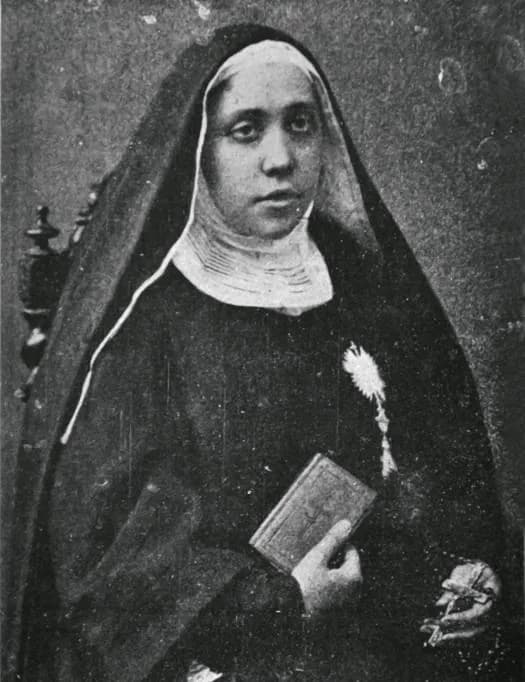
- Religious name
- Maria Cristina of the Immaculate Conception, taken in 1876 2
Saint Maria Cristina Brando was a Neapolitan woman whom illness kept out of the convent three times and who instead founded her own congregation, the Sisters, Expiatory Victims of Jesus in the Blessed Sacrament, devoted to adoration of the Eucharist and to the education of children. 2 She had a small cell built against her church at Casoria and spent her nights there in a chair, so as to stay near the tabernacle. 2 Francis, canonizing her in 2015, said she "was completely given over to ardent love for the Lord." 1
Adelaide Brando of Naples
She was born Adelaide Brando in Naples on May 1, 1856, and baptized the next day in the parish of San Liborio. 4 Her parents were wealthy, the Holy See biography says, and her mother died a few days after the birth. 2 It names her mother Maria Concetta Marrazzo; the Dicastery for the Causes of Saints names her Caterina Marrazzo. 24 The bishop of Cerreto Sannita adds that her father was an official of the Banco di Napoli. 5
The Holy See biography describes a gentle child, drawn early to prayer, who went often to confession, received communion daily, and repeated to herself, "I must become holy; I want to be a saint." 2 She made her first communion on December 8, 1864, at the age of eight, and the Dicastery says that from then on the Eucharist was at the center of her thoughts. 4 At about twelve, before an image of the Child Jesus, she made a vow of perpetual chastity; the Dicastery dates that consecration to Christmas night, 1868. 24
Three convents and a sickbed
Her first choice was the monastery of the Sacramentine nuns in Naples, and her father would not allow it. 2 He did consent to the Poor Clares at their monastery of the Fiorentine. Twice she was about to enter, and twice illness sent her home to her family for treatment. 2
Once she recovered, she was given permission to try the Sacramentines after all. The bishop of Cerreto names their house as San Giuseppe dei Ruffi. 25 In 1876 she received the habit and the name Sister Maria Cristina of the Immaculate Conception. 2 Then she fell ill again, and had to give up what she had begun. 2
The Holy See biography reads this as the point at which she understood that she was meant to found an institute of her own. 2 The Dicastery speaks of a plan for a congregation of adoring sisters that ripened in her all the same. 4
A congregation of adorers
The sources date the beginning differently. The Holy See biography says that in 1878, while renting a room from the Teresian Sisters of Torre del Greco, she laid the foundation of the community; the Dicastery says that in 1880, with a few companions, she began perpetual adoration in Naples. 24 Young women asked to join, the Dicastery says, despite her efforts to stay out of sight. 4 The community grew quickly, according to the Holy See biography, in spite of money troubles and the founder's own poor health. 2
It moved several times. The Holy See biography credits the guidance of Michelangelo of Marigliano and Ludovico of Casoria, and the help of benefactors and clergy, above all the priest Domenico Maglione. 2 On November 22, 1884, at the invitation of Canon Maglione, provost of Casoria and brother of the future Cardinal Luigi Maglione, she moved her companions to a Maglione property at Casoria, a short way from Naples. 4 The mother house is still there. 5
Recognition came slowly. She professed temporary vows in 1897. 2 On July 20, 1903, the Holy See biography says, the congregation received canonical approval, and the Dicastery gives August 16, 1903 as the day it took its official name of Expiatory Victims of Jesus in the Blessed Sacrament. 24 On November 2 of that year she made her perpetual vows, together with nineteen other young women by the Dicastery's count. 24
The little grotto
Her devotion centered on the Incarnation, the Passion and the Eucharist. 2 To be nearer the tabernacle she had a cell built against the church at Casoria and called it the grotticella, the little grotto, after the cave of the Nativity. 2 There, the Holy See biography says, she spent every night of her life "seated in a chair, so as to accompany Jesus in the Eucharist, while awake and while resting." 2
The name of the congregation came from her idea of reparation. In fragments of an autobiography written at her spiritual director's request, she wrote that "the principal purpose of this work is reparation for the offenses that are received by the Sacred Heart of Jesus in the Blessed Sacrament," and she named irreverence, careless and sacrilegious communions, and inattention at Mass, above all among priests and religious. 2
That was one side of it. The same fragments give the sisters of the active life a second office, as "Victims of Charity and of reparation; of charity because they are entrusted with the care of children." 2 The Holy See biography lists what grew from it: schools for girls, orphanages, boarding schools and day schools, "all for reparation," on the reasoning that making God known where he is not known makes him loved. 2 The Dicastery adds the formation of girls from the poorest classes, retreats for adolescent girls, and catechism. 4
She held the office of superior general, by the Holy See biography's account, with humility, prudence and amiability. 2 The Dicastery says that though she was born into comfort she counted poverty her glory, and that on Holy Thursday she washed her sisters' feet. 4
Death, and the road to canonization
She died on January 20, 1906. 24 According to the Dicastery, as she was dying she urged her sisters to help one another, bear with one another and excuse one another, and to become saints. 4 The congregation has since spread beyond Italy, and the bishop of Cerreto counts four of its houses in his diocese alone. 45
Two cardinals from Casoria, Luigi Maglione and Alfonso Castaldo, were among those who asked the archbishop of Naples to open her cause. 4 The first diocesan processes ran from 1927 to 1940, and the cause was formally introduced on May 4, 1972. 4 John Paul II declared her virtues heroic on July 2, 1994. 4
The miracle for her beatification was a healing in the Philippines in 1992, examined in Manila and accepted by decree on December 20, 2001. 4 John Paul II beatified her on April 27, 2003, Divine Mercy Sunday, with five others. 3 "All that God worked through Maria Christina Brando is astonishing," he said, and he described her wish to share in Christ's passion as having "overflowed" into educational works "for the purpose of making people aware of their dignity and open to the Lord's merciful love." 3
The second miracle, the Dicastery says, was a pregnancy carried to term in a case where no such outcome could be hoped for. A tribunal opened in Naples in 2011, the medical board found the case inexplicable in 2013, and the cardinals and bishops judged it a true miracle on September 16, 2014. 4 The bishop of Cerreto places it in the town of Amorosi. 5 Francis canonized her in Saint Peter's Square on May 17, 2015, with Jeanne Émilie de Villeneuve, Marie Alphonsine Danil Ghattas and Mariam Baouardy. 1
What is Saint Maria Cristina Brando the patron saint of?
None of the sources consulted for this profile names a patronage for Saint Maria Cristina, so this page does not claim one. 12345 What they do describe is the double work she left her sisters: perpetual adoration of the Eucharist, and the teaching and care of children, especially poor girls and orphans. 24
Saint Maria Cristina Brando's feast day
Her liturgical memorial is January 20. The Dicastery for the Causes of Saints lists it on that date, and the bishop of Cerreto Sannita-Telese-Sant'Agata de' Goti preached on it as her memorial on January 20, 2022. 45 It is also the day she died in 1906. 2
She is not on the General Roman Calendar, and none of the sources consulted mentions a celebration of her on the calendar of the dioceses of the United States. The date given here is the one the Holy See's own office for causes of saints prints. 4
Praying with Saint Maria Cristina Brando
Most of her early life was a run of doors closing. Her father refused one convent, illness took her out of another twice, and illness again ended her time with the Sacramentines after she had already taken the habit and the name. 2 The Holy See biography places her decision to found a congregation at that point, after the last failure rather than before the first, and it says her health stayed unstable while the community grew. 2
Francis put her life in terms of staying. "Abiding in love," he said, was what she did, and from prayer before the Eucharist "she received strength to endure suffering and to give herself, as bread which is broken, to many people who had wandered far from God and yet hungered for authentic love." 1 The chair in the grotticella is the plainest picture of it: a woman who wanted to be near the tabernacle, and arranged even her sleep so that she was. 2
She did not keep that to herself. Her own writings tie adoration to the care of children, and John Paul II described the one overflowing into the other. 23 Her phrase for it, as the Holy See biography gives it, is that the love of God and the love of neighbor are "two branches that originate from the same trunk." 2
Her words for the vocation, expiation, reparation and being a victim, belong to the devotion of her time, and the sources leave them as she wrote them. 24 What she asked of her sisters at the end was ordinary enough: to help one another, to bear with one another, and to excuse one another. 4
Saint Maria Cristina Brando, pray for us.
Sources
- 1.Francis, Homily at the Holy Mass and Rite of Canonization of Blesseds Jeanne Emilie de Villeneuve, Maria Cristina of the Immaculate Conception Brando, Marie-Alphonsine Danil Ghattas and Mariam of Jesus Crucified Baouardy, Saint Peter's Square, May 17, 2015.
- 2."Mother Maria Cristina Brando (1856-1906)," biography published by the Holy See for the beatification of April 27, 2003.
- 3.John Paul II, Homily for the Beatification of Six Servants of God, Divine Mercy Sunday, April 27, 2003.
- 4."Maria Cristina Brando (1856-1906)," Santi e Beati, Dicastery for the Causes of Saints (in Italian).
- 5.Bishop Giuseppe Mazzafaro, homily for the liturgical memorial of Saint Maria Cristina Brando, Diocese of Cerreto Sannita-Telese-Sant'Agata de' Goti, January 20, 2022 (in Italian).
Saints to turn to next
Others in this collection who are turned to for some of the same things.
- Saint Aelred of Rievaulx1109 - January 12, 1166 (or 1167)PrayerSuffering and illnessStudy and teaching
- Saint Gregory of Narekc. 945 - c. 1003PrayerStudy and teachingSuffering and illness
- Saint Joseph of CupertinoJune 17, 1603 - September 18, 1663PrayerStudy and teachingSuffering and illness
- Saint Maximus the Confessorc. 580 - August 13, 662Suffering and illnessStudy and teachingPrayer