Saint Margaret of Hungary
1242 - January 18, 1270 or 1271
- Died
- January 18, 1271 according to the 1910 Catholic Encyclopedia; 1270 according to the Dominican friars 123
- Convent
- The Blessed Virgin, on the island near Buda now called Margaret Island 1
- Canonized
- By Pius XII in 1943, according to the Dominican Friars Foundation 3; venerated as a saint with Pius VI's consent from 1789 1
- In art
- With a lily and a book 1
Saint Margaret of Hungary was promised to God before she was born, handed to the Dominican nuns at three or four, and spent the rest of her life inside a convent her parents built on an island in the Danube. 12 She was a king's daughter who chose to scrub dishes, refused a royal marriage, and was venerated as a saint while she was still alive, though Rome did not canonize her until 1943. 123
A vow made over the Tatars
Her father was Bela IV, King of Hungary, and her mother Mary Lascaris. 3 The 1910 Catholic Encyclopedia, as printed, calls him "King Bela I," but the same encyclopedia's article on Saint Elizabeth of Hungary names Elizabeth's brother, who "succeeded his father on the throne of Hungary as Bela IV," and both Dominican sources give Bela IV. 126 That makes Margaret the niece of Saint Elizabeth, who had died in 1231 and been canonized in 1235, years before Margaret was born in 1242. 16
The vow came first. The encyclopedia says her parents promised, when Hungary was freed from the Tatars, "that their next child should be dedicated to religion." 1 The Dominican friars of the Province of Saint Joseph tell it slightly differently: the king, worried about the coming invasion, promised with his wife "that they would offer their first daughter to God if He protected their kingdom," and Margaret was born soon after the victory. 2
They kept the promise early. The encyclopedia has her entering the Dominican convent at Veszprem in 1245 and receiving the habit at four; the friars say she was sent there at three and had the habit by her fourth birthday. 12 Within six months, they add, she had memorized the Little Office of the Blessed Virgin. 2
The convent on the island
In her tenth year she was moved to the Convent of the Blessed Virgin, which her parents had founded on an island in the Danube near Buda. 1 The encyclopedia gives its old German name, the Hasen Insel, and notes that by 1910 it was called the Margareten Insel, after her, and that "the ruins of the convent are still to be seen." 1 She lived there for the rest of her life. 1
The sources differ on when she made her final commitment. The friars say she made solemn profession at twelve, and the Dominican Friars Foundation says she professed to Humbert of Romans, the order's fifth Master General, when the General Chapter met at Buda in 1254. 23 The encyclopedia is more cautious: she "appears to have taken solemn vows when she was eighteen." 1
One detail ties her to her aunt directly. According to the friars, she was solemnly veiled, following the rite in the Roman Pontifical, "at the altar of her aunt St. Elizabeth of Hungary." 2
The marriage she refused
A king's daughter was worth an alliance, and her father tried to use her as one. The encyclopedia says Bela, "for political reasons," wished to marry her to King Ottokar II of Bohemia, and that she "strenuously opposed" the plan. 1 The friars do not name the groom. In their account her parents obtained a dispensation from her vows so that she could leave and marry, and she "chose to stay married to her heavenly Spouse rather than forsake Him for an earthly one." 2
Both versions end the same way. She stayed on the island. 12
Menial work, and penance
The fullest picture of her daily life comes, the Dominican Friars Foundation says, from her canonization acts, in the testimony of the nuns who lived with her. 3 She took the lowest work in the house, even in winter when her hands bled from the cold. 3 The friars list sweeping, scrubbing the dishes, working with the poor, and nursing sick sisters in the infirmary "no matter what sickness brought them there." 2 Whatever gifts her royal family sent her, she gave to the poor. 3 She refused fine clothes and royal comforts, and is remembered as saying she would rather have the odor of sanctity when dead than smell sweet while alive. 3
Her penances were severe, and the sources do not soften them. The encyclopedia says her "whole life was one unbroken chain of devotional exercises and penance." It goes on: "She chastised herself unceasingly from childhood, wore hair garments, and an iron girdle round her waist, as well as shoes spiked with nails; she was frequently scourged." 1 The Dominican Friars Foundation adds that she fasted constantly. 3
This page records those practices because they are part of the historical record of her life. It does not hold them up as something to imitate. They belong to a thirteenth-century convent, and the sources report them without proposing them to anyone else.
Alongside the penance, the sources describe prayer. The friars tell of her as a small child embracing a crucifix once she learned what it meant, saying, "Lord, I give and abandon myself to Thee for ever." 2 The Dominican Friars Foundation says she spent her days in prayer and devotion to the Eucharist, and that she inspired her sisters by "her asceticism, works of mercy, pursuit of peace and humble service." 3 The encyclopedia says that she "was venerated as a saint during her lifetime." 1
Seven centuries to canonization
She died on January 18, 1271 according to the encyclopedia; both Dominican sources give the year as 1270. 123 An inquiry began almost at once. The minutes of the proceedings of 1271-1272 record seventy-four miracles, mostly cures of illness and one case of "awakening from death," and twenty-seven of the witnesses were people said to have been healed. 1
The cause then stalled for centuries. The process was introduced in 1275-1276 and not completed, taken up again in 1640 and again left unfinished, and attempted once more in 1770 without result. 1 In 1789 Pius VI consented to her veneration as a saint, and Pius VII later raised the rank of her feast. 1 Writing in 1910, the encyclopedia could still say that "the canonization never took place." 1 It took place in 1943, when, the Dominican Friars Foundation says, Pope Pius XII canonized her. 3
Her body did not fare well in the meantime. Her remains passed to the Poor Clares when the Dominican community was dissolved, were kept first at Pozsony and later in Buda, and after Joseph II suppressed the order they were destroyed in 1789. Some portions survived at Gran, Gyor and Pannonhalma. 1
Popes have since counted her among Hungary's saints. John Paul II, marking a thousand years since the coronation of Saint Stephen, wrote that the first holy family of Hungary bore fruit in "a host of noble figures," naming "St Ladislaus, St Elizabeth and St Margaret!" 4 Pope Francis, in Budapest in 2023, named "Saint Ladislas and Saint Margaret" among "the great confessors of the faith of Pannonia Sacra." 5
What is Saint Margaret of Hungary the patron saint of?
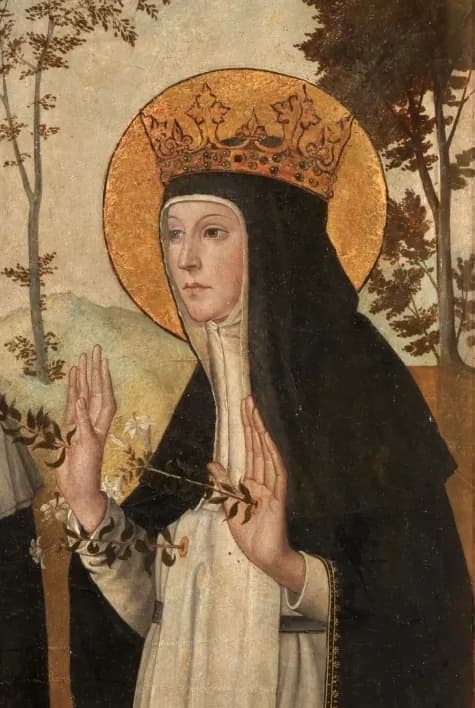
None of the sources consulted for this page names a patronage for Saint Margaret of Hungary, so this page does not give one. 123 The encyclopedia records instead how she is recognized in art: "with a lily and holding a book in her hand." 1 The painting on this page shows her with a lily, a crown and the black and white of the Dominican habit.
Saint Margaret of Hungary's feast day
The feast of Saint Margaret of Hungary is January 18. 12 The 1910 encyclopedia states it in so many words, "The feast day of the saint is 18 January," and gives the same date as the day she died. 1 The Dominican friars of the Province of Saint Joseph also give her feast as January 18. 2
Her feast was kept long before her canonization: the encyclopedia notes that Pius VII raised it to a festum duplex, a higher rank in the calendar of the time. 1
Praying with Saint Margaret
Her vocation began as somebody else's promise. Her parents made the vow, and she was in the habit at four. 12 What the sources record is what she did once she could choose: when her father wanted her for a political marriage, she refused, and stayed where the vow had put her. 12
The work she chose is plain to describe. Dishes, floors, the sick in the infirmary whatever they were sick with, and her hands bleeding from the cold in winter. 23 She was the daughter of the king who had founded the house, and the nuns who lived with her remembered her doing its lowest jobs. 13
Her penances are harder to read across seven and a half centuries, and the sources do not ask a reader to repeat them. 13 The encyclopedia says every account of her calls attention to "her spirit of earthly renunciation." 1 Alongside the penances sit the prayer before the crucifix, the Eucharist, and the gifts from home handed on to the poor. 23
She was honored as a saint by the people around her in her own lifetime, and it took the Church nearly seven hundred years to say so formally. 13 For most of that time she was Blessed Margaret, with a feast on January 18 and an island named after her. 1
Saint Margaret of Hungary, pray for us.
Sources
- 1.Antal Aldásy, "Bl. Margaret of Hungary," The Catholic Encyclopedia, Vol. 9 (New York: Robert Appleton Company, 1910).
- 2."Dominican Saints 101: St. Margaret of Hungary," Dominican Friars, Province of St. Joseph, January 17, 2012.
- 3."St. Margaret of Hungary," Dominican Friars Foundation, Province of St. Joseph.
- 4.John Paul II, Message to the Hungarian Nation on the first Millennium of St Stephen's coronation, August 21, 2000.
- 5.Francis, Address to the Authorities, Civil Society and the Diplomatic Corps, Budapest, April 28, 2023.
- 6.Michael Bihl, "St. Elizabeth of Hungary," The Catholic Encyclopedia, Vol. 5 (New York: Robert Appleton Company, 1909).
Saints to turn to next
Others in this collection who are turned to for some of the same things.
- Saint Claude de la Colombiere1641 - February 15, 1682DiscernmentPrayerSuffering and illness
- Saint Joseph CafassoJanuary 15, 1811 - June 23, 1860PrayerDiscernmentSuffering and illness
- Saint Margaret Mary AlacoqueJuly 22, 1647 - October 17, 1690PrayerSuffering and illnessDiscernment
- Saint Pio of PietrelcinaMay 25, 1887 - September 23, 1968Suffering and illnessPrayerDiscernment