Saint Marcellus I
Died January 16, 309 (or 308)
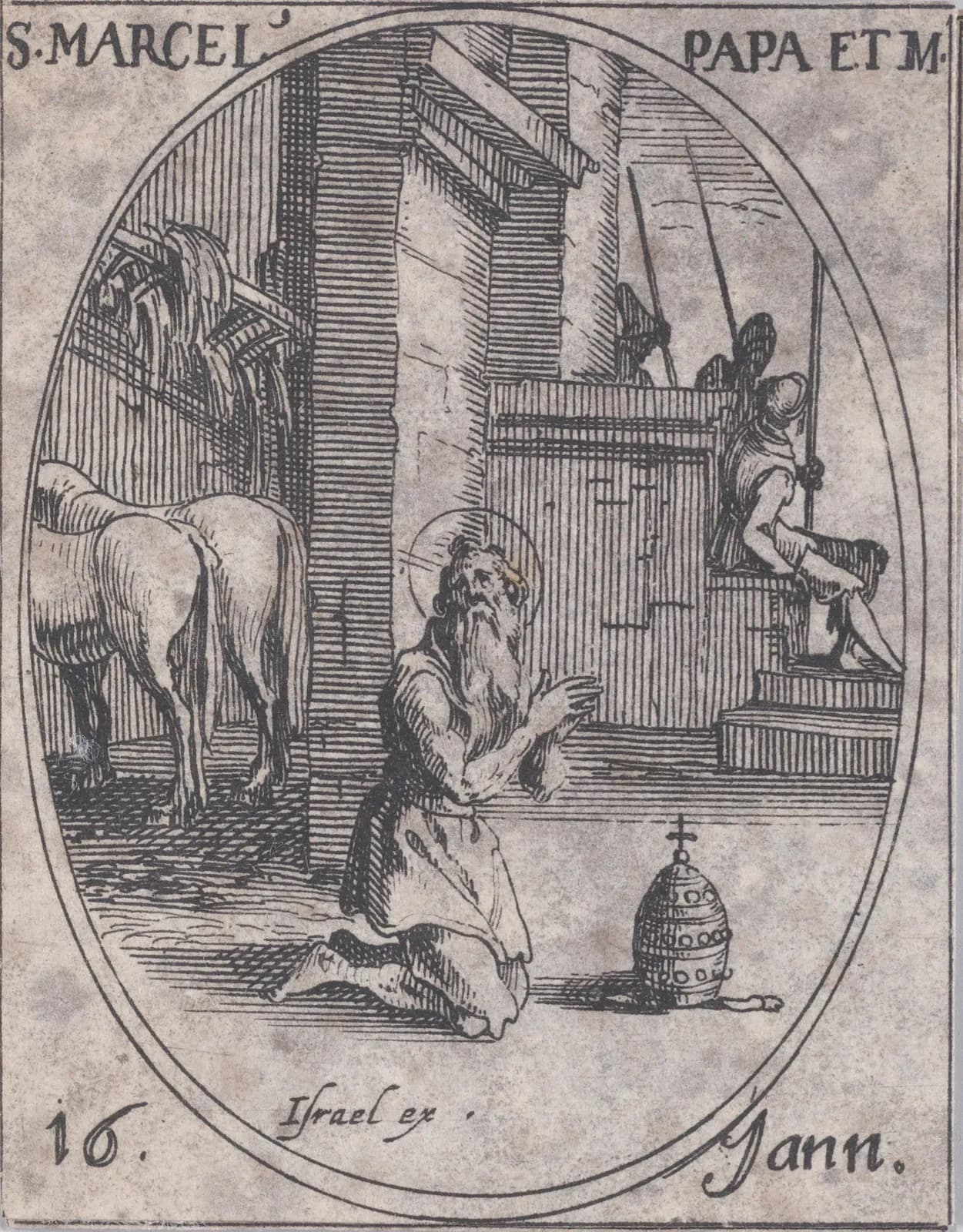
- Elected
- May or June 308 1
- Pontificate
- A year, six or seven months and twenty days, in the Liberian Catalogue 1; seven or eight months, in the view of many scholars 4
- Exiled
- By the emperor Maxentius, at the end of 308 or the beginning of 309 1
- Emblem
- A papal tiara beside a church with a donkey 4
- Patron of
- Stable hands 4
Saint Marcellus I was bishop of Rome for about a year after the Diocletian persecution, elected in 308 to a Church whose meeting places had been confiscated and whose people were divided over those who had denied the faith. 1 He required the lapsed to do penance before returning, the quarrel turned to bloodshed, and the emperor Maxentius sent him into exile, where he soon died. 12 Pope Damasus, who wrote his epitaph, remembered him as a true pastor. 12
An empty chair
The Liber Pontificalis, the early medieval book of the lives of the popes, says Marcellus was a Roman, the son of Benedictus, from the district of the Via Lata. 3 katolsk.no adds that he had been a leading priest under Pope Marcellinus and probably played a key part while the see stood empty. 4
It stood empty a long time. Kirsch, in the Catholic Encyclopedia, says that after Marcellinus died in 304 the persecution "continued with unabated severity," and that even once Maxentius took Rome in 306 and the Christians there "again enjoyed comparative peace," nearly two years passed before a new bishop was chosen. 1 katolsk.no counts more than three and a half years, the longest vacancy in papal history, and notes that the Roman archives burned in 305. 4 The Liber Pontificalis puts the gap at 7 years, 6 months and 25 days. 3
Kirsch dates the election to May or June 308, following the Liberian Catalogue. 1 What Marcellus found, he writes, was "the greatest confusion": meeting places and some burial places confiscated, the ordinary life of the Church interrupted, and a large number of the lapsed demanding readmission "without doing penance." 1
Rebuilding the Church in Rome
The Liber Pontificalis credits him with laying out a cemetery on the Via Salaria and appointing twenty-five parish churches in Rome "as dioceses," in Loomis's translation, "to provide baptism and penance for the many who were converted among the pagans and burial for the martyrs." 3 Kirsch names the cemetery as the Coemeterium Novellae, opposite the catacomb of Priscilla, and says that each of the twenty-five districts had a priest over it who prepared catechumens, directed public penance, buried the dead and kept the anniversaries of the martyrs. 1
How much of that is literally true is uncertain. katolsk.no calls the twenty-five tituli an anachronism, probably reflecting a real reorganization of the Church in a new political climate. 4 Kirsch thinks the compiler may have read a later number back into Marcellus's time, but finds "a clear historical tradition" that this pope reorganized the Roman Church after the persecution. 1 The book also says he ordained twenty-five priests and two deacons in Rome and twenty-one bishops elsewhere. 3
The lapsed, and the epitaph of Damasus
The harder problem was the people who had given way under persecution. Most of what is known comes from the verses Pope Damasus composed later in the century and set over his grave. 1 Kirsch paraphrases them: Marcellus was looked upon "as a wicked enemy by all the lapsed, because he insisted that they should perform the prescribed penance for their guilt." 1 Serious conflicts followed, "some of which ended in bloodshed, and every bond of peace was broken." 1 At the head of the rebels stood an apostate who had denied the faith even before the persecution began. 1
Maxentius had the pope seized and exiled. 1 Loomis summarizes the epitaph the same way: a rebellious faction in the Church, and an apostate who denounced the pope to the tyrant and brought about his banishment. 3 katolsk.no calls it the first case of the secular power interfering in the Church outside a direct persecution, and reads the epitaph as the portrait of a rigorist whose demands turned the majority of the community against him. 4
The current Roman Martyrology keeps Damasus's judgment: a true pastor, bitterly opposed by apostates who refused the penance he had set, shamefully denounced to the tyrant, who died an exile driven from his homeland. 2
Exile, death and a legend
Kirsch says Marcellus "died shortly after leaving Rome." 1 Where is not known, and katolsk.no adds that his body was later brought back and buried in the catacomb of Priscilla, a private property that had not been confiscated. 4 His grave there, Kirsch writes, was mentioned by the pilgrim itineraries as being in the basilica of Saint Silvester. 1
A fifth-century Passio, folded into the legend of Saint Cyriacus, tells a different end, and the Liber Pontificalis follows it. 1 In Loomis's English, Maxentius held him prisoner "that he might deny his bishopric and degrade himself by sacrifices to demons," and when he refused, "he was condemned to the stable." 3 He served there many days without ceasing his "prayers and fastings." 3 In the ninth month his clergy came by night and took him away, and a widow named Lucina received him and dedicated her house as a church in his name. 3 Maxentius seized him again, had the animals of the stable kept in that very church, and set Marcellus to tend them: "And he died in the service of the animals, clad only in a hair shirt." 3
Kirsch judges all this "probably legendary," with only the reorganization of the Church having a historical basis, and finds the tradition in Damasus's verses "much more worthy of belief." 1 Loomis notes that the story "cannot be corroborated from other sources but is not in itself inconsistent" with what is known of the period. 3 katolsk.no points out that the Martyrology of Jerome, from the fifth century, calls him a confessor, one who suffered for the faith without being killed for it. 4
Some scholars have doubted that he was a separate pope at all. Kirsch reports Mommsen's view that he was a priest who ran the Church during the vacancy without being bishop, and says it "has, however, found no support." 1 katolsk.no mentions a further theory that Marcellus and Marcellinus were one man, and answers it: both names stand in the Liberian Catalogue, drawn up some forty years later, and Damasus calls him rector, a word he keeps for bishops. 4
What is Saint Marcellus I the patron saint of?
Saint Marcellus I's feast day
Saint Marcellus I's feast day is January 16. 124 Kirsch says it was kept on that day according to the Depositio episcoporum in the Chronography of 354 "and every other Roman authority," though it is not known whether the date is that of his death or of his burial after his body came home. 1 The current Roman Martyrology keeps it as the day of his burial in the cemetery of Priscilla on the New Salarian Way. 2
The older Martyrology, in its 1897 English edition, calls him "pope and martyr" and tells the stable story: beaten with clubs, "then sent to take care of animals with a guard to watch him," and dying in that servile office "dressed in hair-cloth." 5 The current Martyrology lists him as pope without the title of martyr. 2 Kirsch adds that the church in Rome named in the legend still bears his name. 1
Praying with Saint Marcellus
Marcellus came to a Church that had been broken by persecution, and he began by putting it back in order: priests over districts, a place to bury the dead, catechumens prepared for baptism. 13
Then came the question that had no easy answer. Many had sacrificed to the gods to save themselves, and wanted to come back as though nothing had happened; Marcellus held that coming back meant penance first. 1 The people he was trying to reconcile turned on him, and Damasus says plainly that blood was shed. 1
He lost. The emperor sent him away, and he died in exile soon after, in a place nobody recorded. 14 Damasus, writing later, did not say how he died. 3 He remembered him as a true pastor. 2
The legend gave him a harder end, tending horses in a hair shirt, and in it he still refuses to give up his office or to sacrifice. 3 The Church keeps his day on January 16 whichever account is nearer the truth, and calls him by the title Damasus gave him. 12
Saint Marcellus I, pray for us.
Sources
- 1.J. P. Kirsch, "Pope St. Marcellus I," The Catholic Encyclopedia, Vol. 9 (New York: Robert Appleton Company, 1910).
- 2.Roman Martyrology, entry for January 16, "San Marcello I, papa," as printed in "Santo del giorno," Conferenza Episcopale Italiana (in Italian).
- 3.The Book of the Popes (Liber Pontificalis), I: To the Pontificate of Gregory I, trans. Louise Ropes Loomis (New York: Columbia University Press, 1916), XXXI, "Marcellus," with the translator's notes, Internet Archive.
- 4."Den hellige pave Marcellus I," Den katolske kirke (katolsk.no), Catholic Diocese of Oslo (in Norwegian).
- 5.The Roman Martyrology, January 16 (Baltimore: John Murphy Company, 1897).
Saints to turn to next
Others in this collection who are turned to for some of the same things.