Saint Marcellin Champagnat
May 20, 1789 - June 6, 1840
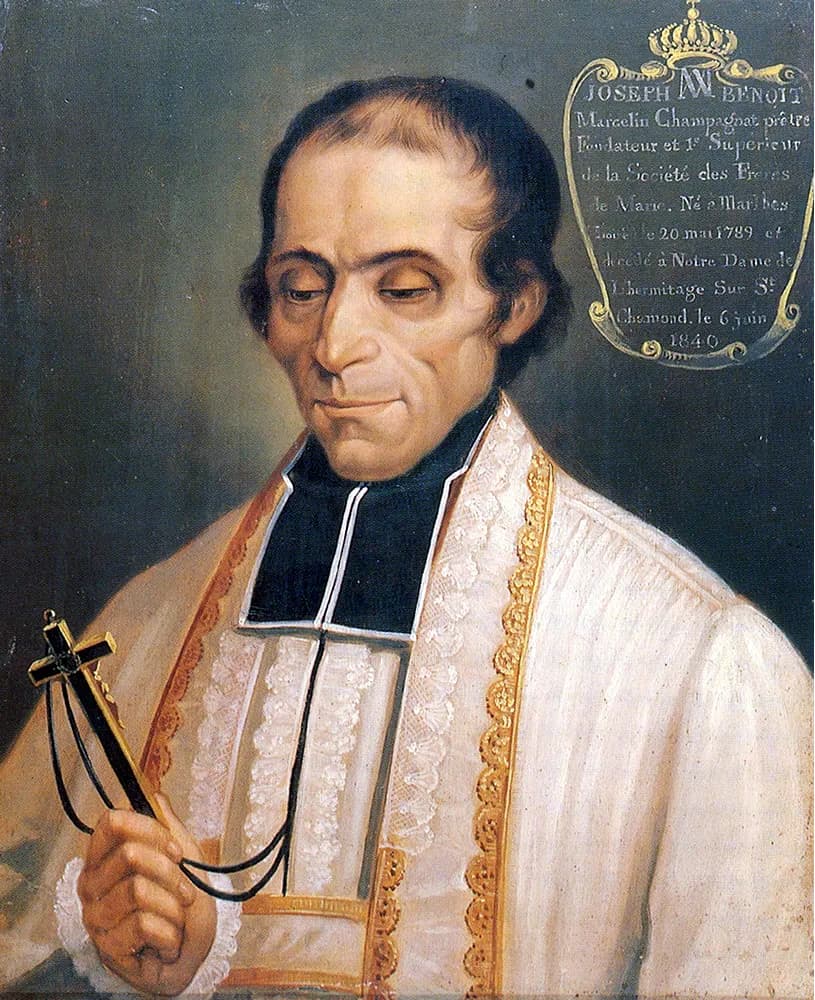
- Born
- May 20, 1789, at Marlhes, in east-central France 1
- Ordained
- July 22, 1816 1
- Brothers at his death
- 310 members in 48 schools 4
- Canonized
- April 18, 1999, by Pope John Paul II 2
- Feast day
- June 6 6
Saint Marcellin Champagnat was a French country priest who, six months into his first parish, gathered two young men in a small house and began the Marist Brothers, a congregation of teaching brothers for the children of the countryside. 1 He had barely been to school himself before he was fourteen. 1 When he died in 1840 there were 310 brothers in 48 schools. 4 John Paul II canonized him on April 18, 1999, and his feast is June 6. 26
A farmer's son from Marlhes
He was born on May 20, 1789, in Marlhes, a village in the mountains of east-central France, as the Revolution was about to break out. He was the ninth child of the family. 1 His mother and an aunt, a nun who had been driven from her convent, gave him his faith and his devotion to Mary. His father was a farmer and merchant with more schooling than most of his neighbors, active in the politics of the village and the region, and from him Marcellin took a liking for manual work and for getting things done. 1
When he was fourteen a priest passing through the village persuaded him that God was calling him to the priesthood. 1 It was an unlikely prospect. His formal schooling, the Vatican biography says, "was practically non-existent," and the people around him, who knew his limits, tried to talk him out of it. He began to study anyway, because "God wills it!" 1 He spent the years from 1805 to 1813 at the minor seminary of Verrières, and they were hard ones. 1
The seminary at Lyon and a promise at Fourvière
At the major seminary in Lyon his companions included Jean-Marie Vianney, the future Curé of Ars, and Jean-Claude Colin. 1 With Colin he joined a group of seminarians who planned a congregation under Mary's name, to include priests, sisters and a lay third order, for what the Vatican biography calls "the re-Christianisation of society." 15 The encyclopedia dates the idea to 1816 and says the group saw an opportunity for religion in the Restoration of the year before. 5
Champagnat wanted the plan to include a branch of brothers who would teach. He was keenly aware of how poor the children of the countryside were, in schooling and in religion alike. 1 The Vatican biography quotes him: "I cannot see a child without wanting to tell him how much Jesus loves him." 1
The group were ordained on July 22, 1816. The next day they went up to the shrine of Our Lady of Fourvière, consecrated themselves to Mary, and put their project under her protection. 1
La Valla
He was sent as curate to the parish of La Valla. He visited the sick, taught the children their catechism and helped the poor, and his plain, direct preaching made an impression. 1 Then he met a dying boy of seventeen who had had no religious instruction at all. The meeting, the biography says, "shook him to his depths" and decided him not to wait any longer. 1
On January 2, 1817, six months after he arrived, he brought his first two recruits together. He was twenty-seven. 1 The Little Brothers of Mary, or Marist Brothers, began, in the biography's words, "in poverty, humility, and total trust in God under Mary's protection." 1 The encyclopedia gives the same year for the foundation. 4
He kept up his parish work and moved in with the brothers, training them as teachers and catechists. The biography calls them "uncultured young country lads." 1 He opened schools quickly. Recruits came, and the first house, though he enlarged it himself, was soon too small. 1 The clergy in general, the biography admits, did not understand what an inexperienced young priest with no money was trying to do. The neighboring villages kept asking for brothers all the same. 1
The Hermitage
Champagnat and the brothers helped build a new house themselves, big enough for more than a hundred people, and named it Our Lady of the Hermitage. 1 In 1825 he was released from parish duties and from then on gave all his time to the congregation: forming the brothers, visiting the schools, opening new ones. 1
His teaching about teaching was simple. "To make Jesus Christ known and loved" was the brothers' mission, and the school was where they carried it out. 1 He taught them to love and respect children and to give particular care to the poor, the ungrateful and the neglected, orphans above all. 1 The encyclopedia adds that he wrote the congregation's rules and "valuable manuals and methods for the pedagogic training of his disciples." 4 It is careful to note that the brothers are not clerics and take no one who hopes to be a priest; they exist solely to teach. 4
He leaned on Mary for all of it. He called her his "Good Mother," his "Ordinary Resource" and his "First Superior," and his motto was "All to Jesus through Mary, and all to Mary for Jesus." 1 He often prayed the psalm that begins "If the Lord does not build the house." 1
Marist priest, and the missions of Oceania
The larger Marist project took twenty years to win approval. The encyclopedia explains that the church authorities in Lyon were cold to it, and that the priests' branch took shape under Colin only when his parish passed to the diocese of Belley. 5 By a brief of April 29, 1836, Pope Gregory XVI approved the priests of the Society of Mary and gave them the missions of Oceania, leaving the brothers and the sisters as separate institutes. 15 The encyclopedia calls Colin "the real founder" of that society and Champagnat "another of the group," the one who established the brothers. 5
On September 24, 1836, Colin was elected superior general and the first Marist professions were made. Champagnat was among those who took vows that day, with Peter Chanel, who became the first martyr of Oceania. 135 He sent three of his brothers with the first Marist missionaries to the Pacific. 1 "Every diocese of the world figures in our plans," he had written. 1
Seeking legal recognition for the brothers cost him a great deal of time and strength. 1 A long illness wore him down, and he died on June 6, 1840, at fifty-one. 1 He left the brothers a message: "May you be of one heart and one mind. May it be said of the Little Brothers of Mary as of the first Christians: see how they love one another!" 1 The Holy See approved the institute by a decree of January 9, 1863, and by 1910 the encyclopedia counted 6,000 brothers at work around the world. 4
What is Saint Marcellin Champagnat the patron saint of?
None of the sources consulted for this page names Saint Marcellin Champagnat as patron of anything, and the page does not supply a patronage. 146 At his canonization John Paul II called his pastoral sense "an example for priests" and said he "was also a model for parents and teachers," which is praise and a recommendation, not a formal patronage. 2 The next day the Pope called him an "apostle of youth." 3
Saint Marcellin Champagnat's feast day
Praying with Saint Marcellin Champagnat
He started behind. A boy with almost no schooling at fourteen began to study against the advice of those around him, and spent eight hard years in a minor seminary. 1 He ended by founding a congregation of schoolteachers for country children. 1
He built with his hands. He enlarged the first house himself and worked on the Hermitage beside his brothers, and the psalm he kept returning to is about the Lord building the house. 1 He held, the biography says, that the congregation "was the work of God and Mary," and it quotes a line he repeated: "When God is on your side, and you rely only on him, nothing is impossible!" 1
John Paul II drew one thing out of his life for parents and teachers: to look at the young with hope and "to love them with a total love which fosters their true human, moral and spiritual formation." 2 Champagnat asked his brothers to keep that up with the children who were hardest to like. 1
The day after the canonization the Pope remembered eleven Marist Brothers who had died violently in the previous five years in Algeria, Rwanda and the Democratic Republic of the Congo. He called them "witnesses of truth and charity." 3 The founder's last request to his brothers had been that people would say of them what was said of the first Christians. 1
Saint Marcellin Champagnat, pray for us.
Sources
- 1."Marcellin Joseph Benoît Champagnat (1789-1840), priest, of the Society of Mary, Founder of the Institute of the Little Brothers of Mary (Marist Brothers)," biography published by the Holy See for his canonization, April 18, 1999.
- 2.John Paul II, Homily at the Canonization of Fr Marcellin Benoît Champagnat, Fr Giovanni Calabria and Sr Agostina Livia Pietrantoni, April 18, 1999.
- 3.John Paul II, Address to the pilgrims gathered for the canonization of Marcellin Champagnat, Giovanni Calabria and Agostina Livia Pietrantoni, April 19, 1999.
- 4.Brother Zéphiriny, "Little Brothers of Mary," The Catholic Encyclopedia, vol. 9 (New York: Robert Appleton Company, 1910).
- 5.Joseph Sollier, "Society of Mary (Marist Fathers)," The Catholic Encyclopedia, vol. 9 (New York: Robert Appleton Company, 1910).
- 6."San Marcellino Champagnat, sacerdote," Santo del giorno, 6 giugno, from the Roman Martyrology, Conferenza Episcopale Italiana (in Italian).
Saints to turn to next
Others in this collection who are turned to for some of the same things.
- Saint Aelred of Rievaulx1109 - January 12, 1166 (or 1167)PrayerWork and vocationStudy and teaching
- Saint Dunstanc. 909 or earlier - May 19, 988Work and vocationPrayerStudy and teaching
- Saint Ephremc. 306 - June 9, 373Study and teachingPrayerWork and vocation
- Saint Jadwiga of Poland1373 - July 17, 1399Study and teachingPrayerWork and vocation