Saint Marcella of Rome
c. 330 - 410
- Way of life
- A widow who lived as an ascetic in her own house on the Aventine, and later in a retreat outside the city 12
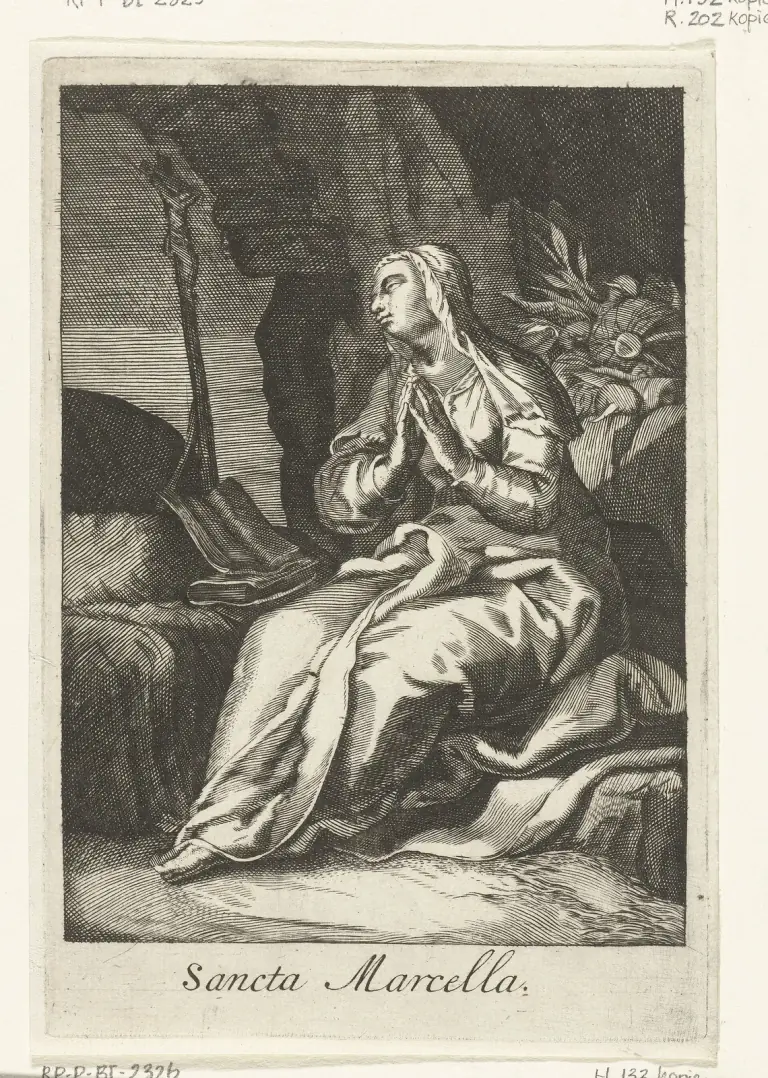
Saint Marcella was a Roman noblewoman who was widowed after less than seven months of marriage, refused to marry again, and lived for the rest of her life in prayer, study and poverty, first in her own house and then in a retreat outside the city. 1 Jerome, who taught her the Scriptures and found himself argued with, called her "the glory of her native Rome" and wrote her memoir after she died in 410, beaten by the Goths who sacked the city. 13 Her feast is January 31. 4
A widow who would not remarry
Almost everything known about Marcella comes from one letter. Two years after her death Jerome wrote to Principia, the young woman who had lived with her, a long memoir of her friend, and santiebeati names that letter as the principal source for her life. 12
Jerome refuses to praise her lineage, though he lets it be known that it ran "through a line of consuls and prætorian prefects." 1 santiebeati says she was of the Marcelli, one of the most illustrious families of Rome, or according to others of the Claudii, and dates her birth about 330. 2 She lost her father early. Then she married, and her husband died before seven months were out. 12
She was young, rich and handsome, and an elderly former consul named Cerealis courted her, offering to settle his fortune on her so that she could think of herself as his daughter more than his wife. 1 Butler identifies him as the uncle of the Caesar Gallus; santiebeati dates the offer to 358. 23 Her mother Albina wanted the match. 1 Marcella answered that if she wished to marry and not to dedicate herself to chastity, she would look for a husband and not for an inheritance, and when Cerealis said that old men sometimes live long and young men die early, she replied that a young man might die early but an old man could not live long. 1 After that, Jerome says, nobody else tried. 1
The house on the Aventine
Her model came from Egypt. Jerome writes that she learned of Antony, then still alive, and of the monasteries of the Thebaid founded by Pachomius, from priests of Alexandria, from Athanasius and later from Peter of Alexandria, all of whom had fled to Rome to escape the Arians. 1 santiebeati puts Athanasius at her family's house between 340 and 343, when she was still a child, and Peter there in 373. 2 "In those days," Jerome writes, "no highborn lady at Rome had made profession of the monastic life," and to call oneself a nun was thought degrading. 1 She did it anyway. 1
Jerome describes the life plainly. Her clothes were for warmth, not show; she would not wear even a gold signet ring; she ate no meat and hardly tasted wine; she went nowhere without her mother and saw the monks and clergy her household needed only before witnesses. 1 She avoided the houses of great ladies and went instead to the basilicas of the apostles and martyrs, where she could pray unnoticed. 1 santiebeati describes the result as an ascetic circle rather than a monastery with a rule, which other noblewomen joined: Sophronia, Asella, Principia, Marcellina, Lea, and in time her mother. 2 Jerome adds that his friend Paula was close to her and that Paula's daughter Eustochium was formed in Marcella's cell. 1
She would not cross her mother even in giving. When Albina wanted to leave her property to her brother's family rather than to her own children and grandchildren, Marcella would have preferred to give it to the poor, but gave her own jewels and goods to relatives who were already rich rather than sadden her. 1 santiebeati reads this as part of a more moderate temperament than Jerome's. 2
Jerome's pupil and critic
Jerome came to Rome with Paulinus of Antioch and Epiphanius of Salamis, santiebeati dates his direction of her circle from 382, and he tried at first to keep away from high-born women. 12 Marcella would not let him. "She never came to see me that she did not ask me some question" about the Scriptures, he writes, "nor would she at once acquiesce in my explanations but on the contrary would dispute them." 1 She did this, he says, to learn the answers to the objections other people would raise. 1
santiebeati says she learned Hebrew to understand the Psalms better, and that Jerome became the spiritual director of the circle and kept up the friendship by letter after he left for Palestine. 2 Butler counts eleven of his letters to her answering her questions. 3 After Jerome left Rome, he says, any dispute about the meaning of Scripture was taken to her. 1 When she answered, she gave her view as his or someone else's, because she remembered Saint Paul's rule that women should not teach, and did not want to seem to wrong the men, priests among them, who came to her with questions. 1
She did not follow him everywhere. santiebeati notes that she did not share his violent polemics, and that she stayed in Rome despite a pressing letter from Paula and Eustochium inviting her to Bethlehem. 2 Yet when a controversy over the writings of Origen reached Rome at the end of the century, Jerome credits her with leading the opposition: she produced witnesses and the disputed books, and wrote letter after letter calling the other side to answer. 1 He calls the eventual condemnation her victory. 1
The sack of Rome
In her later years she lived outside the city with Principia, in what santiebeati thinks was a suburban property, the two of them, in Jerome's words, like mother and daughter. 12 Butler is careful to add that Principia was her pupil and not her daughter, as some had wrongly supposed. 3 santiebeati says Marcella came back into Rome in 410 for fear of the Goths. 2
The Goths under Alaric plundered Rome in 410. 3 Jerome had the story from witnesses. When soldiers came into her house and demanded gold, she showed them her coarse dress; they did not believe that she was poor, and scourged her and beat her with clubs. 1 She threw herself at their feet and begged them not to take Principia from her. 1 They brought the two women to the basilica of Saint Paul, which Butler says Alaric had made a sanctuary, and there, Jerome says, she thanked God that the fall of the city "had found her poor, not made her so." 13
She died a few days later, in Principia's arms, smiling. 1 Butler dates her death about the end of August 410. 3 She left Principia, Jerome says, the heir of her poverty, or rather left the poor her heirs through Principia. 1
What is Saint Marcella the patron saint of?
Saint Marcella's feast day
Saint Marcella's feast day is January 31. 2 The current Roman Martyrology, as the Italian bishops publish it, commemorates her at Rome on that day as a widow who, on the testimony of Saint Jerome, despised riches and nobility and became nobler still through poverty and humility. 4 Butler records that she died about the end of August 410, and that her name stands in the Roman Martyrology on January 31. 3
Praying with Saint Marcella
She lived the way she did for decades, most of the time without a rule, a convent or a famous teacher, in the middle of a city that thought it ridiculous. 12 Jerome says she grew old before she remembered she had been young. 1
Her prayer and her study were the same work. She asked hard questions of the best scholar she knew and would not take the first answer, and she still spoke modestly about what she had learned. 1
Her poverty was tested at the end, when soldiers would not believe it and beat her for it. 1 What she asked for then was not her own safety but Principia's. 1
Saint Marcella of Rome, pray for us.
Sources
- 1.Jerome, Letter 127, "To Principia," trans. W. H. Fremantle, G. Lewis and W. G. Martley, in Nicene and Post-Nicene Fathers, Second Series, Vol. 6 (Buffalo, NY: Christian Literature Publishing Co., 1893), revised and edited for New Advent by Kevin Knight.
- 2.Gian Domenico Gordini, "Santa Marcella di Roma, Vedova," Santi, beati e testimoni (santiebeati.it), with the Roman Martyrology entry (in Italian).
- 3.Alban Butler, "St. Marcella, Widow," January 31, in The Lives of the Fathers, Martyrs, and Other Principal Saints, Vol. I (New York, 1895), Project Gutenberg eBook #20450.
- 4.Roman Martyrology, entries for January 31, Santo del giorno, Conferenza Episcopale Italiana (in Italian).
Saints to turn to next
Others in this collection who are turned to for some of the same things.
- Saint Józef BilczewskiApril 26, 1860 - March 20, 1923Study and teachingPrayerPoverty and simplicity
- Saint Peter Damian1007 - February 21, 1072Study and teachingPrayerPoverty and simplicity
- Saint Abercius of HieropolisSecond century; died at seventy-two or laterPrayerStudy and teaching
- Saint Aelred of Rievaulx1109 - January 12, 1166 (or 1167)PrayerStudy and teaching