Saint Mansuetus of Toul
d. c. 375
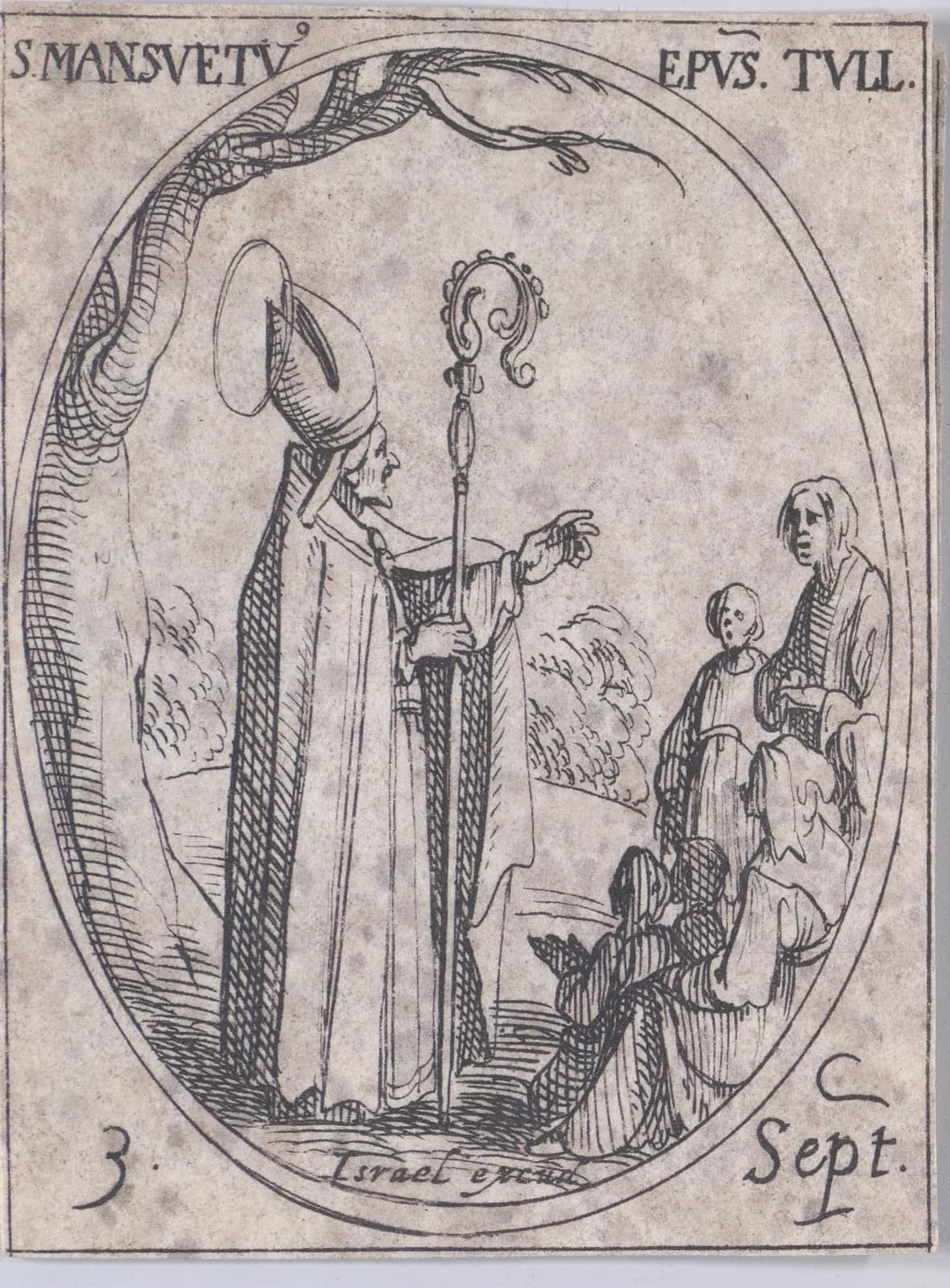
- Also called
- Mansuy, in French 1
- Date
- Not before the fourth century, says the 1911 Catholic Encyclopedia 3; died about 375 after thirty-seven years as bishop, says katolsk.no 1
- Buried
- In the church of Saint Peter outside the walls of Toul, which he had built 1
- Life
- Written in the tenth century by Adso, and judged by katolsk.no to be invention 1
- Emblem
- A child holding a ball 1
Saint Mansuetus, Mansuy in French, was the first bishop of Toul and is called the apostle of the Leuci, the Celtic people of that region of Gaul. 123 He probably died about 375. 1 Nearly everything else told of him comes from a Life written six hundred years later, which the Norwegian bishops' saints database calls pure fantasy. 1
The Leuci and their first bishop
The Leuci lived in Gallia Belgica, around Toul, in what is now Lorraine. 1 The Norwegian bishops' saints database (katolsk.no) says the light of Christianity reached them late compared with more favored parts of Gaul, and that the gospel began to be preached openly only around the middle of the fourth century. 1 At about the same time, under the emperor Julian, several Christians were martyred in their country: Eucharius near Pompey, Elophius at Solimariaca, and Libaria near Grand. 1 Before then, katolsk.no says, conversions were rare, secret and isolated; afterward they were public and nearly universal. 1
Mansuetus was the first bishop. 123 Georges Goyau, in his article on Nancy in the 1911 Catholic Encyclopedia, calls him "Apostle of the Leuci and first Bishop of Toul," and deals briefly with the claim that he was "a disciple of St. Peter": he "cannot have been anterior to the fourth century." 3 The dates of his first successors, Goyau adds, cannot be determined. 3
katolsk.no says many sources give 365 for the start of his episcopate, probably to fit a legend that Pope Damasus sent him to Toul. 1 By the list of the bishops of Toul, he died about 375 after an episcopate of thirty-seven years. 1
The Life by Adso
The only account of his life was written in the tenth century by Adso, head of the school at the abbey of Saint-Èvre in Toul and later abbot of Montier-en-Der. 1 katolsk.no calls it bombastic and full of fiction. 1 It makes Mansuetus a Scot or an Irishman, consecrated bishop in Rome and sent to northeastern Gaul by the apostle Peter himself. 1
Its central story is a miracle. katolsk.no quotes it at length. The son of the governor of Toul, whom the legend also calls its king, had drowned while playing by the river, and his body could not be found. 1 The queen dreamed that the stranger Mansuetus promised to recover it if she would turn to the true God, and the king had him found and promised that he and all his people would give up their gods if he could hold his son's body again. 1 Mansuetus prayed on the riverbank, the body rose to the surface, and at his second prayer the child came back to life. 1 The king, his household and the people were baptized, and they proclaimed Mansuetus the first pastor of the church of Toul. 1
katolsk.no is plain about what this is worth: all of it, it says, is pure invention. It keeps the story because the cult kept it. 1 The drowned boy became his emblem. He is shown beside a child holding a ball, for the governor's son who drowned while at play. 1
The Life also says he ordained many priests and built churches across the region, three of them at Toul: one to Mary and Saint Stephen, one to John the Baptist on its south side, and one to Saint Peter outside the walls near an old cemetery. 1 He was buried in that last church. 1 Adso adds that Martin of Tours visited his tomb, and katolsk.no allows that this may not be baseless, since Martin traveled to Trier in 384 or 386. 1
The cult at Toul
The tomb drew pilgrims soon after his death, katolsk.no says, but the cult grew in earnest only in the tenth century, when the church of Saint Peter was restored, first under Bishop Gauzelin and then under Bishop Gerard. 1 Gerard built over the grave the abbey of Saint-Mansuy, enshrined the relics, and asked Adso to write the Life. 1 Goyau counts both bishops among the saints of the see: Gauzelin, who reformed the monastery of Saint-Èvre, and Gerard, who held it from 963 to 994. 3
katolsk.no tells a small episode from Adso that shows how local the devotion was. Two men from the Barrois, in the west of the diocese, were bringing a load of salt past Toul on his feast. 1 The people of Gondreville tried to stop them, since no work was allowed that day, and the men answered that they were not bound to keep a feast that concerned only the Leuci. 1
There were later translations. Bishop Pibo moved the relics in 1104, and a separate feast of the translation is still kept on June 15. 1 Pope Leo IX, who as Bruno had been bishop of Toul, dedicated a church to him at Voerendaal in what is now Dutch Limburg; katolsk.no explains this exception by the church's owner, a cleric of Toul. 13 Otherwise the cult never left the diocese, and Mansuetus was always overshadowed there by Gerard. 1
Toul honored many of its bishops. katolsk.no says nineteen of them, from the founding of the see to 1802, are counted saints, and that Mansuetus is depicted in the apse of the cathedral with fourteen other saints. 1 A feast of all the holy bishops of Toul was kept in the diocese of Nancy and Toul on September 4 until 1955, when a reform of the diocesan calendar removed it along with most of the bishops. 1 Churches dedicated to him stand at Bouvron, Fontenoy-le-Château, Loisey-Culey, Nancy and Serécourt. 1
What is Saint Mansuetus the patron saint of?
Saint Mansuetus's feast day
Praying with Saint Mansuetus
What can be known of Mansuetus is short. He was the first bishop of a people who came late to the faith, he governed them for many years, and he was buried outside the town in a church he had built. 13
The rest is a story his diocese told about him six centuries later. katolsk.no does not pretend it is history, and neither does this page. 1 The story is still worth noticing for what Toul wanted to say about its founder: that the faith came to them through a grieving family, and that he was remembered beside a child. 1
He belonged to one place. His feast was kept by the Leuci and nobody else, and men from the next district felt free to work on it. 1 Being the patron of one diocese is how most of the Church's saints have been remembered, and Mansuetus is one of them. 12
Saint Mansuetus of Toul, pray for us.
Sources
- 1."Den hellige Mansuetus av Toul (d. ~375)," Den katolske kirke (katolsk.no), Catholic Diocese of Oslo (in Norwegian).
- 2.Roman Martyrology, entry for September 3, "San Mansueto, vescovo," as printed in "Santo del giorno," Conferenza Episcopale Italiana (in Italian).
- 3.Georges Goyau, "Nancy," The Catholic Encyclopedia, Vol. 10 (New York: Robert Appleton Company, 1911).
Saints to turn to next
Others in this collection who are turned to for some of the same things.