Saint Mamertus of Vienne
d. c. 475
- Also called
- Mamert; Mamertius 1
- Bishop of Vienne
- Elected and consecrated shortly before 462 3
- Patron saint of
- Nursing mothers in France and firefighters; invoked against drought and fever 1
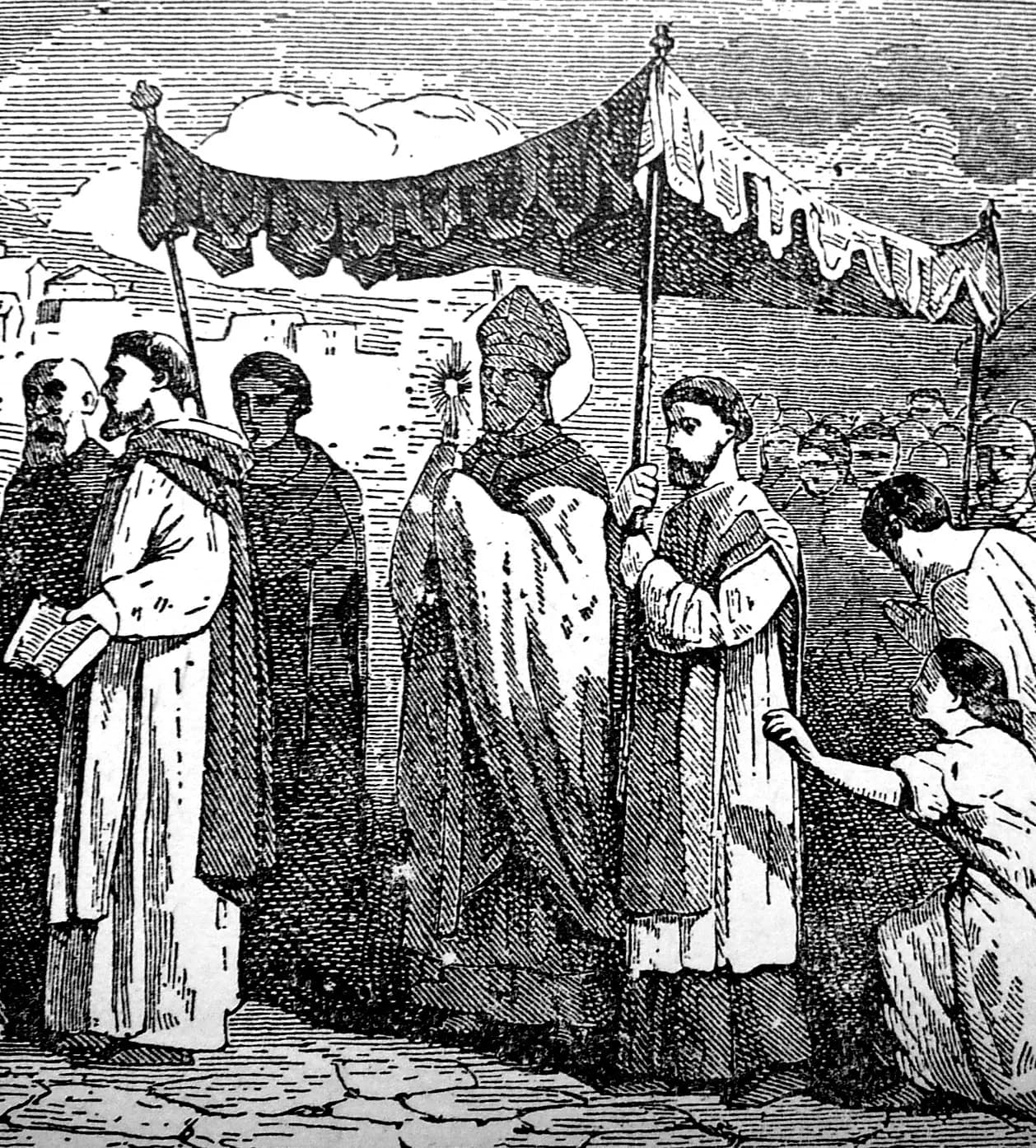
Saint Mamertus was bishop of Vienne, on the Rhône south of Lyon, in the second half of the fifth century, and the man who gave the Church its Rogation Days: three days of fasting, prayer and procession before the feast of the Ascension. 234 He began them when his city had been shaken by earthquake, fire and fear, and in 511 a council ordered them for all the churches of Gaul. 49
A bishop with a scholar for a brother
Of his life before he became bishop, the Catholic Encyclopedia says plainly that "nothing certain is known." 3 His brother Claudianus Mamertus was a well-trained theologian and writer, which suggests a wealthy Gallic family from near Lyon, and Mamertus himself was known for learning in both secular subjects and theology. He seems to have been married. 3 He was elected and consecrated bishop of Vienne shortly before 462. 3
As bishop he brought his brother out of a monastery and ordained him a priest of Vienne. 35 Sidonius Apollinaris, who knew them both, described the partnership after Claudianus died. The bishop had in his brother "a counsellor in every disputed question, a representative in his churches, an agent in business matters, a steward on his farms," and more besides. "They were the very exemplars of brotherly affection, with an absolute confidence in each other." 8 Claudianus trained the singers to chant the psalms in alternating groups before the altar while his brother celebrated Mass, and chose the readings for the year. 58
A quarrel with Rome
His episcopate had one recorded misstep. Pope Leo I had divided the old province between Arles and Vienne, leaving Vienne only four dioceses. In 463 Mamertus ignored the arrangement and consecrated a bishop for Die, a see that belonged to Arles. 3 The Burgundian king Gundiac complained to Pope Hilary, who ordered the bishop of Arles to call a synod. It found against Mamertus. 3
Hilary's letter of February 25, 464 said that Mamertus and the bishop he had consecrated really ought to be deposed. Choosing clemency instead, the pope sent word that if Mamertus did not submit to Leo's arrangements he would lose his four remaining dioceses as well; the bishop of Die could stay, once confirmed by Arles. 3 "Mamertus evidently submitted," the encyclopedia concludes, "since we find no subsequent reference to the incident." 3
He also found the remains of the martyr Ferreolus and moved them to a church built in his honor at Vienne. 3 Sidonius, writing to him, added the head of the martyr Julian of Brioude, and said that since Ambrose found Gervasius and Protasius, "it has been granted to you alone in the West to translate the relics of two martyrs." 6
The Rogations
Vienne went through a terrible season. Sidonius, writing to Mamertus, listed it: "Now it was earthquake, shattering the outer palace walls with frequent shocks; now fire, piling mounds of glowing ash upon proud houses fallen in ruin; now, amazing spectacle! wild deer grown ominously tame, making their lairs in the very forum." Rich and poor were leaving the city. 6 Avitus, the second bishop after Mamertus, told the rest in a homily, which katolsk.no retells: the worst came on Easter night of 469, when a fire broke out during the vigil and threatened the city. Everyone fled the church but the bishop, who prayed alone all night, and at dawn the fire died. 1
Sidonius gives the fire in a single scene: "you stood forth all alone to stay them, and lo! the fire leapt back before you, a sinuous beaten fugitive." 6 Mamertus then called the people to penance, and he promised God, so Avitus's account runs, a new form of prayer in thanksgiving. 1 On the three days before the Ascension the city fasted, walked in procession, prayed and gave alms. 14 Sidonius wrote that "after those days there were neither portents to alarm, nor visitations to bring disaster." 6
The dates are disputed. Pius Parsch, quoted by Catholic Culture, puts the beginning "about the year 450." 9 katolsk.no puts the crisis in 469. 1 The encyclopedia does not date the first procession, but it says Mamertus summoned a synod at Vienne about the processions between 471 and 475. 3
How the custom spread
Prayer in procession was not new, but Sidonius thought the old kind half-hearted. Before, he told a friend, the public prayers were "lukewarm, irregular, perfunctory," interrupted for meals, and chiefly for rain or fine weather, so that "the potter and the market-gardener could never decently attend together!" In the Rogations of Mamertus, "we fast, we pray with tears, we chant the psalms." 7
Clermont took them up when the Visigoths were at its walls. "Our only present help we find in those Rogations which you introduced," Sidonius wrote to Mamertus, "and this is the reason why the people of Clermont refuse to recede, though terrors surge about them on every side." 6 The Council of Orléans in 511 ordered them for the churches of Gaul, Pope Leo III approved them, and in time they became part of the liturgy of the Western Church. 49 The encyclopedia lists Gregory of Tours, Avitus, Ado of Vienne and the Roman Martyrology as witnesses that Mamertus began them, and notes that Sassi and the Bollandist Henschen credited an earlier Saint Lazarus with the same thing. 4
His last years and his relics
About 475 he attended a synod at Arles on the predestination teaching of a Gallic priest, Lucidus, and that is the last we hear of him. 3 The encyclopedia assumes he died shortly after; katolsk.no gives 477, with burial outside the city in the Church of the Apostles. 13 His sarcophagus was found in the nineteenth century and is kept in the old church of Saint-Pierre at Vienne, now an archaeological museum. 1
His relics were taken to Orléans in the seventh century and burned by Calvinists in 1563. 1 In northern Germany he is counted among the "ice saints" of mid-May, after whose days farmers expect no more frost. 1
What is Saint Mamertus the patron saint of?
Saint Mamertus's feast day
Saint Mamertus's feast day is May 11. His name stands under that date in the ancient Martyrology of Jerome and in that of Florus of Lyon, "on which day his feast is still celebrated," as the encyclopedia puts it. 3 The current Roman Martyrology keeps him on May 11 and remembers him for one thing: that when disaster threatened his city he instituted the solemn three days of litanies before the Ascension. 12 Orléans, which held his relics, once kept him three times a year. 1
Praying with Saint Mamertus
Sidonius saw clearly what Mamertus had done. In a city where people were packing to leave, he answered with penance. He "enjoined a fast," denounced sins, announced punishment and promised relief, and taught that "it was by water of tears rather than water of rivers that the obstinate and raging fire could best be extinguished." 6 The poor came first, and then the people of rank who had fled came back. 6
The Rogations were his idea of what a frightened people should do together: fast, walk the streets, sing the psalms and say they were sorry. 7 Sidonius invited a friend to them and called them a festival of tears, "in place of banquets." 7 They outlasted the empire Mamertus lived under, and for centuries afterward the Western Church walked in procession before the Ascension because a bishop of Vienne once had. 49
The rest of what is known is ordinary in the best way: a man who loved and leaned on his brother, overstepped his authority, and submitted when Rome told him so. 38
Saint Mamertus of Vienne, pray for us.
Sources
- 1."Den hellige Mamertus av Vienne (~400-477)," Den katolske kirke (katolsk.no), Catholic Diocese of Oslo (in Norwegian).
- 2.Roman Martyrology, entry for May 11, "San Mamerto, vescovo," as printed in "Santo del giorno," Conferenza Episcopale Italiana (in Italian).
- 3.Johann Peter Kirsch, "St. Mamertus," The Catholic Encyclopedia, Vol. 9 (New York: Robert Appleton Company, 1910).
- 4.Francis Mershman, "Rogation Days," The Catholic Encyclopedia, Vol. 13 (New York: Robert Appleton Company, 1912).
- 5.Paul Lejay, "Claudianus Mamertus," The Catholic Encyclopedia, Vol. 4 (New York: Robert Appleton Company, 1908).
- 6.Sidonius Apollinaris, Letters, Book VII, letter I to Bishop Mamertus, trans. O. M. Dalton (Oxford, 1915).
- 7.Sidonius Apollinaris, Letters, Book V, letter XIV to Aper, trans. O. M. Dalton (Oxford, 1915).
- 8.Sidonius Apollinaris, Letters, Book IV, letter XI to Petreius, trans. O. M. Dalton (Oxford, 1915).
- 9."May 11, 2026: Monday of the Lesser Rogation Days," Liturgical Year calendar, Catholic Culture (Trinity Communications), with Pius Parsch, The Church's Year of Grace.
Saints to turn to next
Others in this collection who are turned to for some of the same things.