Saint Macarius of Jerusalem
d. before 335
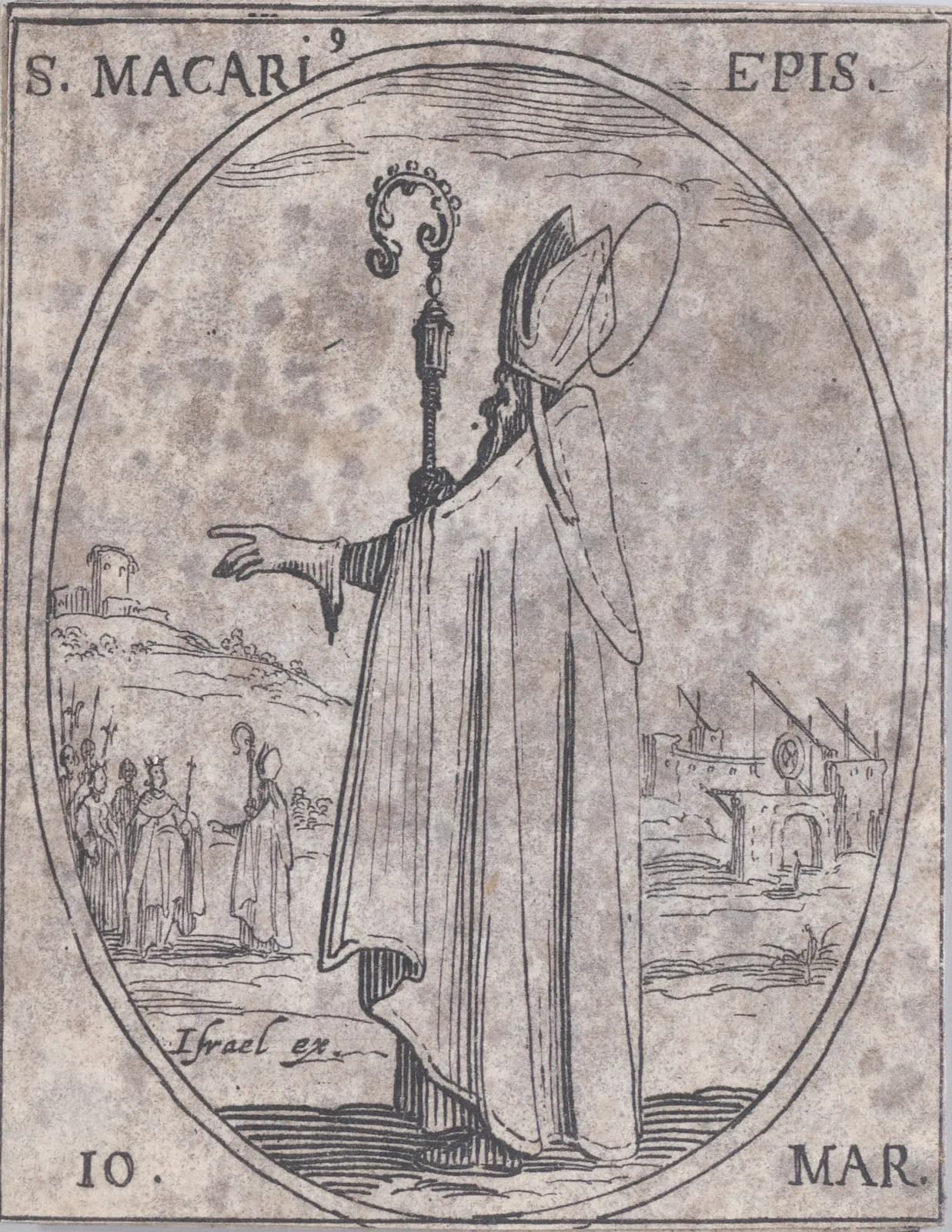
- Bishop of Jerusalem
- From 312, by the date in Jerome's version of Eusebius's Chronicle 1; he succeeded Hermon 6
- Remembered for
- The uncovering of the holy places and the building of the church over the tomb of Christ 23
- Died
- Before the Council of Tyre in 335 1
- Feast day
- March 10 2
Saint Macarius was bishop of Jerusalem from 312 until shortly before 335, and the emperor Constantine's letter ordering a church over the newly uncovered tomb of Christ was addressed to him. 13 Arius counted him among his enemies, and he sat at the Council of Nicaea. 146 The historians of the next century add that when three crosses were dug up near the tomb, it was Macarius who settled which one was Christ's. 456
Bishop of a small see
Jerusalem in the early fourth century was a Roman town called Aelia, and its bishop answered to the metropolitan at Caesarea. 1 Francis Bacchus, writing in the 1910 Catholic Encyclopedia, dates Macarius's accession to 312, from the entry in Jerome's version of Eusebius's Chronicle. 1 Theodoret, writing a century later, says that after Hermon the church of Jerusalem passed to Macarius, "a man whose character was equal to his name, and whose mind was adorned by every kind of virtue." 6
None of the sources consulted says anything of his life before he became bishop. What they do record is the side he took when the dispute over Arius broke out at Alexandria. Bishop Alexander of Alexandria wrote to him among other bishops to warn him about the new teaching. 1 Arius, writing to his ally Eusebius of Nicomedia, complained that all the bishops of the East were against him "except Philogonius, Hellanicus, and Macarius, who are unlearned men, and who have embraced heretical opinions." 6 Theodoret explains that Arius slandered the three because they taught that the Son is eternal and of the same substance with the Father. 6 Bacchus reads the insult as a compliment: "The vigour of his opposition to the new heresy is shown by the abusive manner in which Arius speaks of him." 1
At Nicaea
Macarius went to the Council of Nicaea in 325. Socrates names "Macarius of Jerusalem" in his short list of those present, and Bacchus notes that his name stands first among the bishops of Palestine who signed, with that of Eusebius of Caesarea, his own metropolitan, fifth. 14
Bacchus offers two guesses about his part there and labels both as guesses. 1 One is that he quarreled with Eusebius over the standing of their sees. The council's seventh canon says that since custom gives honor to the bishop of Aelia "he shall have precedence; without prejudice, however, to the dignity which belongs to the Metropolis," a wording that, Bacchus says, "by its vagueness suggests that it was the result of a drawn battle." 1 The other guess is that Macarius and Eustathius of Antioch helped draft the Creed, since some of its phrases recall the creeds of their churches. 1
A later "History of the Council of Nicaea" ascribed to Gelasius of Cyzicus has Macarius debate a philosopher in Arius's pay and defend Christ's descent into hell. Bacchus introduces it bluntly: "From conjectures we may turn to fiction." 1
The tomb under the temple
In Hadrian's time a great mound had been raised over the tomb of Christ, with a temple of Venus on top. 1 Eusebius tells how Constantine had the temple pulled down, its stone and timber carried away, and the soil beneath it dug out to a depth, and how "contrary to all expectation" the tomb itself came to light. 3 He does not name the bishop who stood by. The Martyrology does: it remembers Macarius as the one at whose urging Constantine and his mother Saint Helena brought the holy places to light and adorned them with basilicas. 2 Bacchus cites the chronicler Theophanes, who died in 818 and who says Constantine ordered Macarius at the close of Nicaea to search for the sites, and judges, "It is likely enough that this is what happened, for excavations were begun very soon after the council, and, it would seem under the superintendence of Macarius." 1
Eusebius copied the emperor's letter to him into the Life of Constantine, and Socrates and Theodoret copied it again. 346 It opens, "Victor Constantius, Maximus Augustus, to Macarius," and says that "no power of language seems adequate to describe the wondrous circumstance." 3 The practical part leaves a good deal to the bishop. The governors would supply workmen and money, but Macarius was to say what columns and marbles he wanted, "for it is fitting that the most marvelous place in the world should be worthily decorated," and whether he thought the ceiling should be "panel-ceiled, or finished with any other kind of workmanship"; if paneled, it might also be gilded. 3
A second letter went "to Macarius, and the rest of the bishops in Palestine" about Mamre, where, Eusebius says, Christ had once appeared to Abraham. 3 Constantine's mother-in-law had reported pagan altars and sacrifices at the old oak, and the emperor wanted to know why the bishops had allowed a thing "which, though it has eluded your sagacity," she had noticed and reported. 35 He ordered the altar destroyed and a church built. 35 Eusebius, though the letter names Macarius first, calls it a letter written to himself. 13
The three crosses
Eusebius, who knew the site and wrote the longest contemporary account of the work, says nothing about finding the Cross. 3 The story appears in the church historians of the fifth century, and in all three Macarius has the decisive part. 456
Socrates says that Helena, directed by dreams, had the site cleared and found three crosses in the tomb, with the tablet Pilate had written. 4 No one could tell which cross was Christ's, and "from this trouble the bishop of Jerusalem, Macarius, shortly relieved her. And he solved the doubt by faith, for he sought a sign from God and obtained it." 4 A woman of the neighborhood lay dying; the crosses were brought to her one at a time, and at the touch of the third she was healed. 4
Sozomen tells it with more ceremony. In his account the sick woman was a lady of rank, and Macarius went to her bedside with Helena and her attendants, prayed, and then made signs to the bystanders that the true cross would be the one that cured her. 5 Two crosses did nothing, and at the third "she suddenly opened her eyes, regained her strength, and immediately sprang from her bed, well." 5 He adds, as hearsay, "It is said that a dead person was, in the same way, restored to life." 5 Theodoret, briefest of the three, credits "the wise and holy Macarius" and the prayer that went with the test. 6
The sources differ on who led the search. Eusebius gives the work to the emperor; Socrates and Theodoret give it to Helena; Sozomen mentions a report that a Jew of the East had learned the spot from family papers, but thinks it likelier that God revealed it. 3456 Socrates is candid about one later detail, the fragment of the Cross he says Constantine sealed inside his own statue: "I have written this from report indeed." 4
Maximus and the end
Sozomen preserves one story from the end of Macarius's life. 5 He had ordained Maximus, a confessor, bishop of Diospolis, but the people of Jerusalem would not let Maximus go, wanting him as their next bishop, and he stayed to share the work with Macarius. 5 Sozomen also gives a second version: that Macarius himself "regretted the ordination of Maximus," and feared that at his death the followers of Eusebius and Patrophilus, who leaned to Arius, would put one of their own in his see. 5
Bacchus reports that the French historian Tillemont doubted the story, partly because the bishop of Lydda at the time seems to have outlived Macarius. Bacchus himself finds it "plausible enough" if that bishop died soon after 331, and adds that Macarius's approaching death would explain why he, or his people, did not want to lose Maximus. 1
Macarius died before the Council of Tyre in 335, at which Maximus seems already to have sat as his successor. 1 He did not see the church he had planned with the emperor dedicated; the bishops went up from Tyre to Jerusalem for that. 14 Years later Athanasius, writing to the bishops of Egypt and Libya, listed him among the bishops renowned for their orthodoxy. 1
What is Saint Macarius of Jerusalem the patron saint of?
Saint Macarius of Jerusalem's feast day
Saint Macarius of Jerusalem's feast day is March 10. 2 The current Roman Martyrology keeps a commemoration of him on that day as bishop of Jerusalem, at whose urging the holy places were uncovered by Constantine and Helena and honored with basilicas. 2 The 1910 encyclopedia cites the Bollandists' Acta Sanctorum under the same date. 1
Praying with Saint Macarius
Macarius stood where Christ was buried and risen, and spent the last years of his life making that ground fit to be prayed in. 123 The emperor wrote to him about marble and ceilings, and he was expected to have an answer. 3
The quarrel over Arius came to him from Alexandria. Arius named him an enemy in his own letter, and Macarius went to Nicaea and signed with the bishops who held that the Son is eternal. 16 In the story of the crosses he is the one who prays, and he does nothing until the sign is given. 456
The sources leave a good deal unsure about him: what he did at Nicaea, how much of the search for the tomb he directed, even whether the story of the crosses happened as told. 13 What they agree on is a bishop who held the faith of Nicaea in a small see under a powerful metropolitan, and who, in one of Sozomen's versions, worried at the end about who would hold it after him. 15
Saint Macarius of Jerusalem, pray for us.
Sources
- 1.Francis Joseph Bacchus, "St. Macarius," The Catholic Encyclopedia, Vol. 9 (New York: Robert Appleton Company, 1910).
- 2.Roman Martyrology, entry for March 10, "San Macario, vescovo," as printed in "Santo del giorno," Conferenza Episcopale Italiana (in Italian).
- 3.Eusebius of Caesarea, Life of Constantine, Book III, trans. Ernest Cushing Richardson, Nicene and Post-Nicene Fathers, Second Series, Vol. 1 (Buffalo, NY: Christian Literature Publishing Co., 1890), via New Advent.
- 4.Socrates Scholasticus, Church History, Book I, trans. A.C. Zenos, Nicene and Post-Nicene Fathers, Second Series, Vol. 2 (Buffalo, NY: Christian Literature Publishing Co., 1890), via New Advent.
- 5.Sozomen, Ecclesiastical History, Book II, trans. Chester D. Hartranft, Nicene and Post-Nicene Fathers, Second Series, Vol. 2 (Buffalo, NY: Christian Literature Publishing Co., 1890), via New Advent.
- 6.Theodoret, Ecclesiastical History, Book I, trans. Blomfield Jackson, Nicene and Post-Nicene Fathers, Second Series, Vol. 3 (Buffalo, NY: Christian Literature Publishing Co., 1892), via New Advent.
Saints to turn to next
Others in this collection who are turned to for some of the same things.