Saint Luigi Guanella
December 19, 1842 - October 24, 1915
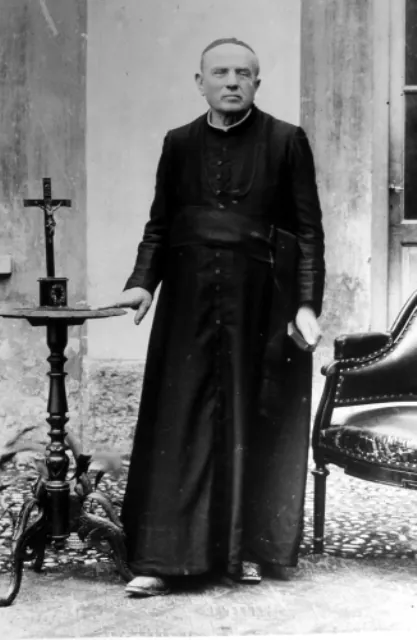
- Born
- December 19, 1842, at Fraciscio, in the municipality of Campodolcino, Diocese of Como, Italy 1
- Ordained
- May 26, 1866, by the Holy See biography and the Servants of Charity; two other sources print 1886 1468
- Founded
- The Daughters of St. Mary of Providence (1890), the Servants of Charity (1908) and the Pious Union of St. Joseph for the dying 146
Saint Luigi Guanella was a priest of the Diocese of Como who founded two religious congregations, the Daughters of St. Mary of Providence and the Servants of Charity, for people whom the rest of society had set aside: the incurable, the abandoned, the old, the physically and mentally impaired, and orphaned children. 568 At seventy he sailed for the United States to see how Italian immigrants were living, and the sisters he sent to Chicago in 1913 were the first of his communities in America. 14 Benedict XVI, canonizing him in 2011, called him "a prophet and an apostle of love." 2
A farming family in the Alps
He was born on December 19, 1842, at Fraciscio, an outlying village of Campodolcino in the Diocese of Como, and baptized the next day. 1 The Holy See biography describes his parents, Lorenzo and Maria Bianchi, as exemplary Christians who worked the fields and kept sheep and cattle, prayed the Rosary together and read the lives of the saints, a habit it says marked his own apostolic work for the rest of his life. 1 His congregation adds that he grew up among poverty and illiteracy, at a time when priests and religious in Italy were often harassed by the civil authorities. 45
He studied at the seminary in Como and was ordained a priest on May 26, 1866, the date given by the Holy See biography, his own congregation and the Tennessee Register. 145 The Pious Union of St. Joseph and CatholicPhilly print the year as 1886, which does not fit the rest of his story. 68 A year after ordination he became parish priest of Savogno, a small parish, and stayed seven years. 14
With Don Bosco, and back again
At Savogno he came into contact with Don Bosco and with the Cottolengo institution in Turin. 1 Wanting what the Holy See biography calls "a more radical religious experience," he joined Don Bosco's order in 1875 and took vows for three years. 1 The Servants of Charity date his time with the Salesians to 1875-78. 4
Then the Bishop of Como called him home. He came back intending to found a house for needy boys, opened a school, and had to close it because of the hostility of the civil authorities. 1 The Pious Union, which he founded, is blunter: his early attempts were stamped out by suspicion, lack of understanding and persecution from fellow priests and the local government. 8
"The hour of mercy"
In November 1881 he was sent as parish priest to Pianello Lario, a village on Lake Como. 14 He called that moment "the hour of mercy," and there he found a group of young women already devoted to helping the needy. 1 The Pious Union says they had been formed by his predecessor, Father Carlos Coppini. 8 They became the nucleus of the Daughters of St. Mary of Providence. 1
On April 6, 1886, according to the Pious Union, he sent a small boat across the lake to Como carrying two sisters, a few orphan girls and a few pieces of furniture, to a simple house he had prepared for them. 8 That "House of Divine Providence" became the mother house of both his congregations. 1 CatholicPhilly dates the founding of the sisters to 1890. 6 He also gathered priests, whom he called "Servants of Charity," and on March 24, 1908, they professed perpetual vows with Guanella as their first superior general. 14
The people the houses took in were the ones he called the "favorites" of Providence: the incurable, the abandoned, the aged, the physically and mentally impaired, and orphaned and needy children. 8 "It is impossible to stop as long as there are poor people to be helped," he would repeat, and both congregations spread through Italy and into the Swiss cantons of Grisons and Ticino. 1
Rome, Pius X and a prayer for the dying
In 1904 he reached Rome, realizing what the Holy See biography calls his dream, and under the protection of Pius X opened a house for children living in the streets. 14 The pope asked him to build a church dedicated to the death of St. Joseph, the Transito di San Giuseppe. 1 Construction began in 1908, and the first Mass was said there on March 19, 1912, the feast of St. Joseph. 4
Beside the church grew the Pious Union of St. Joseph, an association of people who pray for the dying. 1 "There is a need to live well, but there is even a greater need to die well," Guanella wrote. 5 Pius X recognized it canonically in 1914 and enrolled as its first member. 145
America
In December 1912, at the age of 70, he boarded a ship for the United States, drawn, the Holy See biography says, by the Italian immigrants in North America. 1 His congregation says he went to the major American cities and saw for himself the deplorable conditions immigrants were living in. 4 In May 1913 six Daughters of St. Mary of Providence arrived in Chicago, the beginning of the Guanellians in America. 45
The work outlived him there. The Tennessee Register describes the Daughters as headquartered in Chicago, serving the elderly and people with disabilities, and the Servants of Charity running residential homes for people with developmental disabilities, among them the St. Louis Center in Chelsea, Michigan, and Don Guanella Village in Springfield, Pennsylvania. 5
The earthquake and the end
In January 1915 an earthquake struck the Abruzzo. 1 The Holy See biography says he chose to stay in Rome to help its victims, working beside Aurelio Bacciarini, the first pastor of St. Joseph's and later his successor at the head of the Servants of Charity. 1 The Pious Union and the Tennessee Register describe him going with his priests and sisters to the stricken area, caring for survivors and sheltering orphans and the old. 58 The Pious Union puts the dead at more than thirty thousand and calls this his last labor. 8
Age, Italy's entry into the First World War and the involvement of several of his confreres at the front wore down his health. 1 In May 1915, in the fiftieth year of his priesthood, he opened his last house at Berbenno; around the same time his health began to fail and he was stricken with paralysis. 4 He had written that "death is like a mother who embraces her son [...] she is the angel who takes us to our homeland." 1 He died at 2:15 in the afternoon on Sunday, October 24, 1915, in Como. 18 Benedict XVI gave his last words as "in caritate Christi," in the charity of Christ. 2 He is buried in the Shrine of the Sacred Heart in Como. 4
Paul VI beatified him on October 25, 1964. 48 The miracle accepted for his canonization happened near Philadelphia. William Glisson, 21, of Springfield, Delaware County, suffered severe head injuries in an in-line skating accident in March 2002; a family friend lent his mother relics of Guanella, and he recovered without lasting deficits. 56 CatholicPhilly reports that a Vatican medical commission found no natural explanation in November 2009 and that the theological commission attributed the cure to Guanella's intercession in January 2010. 56 Benedict XVI canonized him in St. Peter's Square on October 23, 2011, World Mission Sunday, with Guido Maria Conforti and Bonifacia Rodríguez de Castro. 26
What is Saint Luigi Guanella the patron saint of?
None of the sources consulted for this profile names a patronage for Saint Luigi Guanella, so this page does not claim one. 124 The Archdiocese of Philadelphia calls him the patron of its Communities of Don Guanella and Divine Providence, a ministry for people with intellectual and physical disabilities, and says he "advocated for further acceptance of individuals with intellectual and physical disabilities as brothers and sisters and as blessings from God." 7 That is the patron of a particular institution, and it is reported here as that. His own family of congregations has a patroness of its own: Pope Francis, addressing them in 2015, named the Mother of Divine Providence. 3
Saint Luigi Guanella's feast day
His feast is October 24, the day he died. 456 His congregation, the Servants of Charity, says the day is now celebrated as his feast throughout the world, and the Archdiocese of Philadelphia announced its own feast-day Mass for him on October 24, 2019. 47
The Holy See biography and the canonization homily give October 24 only as his date of death and do not set a feast. 12
Praying with Saint Luigi Guanella
Pope Francis, speaking to his congregations on the centenary of his death, said that "Providence, for him, was not 'poetry' but reality," and that he "often had the courage to surpass the limits of human prudence, to put the Gospel into practice." 3 The life bears that out in plain ways. A boat across a lake with two sisters, some orphans and a little furniture. A school shut down by the authorities, and a house opened anyway a few years later. 18
Benedict XVI singled out something quieter. Guanella, he said, "paid caring attention to each one and respected the pace of their development." 2 The Tennessee Register notes that the society he grew up in considered the disabled and the elderly useless and a burden. 5 At a Mass marking his canonization near Philadelphia, Bishop Robert Maginnis put it this way: "persons are of value for what they are, and not what they produce." 6
He also gave a good deal of thought to dying. He built a church to the death of St. Joseph, founded a union of people who pray for the dying, and wrote of death as "a mother who embraces her son." 1 The same man, in the last year of his life and in failing health, went out to the victims of an earthquake. 18 The sources do not set the two against each other.
Francis quoted one of his sayings back to the congregations he founded: "poverty cannot wait. And we cannot stop so long as there are poor to be helped!" 3
Saint Luigi Guanella, pray for us.
Sources
- 1."Aloysius Guanella (1842-1915)," biography in the booklet for the Mass of Canonization, October 23, 2011, Office for the Liturgical Celebrations of the Supreme Pontiff (English text, pp. 27-30).
- 2.Benedict XVI, Homily for the Canonization of Blesseds Guido Maria Conforti, Luigi Guanella and Bonifacia Rodríguez de Castro, St. Peter's Square, October 23, 2011.
- 3.Pope Francis, Address to a Pilgrimage of the Guanellian Family, Paul VI Audience Hall, November 12, 2015.
- 4."St. Louis Guanella: Modern Apostle of Charity," The Founder, Servants of Charity (US province, Chelsea, Michigan).
- 5."St. Louis Guanella: Saint of the sick, servant of the suffering," Tennessee Register, Diocese of Nashville.
- 6."Blessed Don Louis (Luigi) Guanella canonized," CatholicPhilly.com, Archdiocese of Philadelphia, November 2011.
- 7."The Communities of Don Guanella and Divine Providence to Celebrate Feast Day of Patron Saint Luigi Guanella," press release, Archdiocese of Philadelphia, October 18, 2019.
- 8."Saint Louis Guanella," Pious Union of St. Joseph, Grass Lake, Michigan.
Saints to turn to next
Others in this collection who are turned to for some of the same things.
- Saint André BessetteAugust 9, 1845 - January 6, 1937Suffering and illnessWork and vocationPoverty and simplicity
- Saint Giuseppe MoscatiJuly 25, 1880 - April 12, 1927Work and vocationSuffering and illnessPoverty and simplicity
- Saint Ignatius of LaconiDecember 1701 - May 11, 1781Work and vocationPoverty and simplicitySuffering and illness
- Saint John Baptist de RossiFebruary 22, 1698 - May 23, 1764Poverty and simplicitySuffering and illnessWork and vocation