Saint Ludger of Münster
c. 744 - March 26, 809
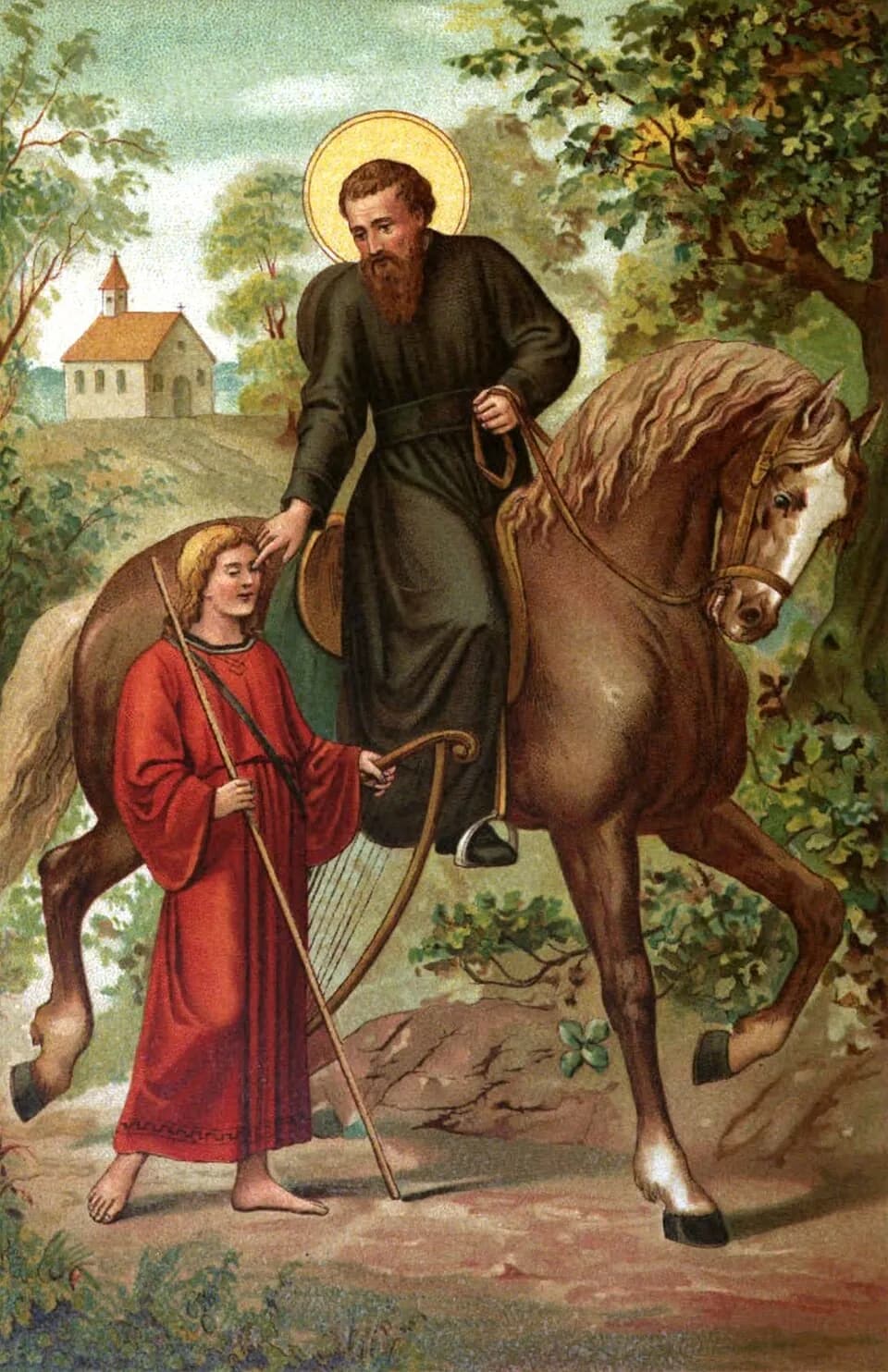
Saint Ludger of Münster was a Frisian nobleman's son, schooled at Utrecht and under Alcuin at York, who preached to the Frisians and the Saxons in the years of Charlemagne's wars and became the first bishop of Münster in Westphalia. 12 He founded the abbey of Werden, where he is buried, and died at Billerbeck on March 26, 809, a few hours after his last sermon. 14 His feast is March 26, and he is the patron of the dioceses of Münster and Essen. 124
A Frisian at Utrecht and York
He was born at Zuilen, near Utrecht, about 744. 12 Butler says 743, and the Catholic weekly of the Diocese of Münster, Kirche+Leben, says 742. 34 His family were wealthy Frisian nobles, already Christian. 12 The encyclopedia names his parents Thiadgrim and Liafburg; katolsk.no, the website of the Catholic Church in Norway, says their names are not known and records instead a grandfather, Wursing, baptized by Saint Willibrord's mission about 721. 12
In 753 the boy saw Saint Boniface, then an old man and a year from his martyrdom. The encyclopedia says the sight and the death that followed "made deep impressions on his youthful mind." 124 At his own request he was sent to the school that Saint Gregory, a disciple of Boniface, had founded at Utrecht. 13 He later wrote the life of that teacher. 2
From Utrecht he went to York to study under Alcuin, who would become one of the chief figures in Charlemagne's reform of education. 12 The sources count the years differently. The encyclopedia has two stays, the first in 767, when he was ordained deacon there; Butler gives four and a half years, katolsk.no about four, Kirche+Leben nearly six. 1234 It ended badly. The encyclopedia speaks of "a friction" between the Anglo-Saxons and the Frisians in 773, and katolsk.no explains it: one of his countrymen had killed an English merchant. 12 Ludger went home for his own safety, "taking with him a number of valuable books," and kept Alcuin's friendship for life. 1
Dokkum and the Saxon revolt
His first commission, in 775, was at Deventer, where pagan Saxons had destroyed the chapel of the missionary Saint Lebwin. He rebuilt it and found Lebwin's relics. 12 He was then sent north to destroy pagan shrines west of the Lauwers Zee. 1
He was ordained priest at Cologne in 777 and given the missions of eastern Friesland, with his base at Dokkum, the place where Boniface had been killed. 12 Each autumn he went back to Utrecht to teach in the cathedral school. 1
This lasted about seven years. Then the Saxon leader Widukind brought the Frisians into his revolt; the missionaries were driven out and the churches burned. 124 Ludger escaped with his disciples. 1
He used the exile to go to Rome, where Pope Adrian received him well, and then to Monte Cassino. 14 There he lived by the Rule of Saint Benedict without taking vows. 134
The mouth of the Ems
Widukind submitted and was baptized, and in 787 Ludger was sent back, this time to five districts at the mouth of the Ems that were still almost wholly pagan. 12 He was a Frisian preaching to Frisians, and the encyclopedia notes the advantage: "knowing the language and habits of the people, he was able to turn to advantage many national traits in effecting their conversion." 1
He crossed to Heligoland, where Willibrord had preached before him, and built a church; Kirche+Leben dates it to 791. 14 "The well once sacred to the heathen gods became his baptismal font." 1 On the way back he met a blind bard, whom the encyclopedia calls Berulef and the Dutch book behind the picture on this page calls Bernlef. Ludger cured his blindness and "made him a devout Christian." 1
Katolsk.no draws the contrast that the other sources leave implicit: his gentle persuasion and preaching had more success than Charlemagne's methods of force. 2
Münster and Werden
In 793, the encyclopedia says, Charlemagne wanted to make him bishop of Trier. 1 He declined, telling the king there were men far more learned for the post, and asked instead to be allowed to evangelize the Saxons of Westphalia. 14
The center of the new district was a river crossing called Mimigernaford. Ludger built a monastery there, a monasterium, and the town that grew around it took the name Münster. 12 He lived in it with his clergy under the rule of Saint Chrodegang of Metz. 12
From there he organized some forty parishes, founded the cathedral and its school, and built churches at Billerbeck, Coesfeld, Herzfeld and Nottuln. 124 At Nottuln he built a house for his sister, who had consecrated herself to God, and the women who gathered around her became the first convent in Westphalia. The encyclopedia calls her Gerburgis, the other two Heriburg. 124 "His principal care was to have a good and efficient clergy," the encyclopedia says. He taught his students himself and took some of them along on his journeys. 1
Since Monte Cassino he had wanted to found a Benedictine house of his own. He chose Werden, on the Ruhr; building began in earnest in 799, and he consecrated the church in 804. 14
He was consecrated bishop late and reluctantly, by Archbishop Hildebald of Cologne. 23 The year is not agreed. Butler says 802, katolsk.no March 30, 804, and Kirche+Leben 805. The encyclopedia will say only that a document of January 13, 802 still calls him abbot and one of April 23, 805 calls him bishop. 1234 He dedicated the diocese to Saint Paul. 4
The bishop who kept the emperor waiting
Butler preserves the sketch of his character. He read Scripture daily with his disciples, fasted, and wore a hair shirt that nobody knew about until shortly before he died. 3 "To the poor he was affable and courteous, but firm and resolute to the proud rich." 3 Beyond what he needed to live, he gave the income of his own estate and of his see away. 3
That generosity got him denounced. He was accused before Charlemagne of wasting his revenues and neglecting the adornment of his churches, and was summoned to court. 23 When the chamberlain came for him the next morning he was at prayer, and said he would follow when he had finished. He was sent for three times before he came. Asked why, he answered that he had the deepest respect for the emperor, but that "God was infinitely above him." 3 Charlemagne, Butler says, dismissed him with honor and disgraced his accusers. 3
Passion Sunday, 809
By the spring of 809 he was ill and worn out, and still traveling his diocese. 24 On Passion Sunday he preached early in the morning at Coesfeld, went on to Billerbeck, preached again at nine and said his last Mass. 1 Kirche+Leben puts that journey on the morning of March 25 and his death, among his companions, in the night that followed, on March 26. 5 Kirche+Leben tells the old story that his sister and his nephew Gerfrid, who would succeed him as bishop, did not reach him in time and saw a great light like fire rising at the hour of his death. 5
Münster and Werden both claimed the body. His brother Hildegrim was asked to decide and, after consulting the emperor, chose Werden, as Ludger himself had wished. 134 There, the encyclopedia wrote in 1910, "the relics have rested for eleven centuries." 1 Most of them are there still, in the former abbey church. 2
What is Saint Ludger of Münster the patron saint of?
Saint Ludger of Münster is the patron of the dioceses of Münster and Essen. 24 CatholicCulture.org lists both, along with places he worked or is buried: Münster itself, Billerbeck, Werden, Helmstedt, Deventer, Groningen and East Frisia among them. 6 No source consulted here names a trade, a condition of life or a cause under his patronage.
He is usually pictured as a bishop holding a model of a church, or reciting his breviary, and often with geese or swans beside him. 126 The geese come from a legend. As Kirche+Leben tells it, a story already current in the twelfth century has a farmer complaining to the bishop that wild geese were eating his spring seed, and the bishop ordering the birds into a barn. 5 The same article is frank that such tales are not historically vouched for. 5
Saint Ludger of Münster's feast day
Saint Ludger of Münster's feast day is March 26, the day of his death. 13 Katolsk.no says the date appears in liturgical books of the ninth century and that his name stands in the Roman Martyrology; CatholicCulture.org lists him on March 26 as a commemoration from the Martyrology, noting that he "has been called the 'Apostle of Saxony.'" 26 In Werden, Kirche+Leben reports, the great local celebration is a Ludgerus festival held in September. 4
Praying with Saint Ludger of Münster
The scene with the chamberlain is the one people remember, and it is easy to tell it as a snub. Butler does not. In his telling Ludger argued that he had obeyed the emperor, who on naming him bishop had told him always to put the service of God before that of men. 3 Butler adds a caution of his own: those who leave prayer for necessary works of charity or obedience still find God in them. 3
The rest of the life is mostly rebuilding. The chapel at Deventer had been burned before he arrived. 1 Seven years of work around Dokkum were undone by a revolt, and he spent the years after it as an exile in Italy. 12 He went back to the same coast and began again.
He also turned down the larger thing. He was offered the see of Trier and asked instead for a mission whose center was a settled crossroads beside a small river. 14 He built a house of prayer beside it, taught the young clergy himself, and spent what he had on the poor until someone complained to the emperor. 13
His last day was like the others. Sick, he preached twice in two towns and said Mass, and died before morning. 14
Saint Ludger of Münster, pray for us.
Sources
- 1.Francis Mershman, "St. Ludger," The Catholic Encyclopedia, Vol. 9 (New York: Robert Appleton Company, 1910).
- 2.Per Einar Odden, "Den hellige Liudger av Münster (~744-809)," Den katolske kirke (the Catholic Church in Norway), last updated February 1, 2000 (in Norwegian).
- 3.Alban Butler, "St. Ludger, Bishop of Munster, Apostle of Saxony," from The Lives of the Fathers, Martyrs and Other Principal Saints, Vol. III (D. & J. Sadlier, 1864), as published by EWTN.
- 4."Heiliger Liudger," lexicon article, Kirche+Leben, Catholic weekly of the Diocese of Münster (in German).
- 5."Heiliger Liudger – Legenden über sein Leben," Kirche+Leben, Catholic weekly of the Diocese of Münster (in German).
- 6."Thursday of the Fifth Week of Lent; Other Commemorations: St. Ludger, Bishop (RM)," Liturgical Year calendar for March 26, 2026, CatholicCulture.org.
Saints to turn to next
Others in this collection who are turned to for some of the same things.
- Saint Aelred of Rievaulx1109 - January 12, 1166 (or 1167)PrayerWork and vocationStudy and teaching
- Saint Dunstanc. 909 or earlier - May 19, 988Work and vocationPrayerStudy and teaching
- Saint Ephremc. 306 - June 9, 373Study and teachingPrayerWork and vocation
- Saint Jadwiga of Poland1373 - July 17, 1399Study and teachingPrayerWork and vocation