Saint Lucius I
Birth unknown - March 254
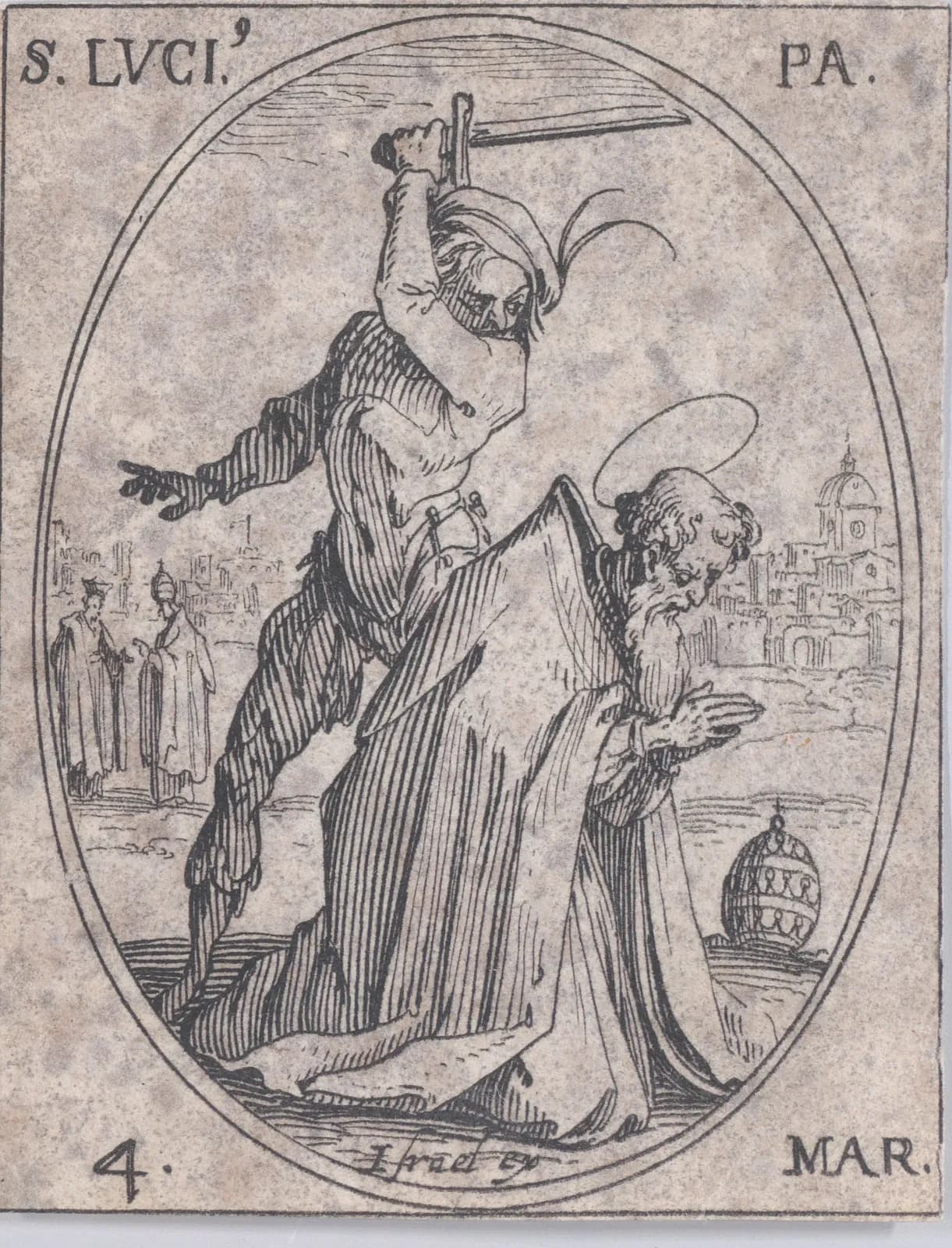
- Died
- At Rome in early March 254: March 5 in the Chronograph of 354, March 4 in the Martyrologium Hieronymianum 12
- Patron of
- Roskilde Cathedral and the diocese of Zealand, in Denmark 2
Saint Lucius I was bishop of Rome for less than a year, in 253 and 254, and spent part of it in exile. 16 When he came home, Cyprian of Carthage wrote to congratulate him that "the shepherd might be restored to feed his flock, and the pilot to manage the ship." 4 Like Cornelius before him, he held that Christians who had denied the faith under persecution could be received back after penance, and Cyprian names the two of them together as "the blessed martyrs Cornelius and Lucius." 57
Elected in a persecution
Saint Cornelius died in exile in the summer of 253, and Lucius was chosen to take his place and consecrated bishop of Rome. 1 Nothing is known of his life before that. 1 The Liber Pontificalis, the old book of papal lives, says he was a Roman and that his father was called Porphyrius; Johann Peter Kirsch, in the 1910 Catholic Encyclopedia, notes that where its author found this is not known. 12
The persecution under the Emperor Gallus, which had sent Cornelius into banishment, was still going on, and Lucius too was exiled soon after his consecration. 12 Where he was sent is unknown. 2 It did not last. He was allowed to return, Kirsch thinks, when Valerian became emperor, since Valerian was at first well disposed toward the Christians. 12 katolsk.no, the saints database of the Catholic Diocese of Oslo, says many others who had been driven out with him came back too. 2 An early list of popes, which Kirsch quotes, says that he was an exile and afterward returned to his church unharmed "nutu Dei," by the will of God. 1
Cyprian's letters
Cyprian, bishop of Carthage, had already written once to congratulate Lucius on his election and his exile; that letter is lost. 1 The second survives. 14 Writing with his fellow bishops, he greeted the pope on his return and recalled that God had given him "a double honour" in making him "as well a confessor as a priest." 4 He hoped the return meant "that the shepherd might be restored to feed his flock, and the pilot to manage the ship, and the ruler to govern the people," and that Lucius would "return to the Church greater than he had left it." 4
He was careful about what the return did not mean. The three young men in the furnace were no less witnesses because the fire did not kill them, he wrote, nor was Daniel among the lions. 4 "Among confessors of Christ, martyrdoms deferred do not diminish the merits of confession, but show forth the greatness of divine protection." 4 Then he imagined the scene in Rome: "What exultation among all the brethren there; what running together and embracing of each one as they arrive!" 4
The letter also has an edge. Rome was still divided by the schism of Novatian, who had set himself up against Cornelius, and Kirsch reads Cyprian's remark that persecution shows "which was the Church" as aimed at the Novatians. 14 Cyprian ends by suggesting that God might have brought Lucius home so that, if he were to die for the faith, he would do so among his own people. 4
The lapsed
The great question of these years was what to do with the lapsed, the Christians who had given way during the persecutions. 17 Lucius kept to the line Cornelius and Cyprian had taken: after suitable penance, they could be readmitted to communion. 127 Vatican News sums up his reign in exactly these terms, as a pope who opposed the rigorism of the Novatians, who refused absolution to the lapsed. 7
The evidence for this comes from Cyprian, writing a few years later to Pope Stephen. "The glorious honour of our predecessors, the blessed martyrs Cornelius and Lucius, must be maintained," he wrote, for "they, full of the Spirit of God, and established in a glorious martyrdom, judged that peace should be granted to the lapsed." 5 Both men, he says, set this down in their letters. 5 The current Roman Martyrology remembers Lucius in the same spirit, as one who faced the troubles of his time with moderation and prudence. 3
Two other reports are less secure. katolsk.no says Lucius received a letter from Dionysius the Great of Alexandria on whether baptism given by heretics was valid. 2 Eusebius, whose Church History preserves Dionysius's letters, says Lucius died after less than eight months and that Dionysius wrote the first of his letters on baptism to Stephen, his successor. 6 katolsk.no also reports that Lucius is said to have been an ascetic who forbade unrelated men and women to live in the same house. 2
Death, and the question of martyrdom
Lucius died at the beginning of March 254. 12 The Chronograph of 354 gives the date as March 5 and the Martyrologium Hieronymianum as March 4; Kirsch says "the first date is probably right," and suggests he may have died on the 4th and been buried on the 5th. 1
The Liber Pontificalis says he was beheaded under Valerian. 12 Kirsch says this "cannot be admitted": Valerian was still favorable to the Christians, and his first edict of persecution came only in 257. 1 Cyprian does call him a martyr, but Kirsch thinks the title was given for his exile. 15 The Roman calendar in the Chronograph of 354 lists him among the bishops and not among the martyrs. 1 katolsk.no agrees that the beheading is almost certainly wrong, and that the older Liberian Catalog has him die a natural death. 2 Kirsch also calls "a fabrication" the Liber Pontificalis's story that on his way to death he handed authority over the Church to the archdeacon Stephen. 1
He was buried in the papal crypt of the catacomb of Saint Callistus. 123 When the crypt was excavated, the archaeologist de Rossi found a large fragment of his epitaph, which gives only his name in Greek letters: LOUKIS. 1 His relics were later moved into the city. Kirsch says this was done either by Paul I, to San Silvestro in Capite, or by Paschal I, to Santa Prassede. 1 katolsk.no says they were taken with the relics of Saint Cecilia to her church in Trastevere. 2
What is Saint Lucius the patron saint of?
None of the sources names a patronage of a cause or a trade for Saint Lucius. 12 His one recorded patronage is in Denmark. katolsk.no says that around 1100 envoys of the cathedral chapter of Roskilde went to Rome for a relic for their rebuilt cathedral and brought back the skull of Pope Lucius, and that he became the patron saint of the cathedral and of the whole diocese of Zealand. 2 The relic is now in the Catholic cathedral of Saint Ansgar in Copenhagen. 2
Saint Lucius's feast day
Saint Lucius's feast day is March 5 in the current Roman Martyrology, which enters on that day his burial in the cemetery of Callistus on the Via Appia. 3 The older date is March 4. Kirsch, writing in 1910, gives March 4 as the day of his feast, and katolsk.no says that date stood in the Roman calendar until 1969. 12
Praying with Saint Lucius
Lucius was bishop of Rome for a few months, and for some of them he was not in Rome. 16 He came back, and Cyprian, writing from Carthage, described the welcome as though he could hear the crowds. 4
Cyprian also refused to let the return count for less. A man ready to suffer who is then spared has still confessed his faith, he argued, and the reprieve does not undo the confession. 4 It is an unusually kind reading of a short and ordinary-looking life.
What Lucius did with the time is known only through other people's letters: he held the door open for those who had failed under persecution and wanted to come back, as Cornelius had. 57 The Church remembers it as moderation and prudence. 3 Cyprian remembered it as the judgment of men "full of the Spirit of God." 5
Saint Lucius I, pray for us.
Sources
- 1.Johann Peter Kirsch, "Pope St. Lucius I," The Catholic Encyclopedia, Vol. 9 (New York: Robert Appleton Company, 1910).
- 2."Den hellige pave Lucius I ( - 254)," Den katolske kirke (katolsk.no), Catholic Diocese of Oslo (in Norwegian).
- 3.Roman Martyrology, entry for March 5, "San Lucio, papa," as printed in "Santo del giorno," Conferenza Episcopale Italiana (in Italian).
- 4.Cyprian of Carthage, Epistle 57, "To Lucius the Bishop of Rome, Returned from Banishment," trans. Robert Ernest Wallis, Ante-Nicene Fathers, Vol. 5 (Buffalo: Christian Literature Publishing Co., 1886), at New Advent.
- 5.Cyprian of Carthage, Epistle 66, to Stephen, trans. Robert Ernest Wallis, Ante-Nicene Fathers, Vol. 5 (Buffalo: Christian Literature Publishing Co., 1886), at New Advent.
- 6.Eusebius of Caesarea, Church History, Book VII, chapter 2, trans. Arthur Cushman McGiffert, Nicene and Post-Nicene Fathers, Second Series, Vol. 1 (Buffalo: Christian Literature Publishing Co., 1890), at New Advent.
- 7."St. Lucius I, Pope," Saint of the Day, March 5, Vatican News.
Saints to turn to next
Others in this collection who are turned to for some of the same things.