Saint Louis IX
April 25, 1214 or 1215 - August 25, 1270
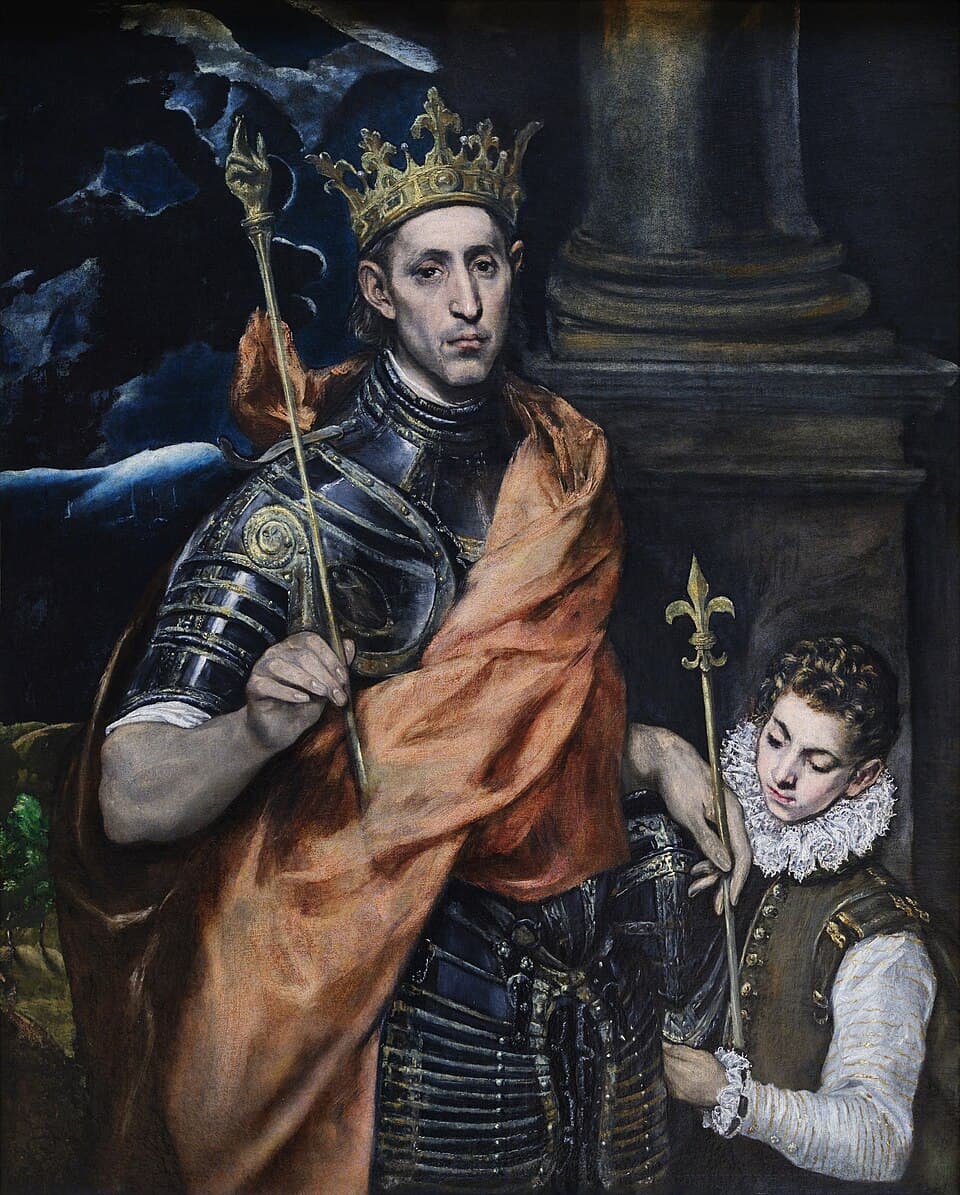
- Patron saint of
- Barbers, grooms and the Secular Franciscan Order 3; Vatican News calls him patron of the Franciscan tertiaries 4
- Born
- Poissy, April 25, 1215, son of Louis VIII and Blanche of Castile 1; Franciscan Media gives 1214 3
- King of France
- From the age of eleven, under his mother's regency until 1234 1
- Married
- Marguerite of Provence, at nineteen; eleven children 1
- Crusades
- Egypt, 1248-1254, where he was captured; Tunis, 1270, where he died 2
- Canonized
- By Boniface VIII, at Orvieto, in 1297 1
Saint Louis IX became King of France at eleven, on the death of his father, and his encyclopedia judges him "above all a lover of peace." 1 He also led two crusades: the first ended with his army surrounded in Egypt and Louis a prisoner, and the second with his death from plague in a camp near Tunis on August 25, 1270. 23 Between the two he fed the poor at his own table, and washed their feet, and French memory still pictures him giving judgment under an oak at Vincennes. 13
A boy king and his mother
Louis was the son of Louis VIII and Blanche of Castile. Goyau's 1910 encyclopedia article has him born at Poissy on 25 April 1215; Franciscan Media gives April 25, 1214. 13 He was eleven when his father died and left him the crown. 1
For eight years his mother ruled for him. Her regency, from 1226 to 1234, was mostly war against great lords: Raymond VII in Languedoc, Pierre Mauclerc in Brittany, Philip Hurepel in the Ile de France, and indecisive fighting with Henry III of England. 1 Raymond's submission at Paris, in front of Notre-Dame, ended the Albigensian war and brought the southern provinces toward union with France under the Treaty of Paris of 1229. 1 Her influence lasted well past his minority. Goyau notes that even when ambassadors were officially received she appeared at his side, until her death in 1253. 1
He kept one thing she said to him for the rest of his life: "I would rather see you dead at my feet than guilty of a mortal sin." 1 At nineteen he married Marguerite of Provence, and they had eleven children. 1
Franciscan Media begins with his coronation oath, by which he bound himself "to behave as God’s anointed, as the father of his people and feudal lord of the King of Peace." Other kings swore the same. "Louis was different in that he actually interpreted his kingly duties in the light of faith." 3
Egypt, and a king for ransom
In 1244 he fell seriously ill, and when news came that Jerusalem had been overrun he resolved to take the cross. 1 Bréhier's article on the crusades dates the vow to December 1244 and adds that, apart from Louis, "no one showed any willingness to lead an expedition to Palestine." 2 Franciscan Media puts his age at 30. 3
He left Paris on 12 June 1248, and Vatican News notes that Queen Margaret sailed with him. 24 The army took Damietta on 7 June 1249 but waited six months before marching on Cairo. On 19 December the advance guard under his brother, Robert of Artois, "began imprudently to fight in the streets of Mansurah and were destroyed." 2 Franciscan Media adds that the army was weakened by dysentery and without support. 3 Louis was cut off and taken prisoner on 5 April 1250. 2
He bought his freedom by giving back Damietta and paying a ransom that Bréhier puts at a million gold bezants. 23 Then he stayed in the East until 1254, bargaining for the release of prisoners and strengthening Acre, Caesarea, Jaffa and Sidon, and went home only when he heard his mother had died. 2 Franciscan Media agrees he stayed four years. 3 Goyau, in his own article, dates this crusade 1248-1249. 1
Goyau also records what paying for it meant. Following the Lateran Council, which forbade kings to tax churches without papal authority, Louis asked successive popes for that authority and used it "to levy quite heavy taxes from the clergy." 1
Justice under the oak
Goyau calls him "a great lover of justice," adding, "French fancy still pictures him delivering judgements under the oak of Vincennes." 1 Under Louis the king's court became a regular court of justice, with experts and commissions sitting at fixed periods, called parlements. 1
Franciscan Media credits him with "extending justice in civil administration": his regulations for royal officials began a series of reform laws, he replaced trial by battle with the examination of witnesses, and he encouraged written records in court. 3 Vatican News likewise names the ban on the judicial duel among his great reforms. 4 Goyau is more cautious. It is "an error" to make him a great legislator, he says, because the so-called Établissements de St. Louis were a private collection of local customs with a few of his ordinances added. 1
Peace was the other half. By the Treaty of Paris in 1258 he gave Henry III fiefs in the south in exchange for Henry renouncing Normandy, Anjou and Poitou and doing homage for Guyenne. 1 Joinville voiced the general opinion that he gave away too much, and Goyau adds that the treaty displeased the English and the French alike. 1 In 1264 he was asked to arbitrate between Henry and the English barons, and decided for the king. 1 Goyau reads the treaties as the work of a king who wanted "not only to put an end to conflicts, but also to remove the causes for fresh wars." 1 Vatican News: "His greatest concern was to pacify, to reconcile with enemies and to extinguish conflicts." 4
He was careful with Rome in both directions. He kept treating the Emperor Frederick II as a sovereign after Innocent IV excommunicated and deposed him, yet in 1247 his measures to defend the pope at Lyons helped make the emperor withdraw. 13 A famous "pragmatic sanction" against papal taxation, once attributed to him, Goyau calls "a forgery fabricated in the fourteenth century." 1
The poor at his table
"The peace and blessings of the realm come to us through the poor," he used to say. Beggars ate from his table and he ate what they left; he washed their feet, looked after lepers, and fed more than a hundred poor people a day. 1 Franciscan Media counts thirteen poor guests at his own meal every day, with many more fed near the palace. In Advent and Lent anyone who came was given a meal, and Louis often served it himself. He kept lists of needy people in every province. 3
He founded hospitals at Pontoise, Vernon and Compiègne, the Quinze-Vingts for three hundred blind men, and a house for women leaving prostitution. 1 He built the Sainte-Chapelle in Paris, which Vatican News describes as "a shrine of light and colored glass" made to hold relics he had acquired from the Byzantine emperor, above all the thorns of Christ's crown. 14
Vatican News says he founded the Sorbonne with Robert of Sorbon in 1257, and liked to have Bonaventure and Thomas Aquinas at his table. 4 Goyau credits the foundation to Robert, "under his patronage." 1
His written instructions to his children, the testimony gathered for his canonization and Joinville's anecdotes show "a man of sound common sense, possessing indefatigable energy, graciously kind and of playful humour, and constantly guarding against the temptation to be imperious." 1 Not everyone was charmed. An envoy of the Count of Gueldre called him a "worthless devotee, hypocritical king," a judgment Goyau thinks "very far from the truth." 1
Tunis
He took the cross again at Paris in March 1267, together with three of his sons, though many knights resisted the call. 2 This time he made for Tunis, whose ruler he hoped to convert. 2 It has been said that his brother Charles of Anjou steered him there for his own ends; Bréhier says Louis tried to thwart his brother's ambitions. 2 Vatican News says he dreamed of converting the Sultan of Egypt, and Franciscan Media that he was "disturbed by new Muslim advances." 34
The army landed at Carthage on 17 July 1270, and plague broke out in the camp. 2 Louis died of it on 25 August. 12 Franciscan Media gives his age as 56. 3
Miracles and healings were reported at his tomb, and the canonization process opened two years after his death. 4 Boniface VIII proclaimed him a saint at Orvieto in 1297. 1 Vatican News counts him among the first lay people canonized through a formal process. 4
What is Saint Louis IX the patron saint of?
Franciscan Media names him patron of barbers, grooms and the Secular Franciscan Order. 3 Vatican News says he is patron of the Franciscan tertiaries and that he is shown with the cross, "the hand of righteousness," and their cord. 4 The Franciscan tie runs through his story: Franciscan Media calls Francis his patron, and says he cared for people with leprosy as Francis had. 3
Neither source calls him patron of France, so this page does not either.
Saint Louis IX's feast day
Praying with Saint Louis
He held the most powerful office in his world and took his mother's sentence about mortal sin into it. 1 What came out was not a gentler king so much as one who kept asking what the office was for. He sat as a judge, and had thirteen poor guests at his own meal every day. 13 The reforms in the courts and the beggars at the table come out of one conviction.
His record is also uneven, and the sources do not hide that. One crusade lost an army and his brother and ended with Louis ransomed; the other killed him in a camp decimated by disease. 23 His own subjects thought the peace he made with England gave too much away. 1 Holiness did not make him right, or lucky, about the things kings decide.
Franciscan Media lingers on his "sense of respect for anyone with whom he dealt, especially the 'humble folk of the Lord.'" 3 He dealt with princes honestly, and hoped, it says, to be treated the same way by the King of Kings, to whom he gave his life, his family and his country. 3 Anyone with authority over others can take that as a measure.
Saint Louis IX, pray for us.
Sources
- 1.Georges Goyau, "St. Louis IX," The Catholic Encyclopedia, Vol. 9 (New York: Robert Appleton Company, 1910).
- 2.Louis Bréhier, "Crusades," The Catholic Encyclopedia, Vol. 4 (New York: Robert Appleton Company, 1908).
- 3."Saint Louis of France," Saint of the Day, Franciscan Media.
- 4."St. Louis, King of France," Saint of the Day, Vatican News.
Saints to turn to next
Others in this collection who are turned to for some of the same things.
- Saint BarnabasFirst centuryWork and vocationPoverty and simplicity
- Saint CajetanOctober 1480 - August 7, 1547Work and vocationPoverty and simplicity
- Saint John Baptist de la SalleApril 30, 1651 - April 7, 1719Work and vocationPoverty and simplicity
- Saint John Francis RegisJanuary 31, 1597 - December 1640Work and vocationPoverty and simplicity