Saint Lorenzo Ruiz
1594 or 1600 - September 1637
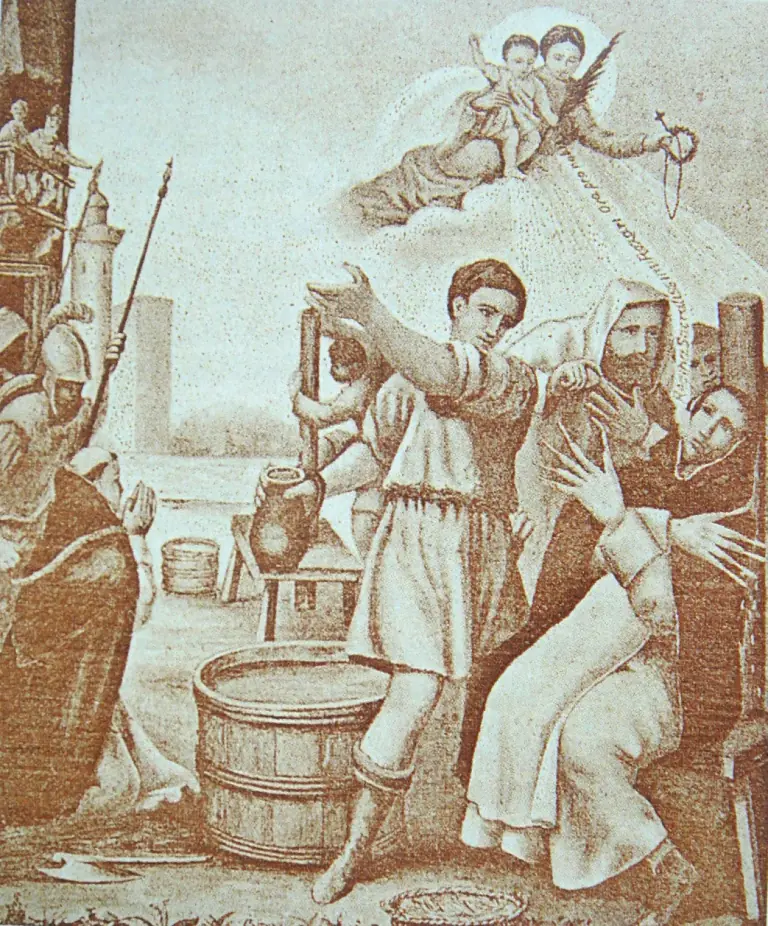
- Born
- In Binondo, Manila, to a Chinese father and a Tagalog mother; 1594 by Vatican News, 1600 by Franciscan Media 134
- Died
- In a pit at Nagasaki after three days hanging, September 1637; the 28th or 29th by Vatican News, the 29th or 30th by Franciscan Media 134
- Beatified
- February 18, 1981, in Manila, by Pope John Paul II 1
Saint Lorenzo Ruiz was a calligrapher from Binondo, in Manila, a husband and the father of three children, who died for the faith at Nagasaki in 1637 and in 1987 became the first Filipino to be canonized. 234 He went to Japan as a fugitive, wanted in a homicide case, and under torture he asked whether giving up the faith would save his life. 34 Before he died he said that if he had a thousand lives he would give them all for God. 13 He is kept on September 28 with fifteen companions martyred in Japan between 1633 and 1637. 235
A calligrapher from Binondo
Lorenzo was born outside the walls of old Manila, in the suburb of Binondo, the son of a Chinese father and a Tagalog mother. 1 Franciscan Media says both parents were Christians and that he learned Chinese and Tagalog from them and Spanish from the Dominicans. 4 The sources do not agree on the year: Vatican News gives 1594, and Franciscan Media heads its page with 1600. 34
He was taught by the Dominicans in their school at Binondo and served in the parish church of Saint Gabriel there, as an altar boy and sacristan in Franciscan Media's account. 14 He was a full member of the Confraternity of the Holy Rosary. 4 For a living he became a calligrapher, copying documents in a fine hand. 34
He married and had two sons and a daughter. 4 Vatican News gives his wife's name as Rosario and describes an ordinary Catholic family, content with its lot. 3
A charge of homicide, and a ship to Japan
What changed his life was an accusation of killing someone, and almost nothing is known about it. Franciscan Media says the only record is a statement of two Dominicans; Vatican News says it is the journal of one Dominican priest. 34 Both quote the same words: he "was sought by the authorities on account of a homicide" at which he was present "or which was attributed to him." 34 Vatican News calls the charge false. 3
He took refuge with three Dominican priests who were about to sail for Japan, where Christians were under violent persecution: Antonio González, Guillaume Courtet (Guillermo in Vatican News and Franciscan Media) and Miguel de Aozaraza. 34 With them went a Japanese priest, Vicente Shiwozuka de la Cruz, and a Japanese layman named Lazaro, a leper. 34 The two accounts differ on what Lorenzo knew. Vatican News says he decided to go with them; Franciscan Media says he learned only once they were at sea that the ship was bound for Japan. 34
They put in at Okinawa, and Franciscan Media records that he could have gone on to Formosa instead. 4 He gave his reason for staying in his own words: "I decided to stay with the Fathers, because the Spaniards would hang me there." 4
Nagasaki, 1637
In Japan they were soon found, arrested and taken to Nagasaki. 4 Vatican News says the Tokugawa shogunate wanted more from the missionaries than their departure: it wanted them to renounce the faith. 3 It says the group was held for two years. 3
The torture is described in both accounts. Water was forced down their throats, then boards were laid across their stomachs and pressed down until the water burst out of mouth, nose and ears. 34 Franciscan Media adds bamboo needles driven under the fingernails. 4 The superior, Father González, died after some days. 34 Shiwozuka and Lazaro broke under it and came near to renouncing Christ, and were brought back by the others. 34
Lorenzo had his own moment. During one session he asked the interpreter, "I would like to know if, by apostatizing, they will spare my life." 34 The interpreter gave no clear answer. 34 Both accounts say that in the hours after, his faith grew strong and he became bold, even audacious, with the men questioning him. 34
The five who were left were hung head down in pits, tightly bound to slow the blood and prolong the dying, with boards around their waists weighted with stones. 34 They hung for three days, and John Paul II says they sang psalms in prison and during the execution. 14 The sources place his profession differently. John Paul II says he told the court that he was a Christian and would give his life for God a thousand times; Vatican News says he spoke the words during that last trial. 13 John Paul II gives them in Tagalog, "Kahit maging sanglibo man / Ang buhay n'yaring katawan," and renders them: "Had I many thousands of lives I would offer them all for him. Never shall I apostatize. You may kill me if that is what you want. To die for God—such is my will." 1 Vatican News has him say, "I am a Catholic, and I wholeheartedly accept death for God. If I had a thousand lives, I would offer them all to Him." 3
Lorenzo and Lazaro died in the pit. 34 The three priests still alive were taken out and beheaded. 34 When the news reached Manila, a Te Deum was sung in the church of Santo Domingo on the evening of December 27, 1637. 1
The fifteen companions
Lorenzo is canonized with fifteen others, men and women martyred in and around Nagasaki between 1633 and 1637. 2 John Paul II named the two men who led the group: Domingo Ibáñez de Erquicia, vicar provincial of the Japanese mission, from Régil in the Spanish Diocese of San Sebastián, and Jacobo Kyuhei Tomonaga, from Kyudetsu in the Diocese of Nagasaki. 1 By his count the companions were nine priests, two professed brothers, two members of the Dominican Third Order, a catechist and a guide-interpreter; nine Japanese, four Spaniards, a Frenchman and an Italian. 1 The canonization homily says the two Third Order members were young women, and that three of the sixteen were laymen engaged in catechesis, Lorenzo and two Japanese. 2
Both of those leaders belonged to the Dominican Province of the Holy Rosary, founded in the Philippines in 1587 for the mission to the Far East, and the Philippines was the place of immediate preparation for eleven of the sixteen. 12 Four taught at the College of Santo Tomás in Manila, one as its rector, and a fifth had studied there. 1
John Paul II quoted several of them. Before the judges at Nagasaki, Courtet summed up their purpose: "We have come to Japan only to preach faith in God and to teach salvation to little ones and to the innocent and to all the rest of the people." 1 Miguel de Aozaraza, looking at Christ's wounds, cried out, "What beautiful carnations, what bloodred roses shed for love of you, my God!" 1 He also named two of the women, Magdalena of Nagasaki and Marina of Omura. 1 In the canonization homily he cited Father Lucas del Espíritu Santo, who wrote that the gift he valued most was to have been sent to that land in the company of such servants of God. 2
Beatified in Manila, canonized in Rome
John Paul II beatified the sixteen at Luneta Park in Manila on February 18, 1981. 1 He called Lorenzo the first beatus of the Philippine nation and compared him to Stephen: as the young church of Jerusalem gave the first martyr, so the church of Manila, founded in 1579, gave its first in Lorenzo. 1 The theme of the papal visit, which he repeated in the homily, was "To die for the faith is a gift to some; to live the faith is a call for all." 1
He canonized them in Saint Peter's Square on October 18, 1987, a Sunday kept as World Mission Day, while the Synod of Bishops was meeting on the vocation of the laity. 2 In the English part of that homily he held Lorenzo up to Philippine families as a "husband and father of three children, who first collaborated with the Dominican Fathers in Manila, and then shared their martyrdom in Nagasaki, and who is now the first canonized Filipino saint." 2
What is Saint Lorenzo Ruiz the patron saint of?
Saint Lorenzo Ruiz's feast day
Saint Lorenzo Ruiz and his companions are kept on September 28. 34 On the calendar of the United States it is an optional memorial, under the English form of his name: Saint Lawrence Ruiz and Companions, Martyrs. 5 The sources do not agree on the day he died; Vatican News gives September 28 or 29, 1637, and Franciscan Media September 29 or 30. 34
Praying with Saint Lorenzo Ruiz
He did not set out to be a missionary. By every account he was a layman with a trade and a family, who left Manila under a charge the records barely describe, and whose reason for staying with the friars at Okinawa was that the Spaniards would hang him in Formosa. 34 The sources leave that as it is, and so does this page.
His question to the interpreter is recorded alongside his last words, by both accounts. 34 He asked whether apostasy would save his life, and got no clear answer. The courage came afterward, and Franciscan Media does not try to explain it, calling it "inexplainable in human terms." 4 Two of the men who died with him had broken under the torture and were brought back by the others. 34
John Paul II read his profession as the completion of the catechesis he had received in the Dominicans' school in Binondo, and pointed to the parish and the family as the place where faith is lived and handed on. 1 The theme of that visit says it plainly: to die for the faith is a gift to some, and to live it is a call for all. 1
Saint Lorenzo Ruiz, pray for us.
Sources
- 1.Pope John Paul II, Homily at the Mass for the Beatification of Lorenzo Ruiz, Manila, February 18, 1981.
- 2.Pope John Paul II, Homily for the Canonization of 16 Martyrs, World Day for Missions, October 18, 1987.
- 3."Sts. Lorenzo Ruiz and Companions, Martyrs," Saint of the Day, September 28, Vatican News.
- 4."Saint Lorenzo Ruiz and Companions," Saint of the Day, Franciscan Media.
- 5."Monday of the Twenty-sixth Week in Ordinary Time," September 28, 2026, with the readings for the Optional Memorial of Saint Lawrence Ruiz and companions, martyrs, Daily Readings, United States Conference of Catholic Bishops.
Saints to turn to next
Others in this collection who are turned to for some of the same things.
- Saint EustaceMartyred at Rome, in 118 by tradition; other accounts give 140 or 188CourageMarriage and familySuffering and illness
- Saint Gianna Beretta MollaOctober 4, 1922 - April 28, 1962Marriage and familyCourageSuffering and illness
- Saint Margaret Clitherowc. 1556 - March 25, 1586CourageMarriage and familySuffering and illness
- Saint Paphnutiusc. 280 - c. 350 or 360CourageSuffering and illnessMarriage and family