Saint Longinus
First century
- In Scripture
- An unnamed soldier, John 19:34 8
- The name
- Tradition; written over the soldier in the Rabbula Gospels of 586, perhaps as a later addition 2
- Historical record
- The Roman Martyrology says he is "venerated as" that soldier 1
- Claimed by
- Lanciano and Mantua, each with its own tradition of his death 3
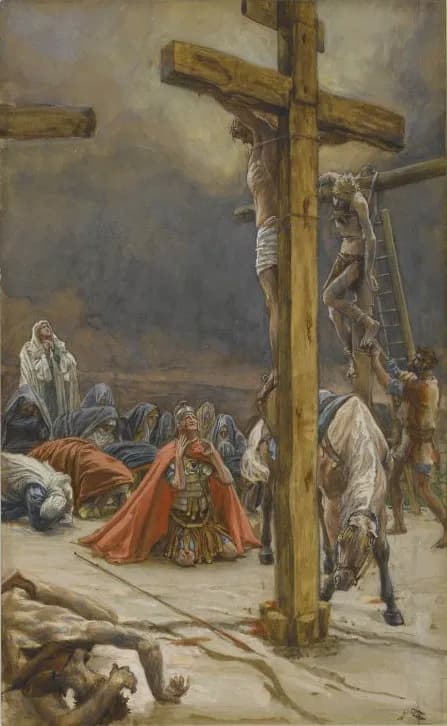
Saint Longinus is the name tradition gives to the Roman soldier who, according to the Gospel of John, pierced the side of the dead Jesus with a lance, so that blood and water flowed out. 18 John does not name him, and almost everything else told about him is legend: the cure of his eyes by a drop of that blood, his conversion, his preaching and his martyrdom. 238 The Church keeps his memory on October 16 with a carefully worded entry in the Roman Martyrology, which speaks of him as the man "venerated as" that soldier. 1
What the Gospel says
John's account is brief. Because the next day was a solemn sabbath, the authorities asked Pilate to have the legs of the crucified men broken and the bodies taken down. The soldiers broke the legs of the two men crucified with Jesus, "but when they came to Jesus and saw that he was already dead, they did not break his legs, but one soldier thrust his lance into his side, and immediately blood and water flowed out." 8 John adds that an eyewitness has testified to it, "so that you also may come to believe," and sees two passages of Scripture fulfilled: "Not a bone of it will be broken," and "They will look upon him whom they have pierced." 8
The notes to the New American Bible explain why John insists on the detail. He probably means to show that Jesus really died, against teachers who said his body was only an appearance, and the blood and water may also point to the Eucharist and to baptism. 8 The soldier himself has no name in the text and does nothing else. 8
Where the name comes from
The name appears centuries later. Herbert Thurston, writing on the Holy Lance in the Catholic Encyclopedia, points to a miniature in the Syriac Gospel book illuminated by a scribe named Rabbula in 586, now in the Laurentian Library in Florence. Over the head of the soldier thrusting his lance into Christ's side, the name is written in Greek letters, LOGINOS - "if, indeed, this is not a later addition." 2 If it is original, Thurston says, the legend that gives the soldier this name is as old as the sixth century. 2
He describes that legend in a single parenthesis: the soldier, "according to the same tradition, was healed of ophthalmia and converted by a drop of the precious blood spurting from the wound." 2 He adds that it is "tempting, even if rash," to suppose the name Longinus is connected with logche, the Greek word for a lance. 2
The soldier and the centurion
Tradition often makes Longinus the centurion as well. Matthew says that the centurion and the men keeping watch with him, terrified by the earthquake, said, "Truly, this was the Son of God!" 9 In Luke the centurion "glorified God and said, 'This man was innocent beyond doubt.'" 10 The notes to Luke say the word can also be translated "righteous." 10 Florentine Bechtel, in the encyclopedia's article on centurions, identifies this officer as the commander of the detachment at the crucifixion, from the imperial cohort stationed at Jerusalem. 7
Catholic Culture joins the two figures. It describes Saint Longinus as "the Roman centurion who pierced the side of Christ with a lance," says he is held to have converted after the darkness that followed Christ's death, and quotes Luke's centurion. 4 The Gospels themselves do not say that the soldier with the lance and the centurion were the same man. 8910 The Martyrology speaks only of the soldier. 1
Lanciano, Mantua and the Precious Blood
Two Italian cities claim him. According to a 2024 report by the Catholic News Agency, Lanciano, in the Abruzzo, says he was born there and martyred there, while Mantua, in Lombardy, says he preached in the region, was martyred there, and brought relics of the Lord's blood and of the sponge used at the Passion to its Basilica of St. Andrew. 3
Mantua still venerates that relic. The diocese's museum describes it as lumps of earth soaked in blood, kept in two reliquaries of crystal and gold called the Sacred Vessels, which by tradition was gathered at the foot of the cross and carried to Mantua by Longinus, "the soldier who pierced Jesus' side." 5 The museum records a second finding of the relic in 1048, before the bishop of Mantua and Beatrice of Canossa, guided by revelations of the Apostle Andrew to a half-blind man, Blessed Adalbert. 5 A fresco of that finding, designed by Giulio Romano and painted by Rinaldo Mantovano, is in the chapel of Saint Longinus. 5
The encyclopedia is more cautious about such relics in general. Joseph Sollier's article on the Precious Blood names Mantua among several places that claim relics of the blood "on the strength of ancient traditions," and adds that "it is often difficult to tell whether the traditions are correct." 6
The Holy Lance
The weapon has a longer documented history than the man. Thurston traces a lance venerated at Jerusalem from the pilgrim Antoninus of Piacenza, about 570, through the Persian capture of the city in 615, when its broken point was taken to Constantinople. 2 That point passed to Saint Louis in 1244 and was kept in the Sainte-Chapelle in Paris until it disappeared after the French Revolution. 2 The larger part, after centuries at Constantinople, was sent in 1492 by the Sultan Bajazet to Pope Innocent VIII, and has stayed in Rome under the dome of St. Peter's ever since. 24
Thurston does not hide the doubts. Its authenticity was questioned in Rome when it arrived, because rival lances were known at Nuremberg, Paris and elsewhere, and he lists others at Vienna, Echmiadzin in Armenia and Cracow. 2 Benedict XIV, he notes, compared a drawing of the Paris point with the Roman relic and was satisfied the two had once been a single blade. 2
Longinus stands beside it. Gian Lorenzo Bernini's statue of him, completed in 1638, fills one of the four niches in the great piers that hold up Michelangelo's dome. 3 CNA describes the Lenten liturgy at which the canons of St. Peter's still show the relic of the lance to the faithful. 3
What is Saint Longinus the patron saint of?
Saint Longinus's feast day
Saint Longinus's feast day is October 16. The Roman Martyrology commemorates him at Jerusalem on that day, and Catholic Culture lists him among the saints of October 16. 14 CNA reports that his feast was historically celebrated on March 15, and that the Martyrology's entry for October 16 makes no mention of martyrdom. 3
Praying with Saint Longinus
Start with the one thing John says. A soldier, doing his job at the end of a long day, made sure a condemned man was dead. 8 It was routine. John saw blood and water and Scripture fulfilled, and he wrote it down so that his readers might believe. 8
Everything after that is the Church's memory working on a man without a name. Tradition gave him one, and a story in which the blood he spilled healed his eyes and changed his life. 2 The Martyrology is honest about it and says only that he is venerated as that soldier. 1 What it keeps is the figure at the foot of the cross, and the wound.
John quotes the prophet: "They will look upon him whom they have pierced." 8 In the tradition Longinus is the man who made the wound and then looked, and the centurion in Matthew, looking at the same cross, said, "Truly, this was the Son of God!" 89 Whether or not they were one man, the tradition keeps putting them in the same place, and it is a place anyone can stand.
Saint Longinus, pray for us.
Sources
- 1.Roman Martyrology, entry for October 16, "San Longino, soldato," as printed in "Santo del giorno," Conferenza Episcopale Italiana (in Italian).
- 2.Herbert Thurston, "The Holy Lance," The Catholic Encyclopedia, Vol. 8 (New York: Robert Appleton Company, 1910).
- 3.Jacob Stein, "Vatican unveils the Holy Lance: a solemn tribute to soldier of faith St. Longinus," Catholic News Agency, March 1, 2024, as published by Catholic World Report.
- 4."Thursday of the Twenty-Eighth Week in Ordinary Time," Liturgical Year, October 16, 2025, Catholic Culture (section "St. Longinus").
- 5."Saletta del Preziosissimo," gallery notes, Museo Diocesano Francesco Gonzaga, Mantua (in Italian and English).
- 6.Joseph Sollier, "Precious Blood," The Catholic Encyclopedia, Vol. 12 (New York: Robert Appleton Company, 1911).
- 7.Florentine Bechtel, "Centurion," The Catholic Encyclopedia, Vol. 3 (New York: Robert Appleton Company, 1908).
- 8.John 19. Bible, United States Conference of Catholic Bishops.
- 9.Matthew 27. Bible, United States Conference of Catholic Bishops.
- 10.Luke 23. Bible, United States Conference of Catholic Bishops.
Saints to turn to next
Others in this collection who are turned to for some of the same things.