Saint Leopold Mandić
May 12, 1866 - July 30, 1942
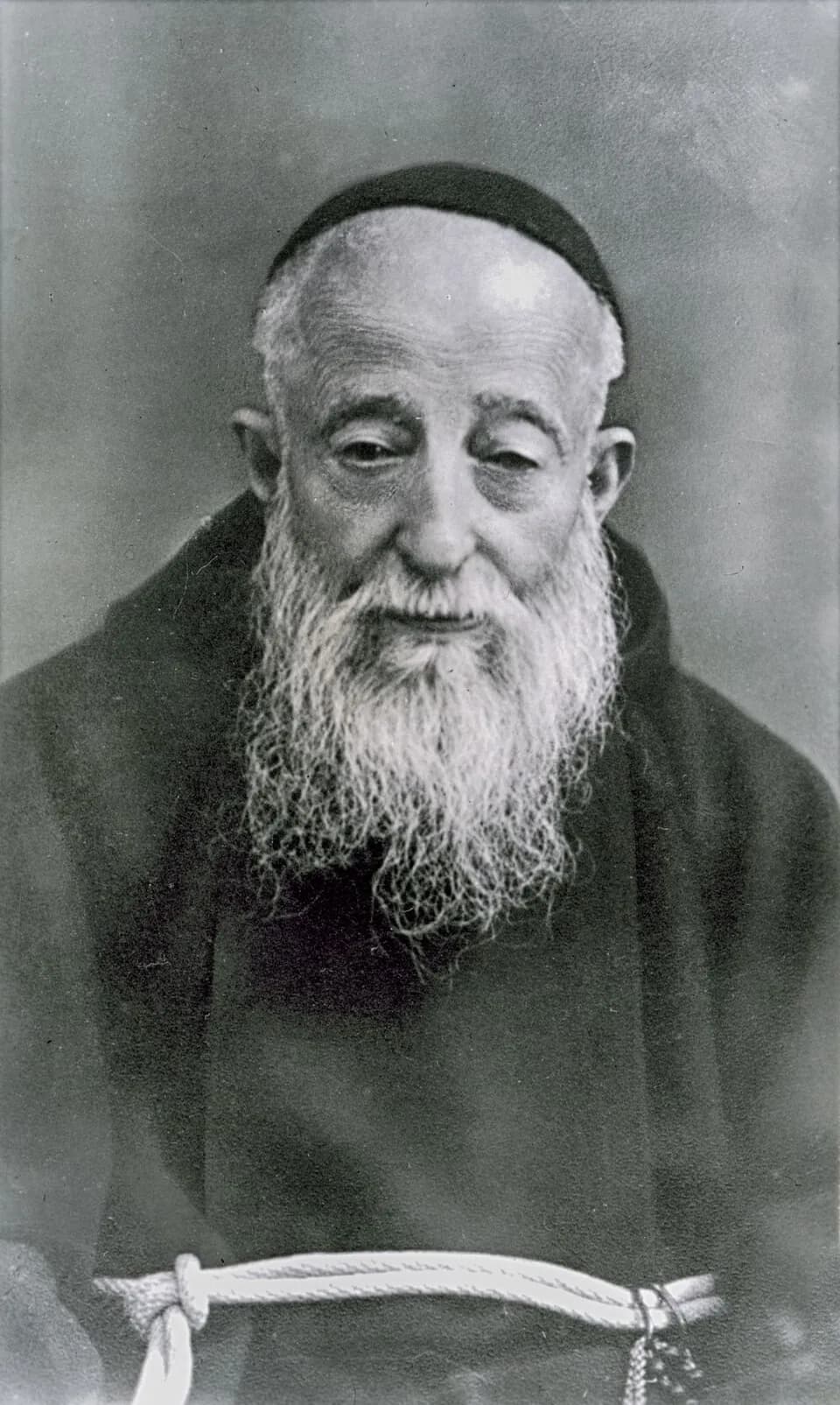
- Feast day
- May 12 (Franciscan Media, the Capuchin Province of St. Mary, Catholic News Agency); Franciscan Media adds that in the Roman liturgy it is July 30 127
- Religious name
- Leopold, taken with the Capuchin habit at Bassano del Grappa, May 2, 1884 3
- Ordained
- September 29, 1890, in Venice 3
- Patronage
- Cancer patients, in the words of Pope Francis 8
Saint Leopold Mandić was a Capuchin friar from the Adriatic coast who wanted to be a missionary to the Orthodox East and was instead kept for more than thirty years in a small confessional in Padua, where he heard confessions for most of every day. 13 He could not speak loudly enough to preach, and the people who came to him included bishops. 1 Pope Francis, sending out the missionaries of mercy in 2016, gave them two models: "St Leopold and St Pio." 6
Bogdan, the twelfth child
He was born on May 12, 1866, at Castelnovo, the town now called Herceg Novi, near the mouth of the Bay of Kotor on the Adriatic, and baptized Bogdan. 23 He was the last of twelve children. 23 The Capuchin Province of St. Mary describes a Croatian family that had once been wealthy and had lost nearly everything, and says that this gave him a lasting compassion for people who fell on hard times. 2 Franciscan Media calls him simply a native of Croatia. 1
CapDox, the Australian Capuchins' library, names his parents as Peter Mandić and Carlotta Zarević, both Catholics, and records what he said of his mother: "She had an extraordinary piety. I am particularly indebted to her for what I am." 3 The Province adds one memory from childhood that it says shaped everything after: a harsh experience in confession as a boy, which made him want to show penitents the gentleness and compassion of God. 2
He suffered all his life from a pronounced stutter. 37 Catholic News Agency lists abdominal pains and chronic arthritis that left him stooped, with gnarled hands; Franciscan Media adds poor eyesight and a stomach ailment, and says he could not speak loudly enough to preach publicly. 17
A Capuchin who wanted to go east
At sixteen, in November 1882, he left home for the Capuchin seminary at Udine. 3 He received the habit and the name Leopold at Bassano del Grappa on May 2, 1884, studied philosophy in Padua and theology in Venice, and was ordained there on September 29, 1890. 37
CapDox dates the idea that governed his life to June 18, 1887, when, as he wrote himself, he first heard God speak to him about the return of the Orthodox to Catholic unity. 3 As soon as he was ordained he asked to be sent as a missionary to Eastern Europe. 3 The answer was no, and it stayed no: CapDox says his superiors thought his stutter too severe, and Catholic News Agency says they refused because of his poor health. 37 Franciscan Media puts it in one line: "His health never permitted it." 1 He kept renewing his vow to go to the Eastern Christians, and the cause of unity stayed in his prayers. 1 The Province calls him the "Apostle of Unity." 2
The next twenty years moved him from house to house. CapDox follows him through seven years in Venice, three in Zara, five in Bassano, a year in Koper, and three at the shrine of the Madonna dell'Olmo at Thiene, where three young workmen played a hoax on him and he was taken off confessional duty for a time. 3 In 1909 he was sent to Padua to direct the young friars and teach patrology, the study of the Church Fathers. 13
The cell at Santa Croce
From 1914, released from directing the students, he gave himself almost entirely to the confessional at the Capuchin friary of Santa Croce in Padua. 3 His heart stayed on the other side of the Adriatic, CapDox says, and for that reason he would never take Italian citizenship. 3 During the First World War, as a Habsburg subject, he was sent away to southern Italy for 1917 and 1918. 37
In 1923 he was assigned as confessor at Zara, which CapDox calls an immense joy to him. 3 It lasted a matter of months. Penitents in Padua went to Bishop Elia Dalla Costa, and the provincial called him back that November. 3 He stayed in Padua for the rest of his life. 37
The room was about two meters by three, with one small window onto a narrow yard. 3 People came from every walk of life: learned and unlettered, priests and religious, and, by Franciscan Media's account, several bishops looking for spiritual advice. 137 How long he sat there each day depends on the source: ten to twelve hours by CapDox's count, up to fifteen by Catholic News Agency's, thirteen to fifteen by Franciscan Media's. 137 In a letter of January 13, 1941, he wrote: "Any soul that needs my ministry will be an East for me." 3
Word of his mercy spread quickly, Catholic News Agency says. 7 CapDox records what he told penitents: "Stay calm, put everything on my shoulders. I will look after it." 3 It also records that he took fasts, night vigils and other penances on himself for them. 37 Not everyone approved. Catholic News Agency reports that he was accused of ignorance or of being too lenient, and gives his answer: "Should the Crucified blame me for being lenient, I would answer Him: Lord, you gave me this bad example. I have not yet reached the folly of your having died for souls." 7
His death, and the cell that stood
His health failed from the autumn of 1940, and in April 1942 he was taken to the hospital. 3 He had cancer of the esophagus, which CapDox says he did not know, and he went back to hearing confessions in the friary. 37 On July 29 he heard confessions without a break and spent the night in prayer. 3 The next morning he collapsed while preparing for Mass, was anointed, and died while reciting, by CapDox's account, or singing, by Catholic News Agency's, the last words of the Salve Regina. 37 Franciscan Media and CapDox date his death July 30, 1942; the Capuchin Province of St. Mary gives July 31. 123
CapDox reports that he had foretold the bombing of Santa Croce: the church and the friary would be hit, he said, "but not the little cell. Here God has shown so much mercy to souls that it must remain as a monument to His goodness." 3 When the friary was bombed on May 14, 1944, CapDox says, the cell was spared. 3
Paul VI beatified him on May 2, 1976, and John Paul II canonized him in Rome on October 16, 1983. 234 Franciscan Media gives the canonization as 1982; the papal homily is dated 1983. 14
In February 2016, for the Jubilee of Mercy, Pope Francis asked for his relics to be brought from Padua to Rome, and they arrived at the Basilica of St. Lawrence Outside the Walls on February 3 together with those of Saint Pio of Pietrelcina. 7 Preaching to the Capuchins in St. Peter's on February 9, Francis spoke of their "charism of confessors" and of "long hours there, seated, like those two [St Leopold and St Pio]." 5 The same day he told the missionaries of mercy that among the Italians there was a Capuchin who "really resembles St Leopold: small, bearded." 6 In 2026 Pope Leo XIV named him again, Vatican News reports, among the priests who became saints in the confessional. 9
What is Saint Leopold Mandić the patron saint of?
Pope Francis called him the patron saint of cancer patients. Addressing the Italian League for the Fight Against Cancer in March 2022, he said: "May you be accompanied from heaven by Saint Leopold Mandić — a great man, the patron saint of cancer patients. A patron also of 'spiritual cancer', because he confessed and forgave all." 8 He died of cancer himself. 37
He is often described as a patron of confessors, but none of the sources consulted here says so, and this page does not claim it.
Saint Leopold Mandić's feast day
His feast is kept on May 12, his birthday. Franciscan Media lists him as its Saint of the Day for May 12, the Capuchin Province of St. Mary heads its page for him with that date, and Catholic News Agency says his feast is celebrated on May 12. 127
Franciscan Media also states that "in the Roman liturgy his feast is celebrated on July 30," the day he died. 1 Both dates are given here, as the sources give them.
Praying with Saint Leopold Mandić
The thing he most wanted was never given to him. He asked again and again to go east, and was refused because of a stammer and a weak body. 13 What the sources record is that he did not stop wanting it. He renewed the vow, kept praying for unity, refused Italian citizenship and was sent into exile for it, and decided that any soul who needed him would be "an East" for him. 13
His work was sitting still in a small room and listening. 3 The sources do not describe great deeds, and they say plainly that he could not preach. 1 What they describe is the same task done for ten or fifteen hours a day for some thirty years, by a man who was often in pain. 137
He also knew what a bad confession was like. The Province traces his gentleness to a harsh confession he made as a child. 2 Pope Francis, preaching to the Capuchins in 2016 and through them to all confessors, asked them to let a penitent "find a father who embraces them." 5
Some thought him too lenient, and he answered by pointing to the cross. 7 He did not resolve the argument, and neither do the sources; they record the charge and his reply side by side. 37
Saint Leopold Mandić, pray for us.
Sources
- 1."Saint Leopold Mandic," Saint of the Day for May 12, Franciscan Media.
- 2."Saint Leopold Mandic of Castelnovo: May 12," Saints and Blesseds, Province of St. Mary of the Capuchin Order.
- 3."Saint Leopoldo Mandic, Capuchin priest (1866-1942)," CapDox, Capuchin Franciscan Friars Australia.
- 4.John Paul II, Homily for the Canonization of Father Leopold of Castelnovo, Sunday, October 16, 1983 (Italian text; cited for the date only).
- 5.Francis, Homily at Holy Mass for the Capuchin Friars Minor, Vatican Basilica, February 9, 2016.
- 6.Francis, Address at the Meeting with the Missionaries of Mercy, Sala Regia, February 9, 2016.
- 7.Elise Harris, "Crippling disease brought this priest to the confessional - and then sainthood," Catholic News Agency, first published February 6, 2016.
- 8.Francis, Address to the Italian League for the Fight Against Cancer, Clementine Hall, March 4, 2022.
- 9."Pope: Do Christians responsible for war examine their conscience?," Vatican News, March 2026.
Saints to turn to next
Others in this collection who are turned to for some of the same things.
- Saint Camillus de Lellis1550 - July 14, 1614Suffering and illnessConversionWork and vocation
- Saint John of Duklac. 1414 - September 29, 1484Suffering and illnessWork and vocationConversion
- Saint Peter Chanel1802 or 1803 - April 28, 1841Suffering and illnessWork and vocationConversion
- Saint FiacreLate sixth century - August 18, c. 670Work and vocationSuffering and illness