Saint John of Dukla
c. 1414 - September 29, 1484
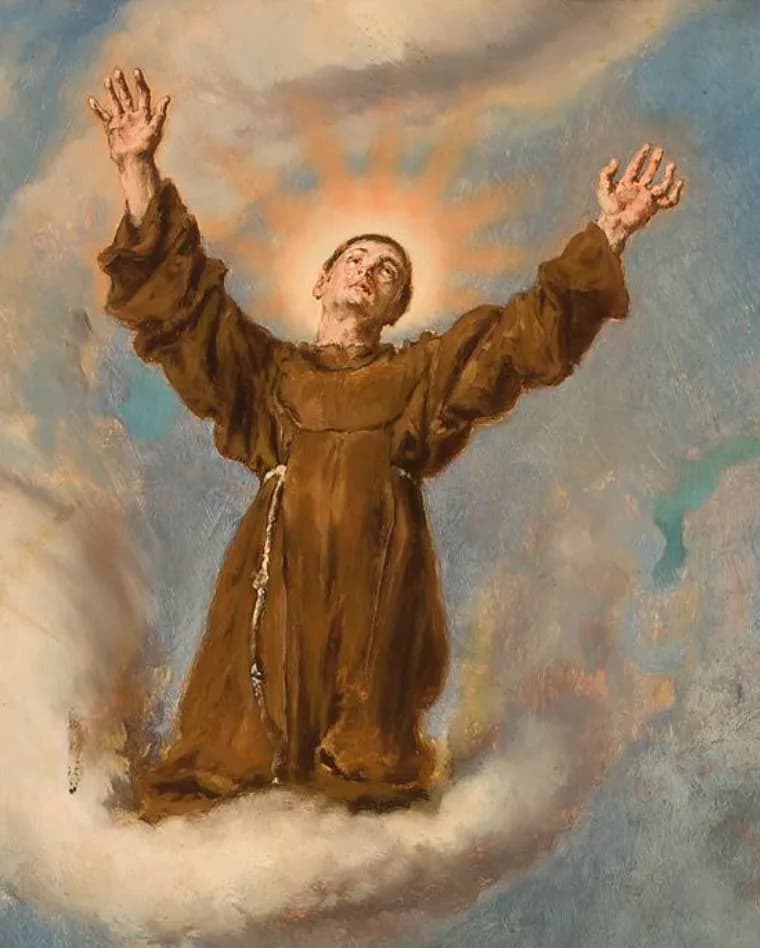
- Patron saint of
- Poland and Lithuania, as one of their patrons; the city of Lviv and the country around it 14
Saint John of Dukla was a fifteenth-century Polish Franciscan who began as a hermit in the hills near his birthplace and spent most of his life preaching and hearing confessions in Lviv, and who kept doing both after he went blind. 124 He is one of the patrons of Poland and Lithuania and of the city of Lviv. 14 John Paul II canonized him at Krosno, near Dukla, on June 10, 1997, and his feast is July 10. 145
Dukla, Krakow and the hermitage
John was born about 1414 in Dukla, a small town in the Beskid Mountains of southeastern Poland. 45 The New Catholic Encyclopedia says his family was middle class. 4 He studied at Krakow, at the university that Queen Jadwiga had completed with a faculty of theology; John Paul II counted him among the many young men of the fourteenth and fifteenth centuries drawn there by that faculty, who then "went eastwards." 145
Before he was a friar he was a hermit. 45 John Paul II, at his tomb, said that his life "began in the nearby hermitage," and that "it was precisely there, in silence and in spiritual struggles, that 'God seized him'." 2 The Pope remembered visiting, years before, the chapel the local people called Blessed John's chapel "in the wilderness." 2 Among those mountains, he said, John "learnt ardent prayer." 2
Franciscan in Lviv
He joined the Conventual Franciscans at Lviv, which the New Catholic Encyclopedia dates to 1440, and was ordained there. 45 Lviv, also called Lemberg and Lvov, was a city closely tied to Poland, and it became the place of his life's work. 15 He served as guardian, the local superior of the friary. 45
He came into an order that was by then well rooted in Poland. 1 John Paul II told the crowd at Krosno that the sons of Saint Francis had arrived in the thirteenth century and found "fertile soil" there, and that to "the tradition of evangelical poverty and simplicity of life they added knowledge and wisdom, which in turn had an effect on their pastoral work." 1 He presented John as one of that line, a friar who was also, as he put it in a later audience, "connected with academic life at the University of Kraków." 13
At the instigation of Saint John of Capistrano, the encyclopedia says, he moved in 1463 to the Observant Franciscans, known in Poland as the Bernardines. 4 John Paul II says the same in his own words: his faith bore fruit first "within the walls of the Conventual Franciscan monastery, and then with the Bernardine Fathers, where he spent the last part of his life." 2 Catholic Ireland is more cautious and says only that he "may have joined the Observants," at a time when there were efforts to unite the two branches. 5
Preacher and confessor
His fame was as "a wise preacher and zealous confessor", a phrase John Paul II and Catholic Ireland both use. 25 "There crowded round him people hungry for sound doctrine of God," the Pope said, some to hear him preach and others "at the confessional grill, to seek comfort and counsel." 2 The New Catholic Encyclopedia lists his hallmarks as "impassioned preaching, pastoral zeal, ardent prayer, patience, and charity." 4
The sources differ on how far he traveled. 45 The encyclopedia says he was a successful missioner in Galicia, especially among the Ruthenians, whom it calls schismatics, and the German burghers of Lviv. 4 Catholic Ireland says he preached in Lviv and also in Moldavia and Belarus, that he constantly worked to reconcile those separated from the Church, and that his life was marked by poverty, obedience, asceticism and devotion to Our Lady. 5
Blind and still working
He lost his sight in old age; Catholic Ireland says when he was seventy. 45 He did not stop. 245 "The written accounts say that despite old age and his loss of sight he continued to work," John Paul II said at Dukla, "and asked to have his sermons read for him, so as to be able to go on." 2 He would "grope his way to the confessional so as to be able to convert people and lead them to God." 2
He died at Lviv in 1484, on September 29 according to the New Catholic Encyclopedia. 45 He was buried in the city, and the encyclopedia says that in 1945 his body was moved to Rzeszów and then to the Franciscan church at Dukla. 4 The Bernardine friars there keep his relics. 2
Beatification and canonization
Pope Clement XII beatified him in 1733. 45 The New Catholic Encyclopedia says the canonization was then held up by the partition of Poland. 4 On June 9, 1997, John Paul II prayed at his tomb in Dukla, and on June 10, the last day of that journey, he canonized him at Krosno, in the Archdiocese of Przemyśl, before about a million people, by Catholic Ireland's count. 235
The Pope said he was grateful that the canonization could take place where John was born, in the small, ancient town at the foot of Mount Cergowa, and recalled tramping those mountains as a young man with a heavy knapsack. 1 He thanked the Lord in an audience the following week "for allowing me to honour his memory at his birthplace." 3 Of the region he said that John "not only made this beautiful land of Bieszczady famous, but above all he made it holy." 1
In the homily the Pope called him "this spiritual son of Saint Francis," and summed up his life in Christ's words, "He who is greatest among you shall be your servant." 1 "Jesus Christ was his only master," he said; "imitating without reserve the example of his Master and Lord, he desired above all else to serve." 1
What is Saint John of Dukla the patron saint of?
Saint John of Dukla's feast day
Praying with Saint John of Dukla
He began alone, in a hermitage, and spent the rest of his life surrounded by people. 24 John Paul II saw no break between the two: the faith learned in silence later bore fruit "no longer in solitude, in the hermitage, but within the walls" of a friary. 2
His work was the ordinary work of a priest, preaching and hearing confessions, done for a long time in one city. 124 The Pope said that the people of Lviv came to him for comfort and counsel, and that he became "a guide of souls and prudent adviser of many." 2
Blindness took away his reading, and so he had others read his sermons aloud and felt his way to the confessional. 24 None of the sources consulted says his sight was restored. 245 He worked on with the body he had, and Catholic Ireland says he brought many back to the Church in those last years. 5
At Dukla the Pope located the root of it all in faith, which "was his source of strength, thanks to which he was able to refuse everything that was material and temporal in order to devote himself to what was of God and the spirit." 2
Saint John of Dukla, pray for us.
Sources
- 1.Pope John Paul II, Homily at the Canonization of Blessed John of Dukla, Krosno, June 10, 1997.
- 2.Pope John Paul II, Address on his Visit to the Tomb of Blessed John of Dukla, Dukla, June 9, 1997.
- 3.Pope John Paul II, General Audience, June 18, 1997, on his pilgrimage to Poland.
- 4."John of Dukla, St.," New Catholic Encyclopedia, 2nd ed. (Detroit: Gale, 2003), via Encyclopedia.com.
- 5."Jul 10 - St John of Dukla (1414-84) Polish Franciscan friar," Saints of the Day, Catholicireland.net.
- 6."Franciscan Saints, Blesseds, and Feasts," National Fraternity of the Secular Franciscan Order, USA, 2023.
Saints to turn to next
Others in this collection who are turned to for some of the same things.
- Saint Aelred of Rievaulx1109 - January 12, 1166 (or 1167)PrayerWork and vocationSuffering and illness
- Saint Alphonsus Rodriguez1532 or 1533 - October 1617PrayerWork and vocationSuffering and illness
- Saint André BessetteAugust 9, 1845 - January 6, 1937PrayerSuffering and illnessWork and vocation
- Saint Andrew Avellino1521 - November 10, 1608ConversionWork and vocationPrayer