Saint Leonard of Port Maurice
December 20, 1676 - November 26, 1751
- Parents
- Domenico Casanova and Anna Maria Benza 1
- Beatified
- June 19, 1796, by Pope Pius VI 1
- Canonized
- June 29, 1867, by Pope Pius IX 1
- Patron saint of
- Preachers of parish missions, so declared by Pope Pius XI 3
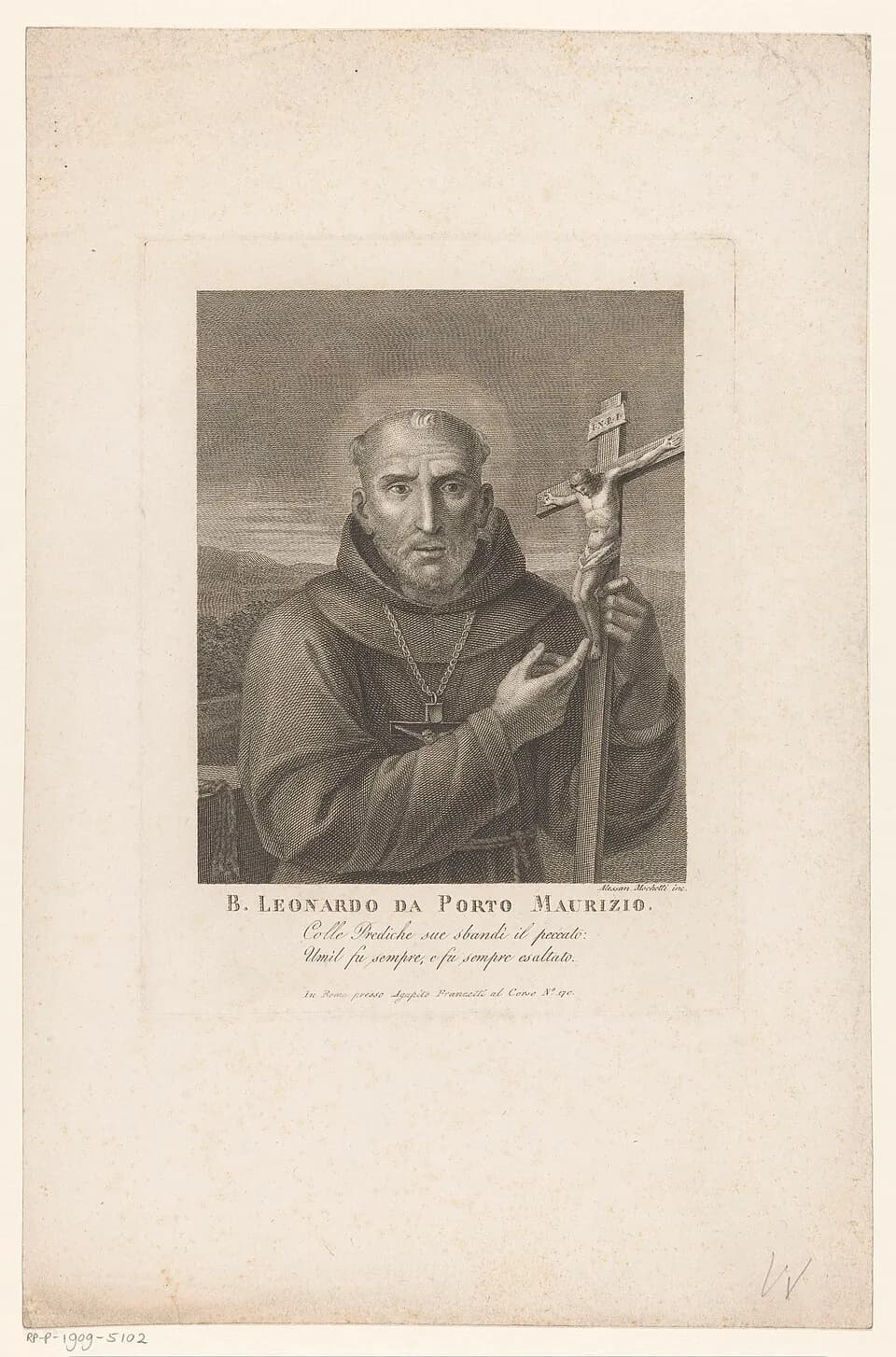
Saint Leonard of Port Maurice was a Franciscan friar who spent some forty years preaching parish missions across Italy, often in the open air because the churches could not hold the crowds. 134 He is the reason the Way of the Cross was set up in the Colosseum in Rome, and he put up hundreds of other sets of Stations wherever he preached. 124 Pius XI declared him patron of preachers of parish missions, and his feast is November 26. 36
From the Riviera to the Palatine
He was born on December 20, 1676, at Porto Maurizio on the Riviera di Ponente, then part of the Republic of Genoa. 13 His parents were Domenico Casanova and Anna Maria Benza, and Monti says his father was a ship captain. 13 At thirteen he was sent to live with an uncle in Rome. 3 The encyclopedia says he made "a brilliant course of study" with the Jesuits at the Collegio Romano; Monti says he studied at the Jesuit college and the Gregorian University to prepare for a career in medicine. 13
Instead he joined the Franciscans, in a strict reform branch the encyclopedia calls the Riformella, and received the habit on October 2, 1697. 1 He made his novitiate at Ponticelli in the Sabine hills and finished his studies at San Bonaventura on the Palatine, the principal house of the Riformella in Rome, where he stayed on to teach after his ordination. 1 Monti dates the ordination to 1703. 3
He hoped to be sent to China. 13 Monti says he was turned down because of his frail health; the encyclopedia says he was struck by a severe gastric hemorrhage and became so ill that he was sent home to Porto Maurizio in 1704. 13 It took four years for him to recover, and when he did he began to preach in his hometown and the country around it. 1 Friedman puts it simply: "Frustrated by illness in his dream to be a foreign missionary, he took up preaching throughout Italy." 4
Forty years of missions
Cosimo III de' Medici handed a friary on the hill of San Miniato above Florence to Leonard's branch of the order, and Leonard was sent there. 1 Monti says the friary of San Salvatore al Monte was his home for the first decades of his ministry. 3 From there he gave missions across Tuscany, which the encyclopedia says "were marked by many extraordinary conversions." 1 In 1710 he founded a retreat house on a mountain about four miles from Florence, where he and his companions could withdraw between missions to pray and do penance. 1
A parish mission in his day was a week or more of sermons and confessions in one place. 4 From 1720 he took them beyond Tuscany into central and southern Italy, and the encyclopedia says that "everywhere the saint made abundant conversions," often preaching outdoors because no church was big enough. 1 After 1736, according to Monti, he was based in Rome. 3 Both Clement XII and Benedict XIV called on him, and Benedict XIV, who thought highly of him, made him promise to come back to Rome to die. 1 Alphonsus Liguori called him "the great missionary of the (18th) century." 3
From May to November 1744 he preached in Corsica, then ruled by Genoa and, in the encyclopedia's words, "frightfully torn by party strife." 1 The missions were hard on the missionaries as well. The encyclopedia says he and his companions kept "the greatest austerities and most severe penances" while they preached. 1
The Way of the Cross
He promoted several devotions: the Sacred Heart, perpetual adoration of the Eucharist, and the Immaculate Conception, which he longed to see defined as a dogma and promoted before it was. 134 The one he is remembered for is the Way of the Cross. 14
He set up Stations wherever he preached, and the sources count them differently. The encyclopedia says that besides the Colosseum he erected "571 others in all parts of Italy"; Friedman gives 572 locations including the Colosseum; Copeland says "nearly 600"; and Monti says "over 500." 1345 The Stations in the Colosseum were set up by Benedict XIV "at the instance of St. Leonard of Port Maurice," the encyclopedia says, and stayed until February 1874, when they were taken down by order of a Commendatore Rosa. 2 Friedman notes that the pope now leads the Way of the Cross there in Holy Week, and that the custom "would have pleased" Leonard. 4
Father Jim Sabak, a Franciscan historian interviewed for Copeland's article, reads the devotion as Leonard's answer to a divided Christianity: "to remember this man, Jesus, who died, who was more important than the conflicting ideas between the Catholics and reformers." 5
His writings and his death
He wrote sermons, letters and books of devotion for lay people and for priests, especially missionaries. 1 Among them were a guide to the Way of the Cross; "Il Tesoro Nascosto," on the Mass, known in English as "The Hidden Treasure"; and his resolutions for a more perfect Christian life. 13 One passage Monti quotes reads: "God has wanted and still wants our salvation so much that he died of desire: he suffered death to give us life." 3
In November 1751 he was preaching in Bologna when Benedict XIV called him to Rome, since there were signs that he was near the end. 1 He reached San Bonaventura on the Palatine on the evening of November 26 and died there that night at eleven o'clock. 1 The encyclopedia gives his age as seventy-five; by his dates he was a few weeks short of it. 1 "The strain of his missionary labours and his mortifications had completely exhausted his body," it says. 1
Pius VI beatified him on June 19, 1796, and Pius IX canonized him on June 29, 1867. 1 In 1910 the encyclopedia described his body, "partly incorrupt," under the high altar of San Bonaventura; Monti says that since 1996 his remains have rested in the cathedral of Porto Maurizio, now part of the city of Imperia. 13
What is Saint Leonard of Port Maurice the patron saint of?
Saint Leonard of Port Maurice is the patron saint of preachers of parish missions. Monti writes that "Pius XI declared him the patron of all those preaching parish missions." 3
Saint Leonard of Port Maurice's feast day
Saint Leonard of Port Maurice's feast day is November 26, the day he died, as Vatican News lists it and as Monti says Franciscans around the world keep it. 36 The 1910 Catholic Encyclopedia gives the same day for the Franciscan Order and adds that "outside this order it is often celebrated on 27 November." 1
Praying with Saint Leonard of Port Maurice
The life he wanted was in China, and his health ruled it out. 13 He spent four years recovering at home before he preached at all. 1 What came after, four decades of missions in his own country, was work he took up because the first plan had failed. 34
He preached to crowds too big for churches, and the method he spread was a simple one that anybody could use in their own parish: fourteen stops along the road to Calvary. 145 Friedman suggests the plainest response to him, which is to go and make the Stations. 4
Monti quotes Leonard on the will of God that all people be saved. It is not, Leonard wrote, "an affected and superficial will in God; it is a real, effective, and beneficial will; for God provides each of us with all the means most proper for us to be saved." 3 He preached for forty years as if he believed it. 3
He died the way the pope had made him promise, back in the house where he had entered the order, on the night he arrived. 13
Saint Leonard of Port Maurice, pray for us.
Sources
- 1.Michael Bihl, "St. Leonard of Port Maurice," The Catholic Encyclopedia, Vol. 9 (New York: Robert Appleton Company, 1910).
- 2.Maurice Hassett, "The Coliseum," The Catholic Encyclopedia, Vol. 4 (New York: Robert Appleton Company, 1908).
- 3.Dominic Monti, OFM, "Saint Leonard of Port Maurice: Preacher of Parish Missions," Commission on the Franciscan Intellectual Tradition, November 26, 2021.
- 4.Greg Friedman, OFM, "Lent with the Saints: Leonard of Port Maurice," Franciscan Spirit, Franciscan Media, March 31, 2020.
- 5.Stephen Copeland, "The Franciscan Connection to the Stations of the Cross," St. Anthony Messenger, Franciscan Media, April 2023.
- 6."St. Leonard of Porto Maurizio, Franciscan," Saint of the Day, November 26, Vatican News.
Saints to turn to next
Others in this collection who are turned to for some of the same things.
- Saint Andrew Avellino1521 - November 10, 1608ConversionWork and vocationPrayer
- Saint Anthony Zaccaria1502 - July 5, 1539Work and vocationConversionPrayer
- Saint Bernardine of SienaSeptember 8, 1380 - May 20, 1444ConversionWork and vocationPrayer
- Saint John EudesNovember 14, 1601 - August 19, 1680PrayerWork and vocationConversion