Saint Leocadia of Toledo
d. December 9, c. 303-304
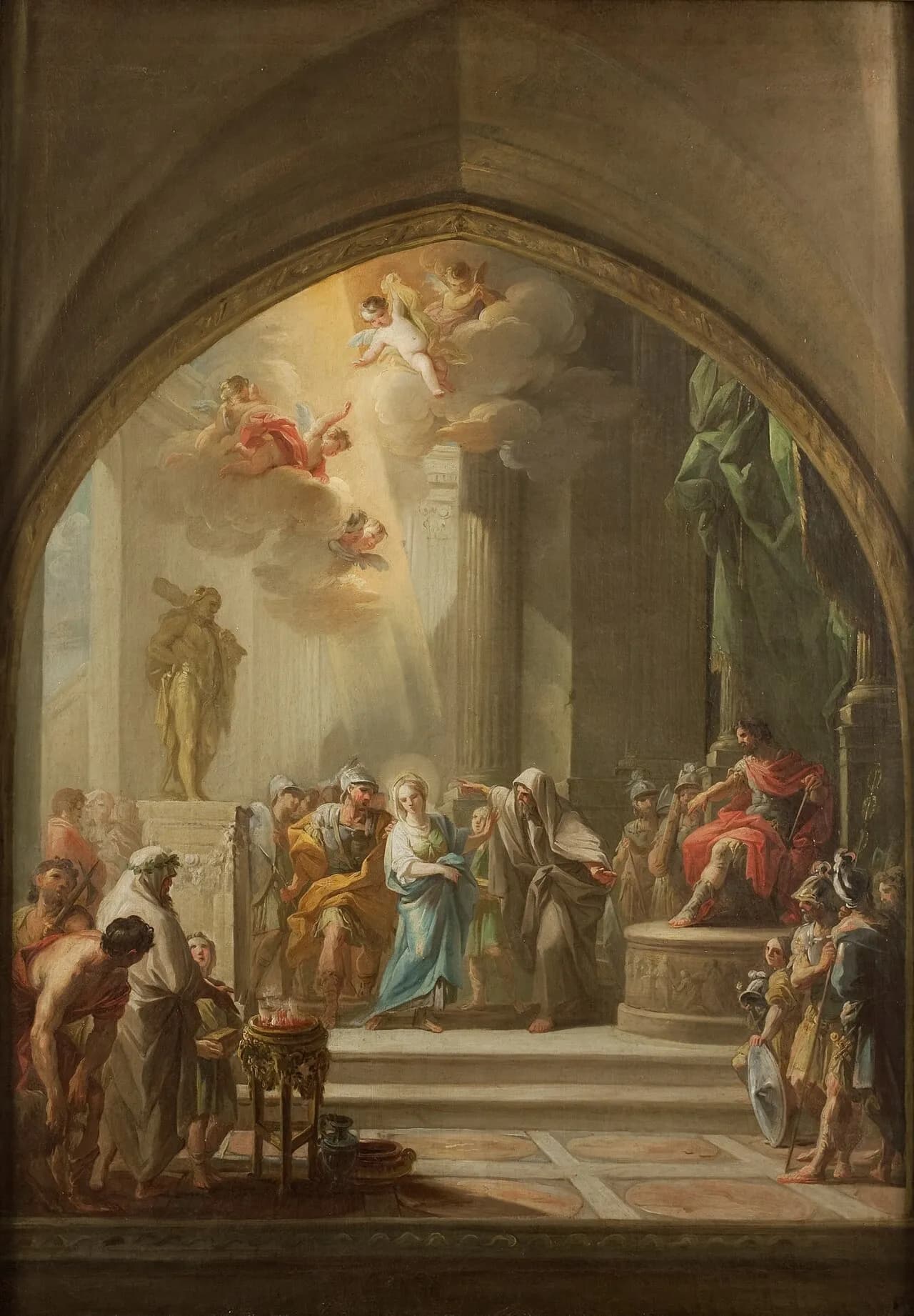
- Born
- At Toledo, late in the third century, to Christian parents 3
- Died
- December 9, in prison at Toledo, in the persecution of Diocletian: 303 3, probably 304 1, or 306 6
- Earliest witness
- Her basilica at Toledo, where councils met in 633, 636 and 638 1
- Historical record
- The 1910 Catholic Encyclopedia: "There is no doubt of the historical fact of her martyrdom" 1
- Relics
- Taken to Belgium and returned to Toledo in the sixteenth century 3
Saint Leocadia of Toledo was a Christian woman of Toledo who died in prison there during the persecution of Diocletian, on December 9, around the year 304. 13 The Catholic Encyclopedia calls her martyrdom a historical fact beyond doubt, and the proof it gives is a building: a basilica raised over her grave, in which the bishops of Visigothic Spain held three of their councils. 1 She is patroness of the Church of Toledo, which still keeps her day on the date its own tradition handed down. 13
What Toledo remembers
The Archdiocese of Toledo tells her story briefly. Leocadia was born in the city to Christian parents toward the end of the third century and was consecrated to God in the order of virgins, known for her charity and her prayer. 3 When the persecution of Diocletian came she was arrested and imprisoned, and the authorities tried to turn her from the faith, first with flattery and then with the threat of torture. 3 She confessed her faith and would not give way. She died in prison while she was praying, on December 9, 303. 3
Because she died in prison, the archdiocese explains, the old documents call her a confessor. 3 The encyclopedia supplies the evidence for that: the acts of the Fourth Council of Toledo, in 633, speak of the "basilica beatissimae et sanctae Confessoris Leocadiae," the basilica of the most blessed and holy confessor Leocadia. 1
The basilica and the councils
Johann Peter Kirsch, who wrote her entry in 1910, places her among the martyrs that the last great persecution gave to Spain between 303 and 305, and dates her death to December 9, "probably 304." 1 The encyclopedia does not agree with itself about the year: Carlos Cedillo's 1912 article on Toledo, which calls her "one of the most illustrious of the martyrs" of the persecution there, gives December 9, 306. 6 Kirsch is frank about the gaps in the record. The poet Prudentius, who wrote a hymn on the martyrs of Spain, does not mention her. 1 The historical martyrologies of the ninth century do. 1
What settles the matter for him is the church. "In very early times," he writes, there was a church dedicated to her at Toledo, and in the first half of the seventh century it was the meeting place of the Fourth Council of Toledo in 633, the Fifth in 636 and the Sixth in 638. 1 It was evidently built over her grave, and so, he concludes, she must have been publicly honored as a martyr long before. 1 His verdict: "There is no doubt of the historical fact of her martyrdom." 1 The date of December 9, he adds, "obviously rests on the tradition of the Church of Toledo." 1
Those were not small gatherings. Toledo was then the seat of the Visigothic court, and Cedillo calls the Fourth Council of 633, over which Saint Isidore of Seville presided, "one of the most important held in Spain." 6 The Fifth, in 636, dealt largely with the protection of the king, and the Sixth, in 638, approved rules of discipline. 6 All three, on Kirsch's account, met in the church built over her grave. 1
The archdiocese says her cult was extraordinary from the sixth century onward, with long liturgical offices composed in her honor. 3 Two more churches in Toledo besides the basilica were dedicated to her, according to Kirsch. 1
The Acts and the governor Decianus
The fuller story comes from what Kirsch calls "more recently compiled Acts." 1 In them Leocadia is filled with the desire for martyrdom by hearing how Saint Eulalia died. 1 The governor Decianus, whom, Kirsch notes, the martyrology describes as the most furious persecutor of the Christians in Spain, has her seized and cruelly tortured to make her give up the faith. She holds firm and is sent back to prison, where she dies of what was done to her. 1
Nicholas Weber, in his encyclopedia article on Braulio, the seventh-century bishop of Saragossa, notes that Braulio "may also have written the 'Passio S. Leocadiae.'" 5 Kirsch draws a firm line between the Acts and the facts. The basilica and the councils he treats as history, and the details of her trial he reports only as what the Acts relate. 1
Ildephonsus at her tomb
Her basilica was also a burial church. Saint Ildephonsus, archbishop of Toledo from about 657 until 667, was buried there. 4 Poncelet's article gives the little that is certain about him: a nephew of his predecessor Eugenius, a monk and then abbot of the monastery of Agli near Toledo, and the author of a treatise defending the perpetual virginity of Mary. 4 The Archdiocese of Toledo adds that his remains were later taken to Zamora to keep them safe at the time of the Muslim invasion. 3
In the late eighth century Cixila, another archbishop of Toledo, wrote up the life of Ildephonsus and added two wonders to it. 4 In one of them, Ildephonsus was praying before the relics of Saint Leocadia "when the martyr arose from her tomb and thanked the saint for the devotion he showed towards the Mother of God." 4 Albert Poncelet, who wrote the Ildephonsus article in 1910, treats this as one of the "doubtful or even legendary anecdotes" added to a life whose authentic details are few. 4
The relics
Her body did not stay in Toledo. The archdiocese says that her relics were carried from Toledo to Belgium and only came home in the sixteenth century, and that the city built a gate for the occasion, the Puerta del Cambrón, which still carries an image of her. 3 Kirsch says she is shown in art with a tower, as a sign that she died in prison. 1
What is Saint Leocadia the patron saint of?
Saint Leocadia's feast day
Saint Leocadia's feast day is December 9, the day of her death. 13 The Archdiocese of Toledo celebrates her on that day, and the current Roman Martyrology enters her on it too, under the spelling Leucadia, as a virgin and martyr "outstanding for her witness of faith in Christ," in the Italian bishops' wording translated here. 23 Kirsch noted in 1910 that December 9 was "still given as her feast in the Roman Martyrology," and that the date itself comes from the tradition of the Church of Toledo. 1
Praying with Saint Leocadia
The sources keep her life almost empty. A woman of Toledo, a virgin given to God, a prison, a death in December, and nothing else that a historian will vouch for. 13 What the Church of Toledo did with that little was to build over her grave and to go on gathering there, so that a little over three centuries later the bishops of a kingdom were holding councils beside her body. 1
Toledo remembers her dying at prayer, and her oldest title is confessor. 3 That is a quiet kind of martyrdom. Nobody in the sources sees her executed. Her witness was to refuse, and then to wait in a cell until she died. 13 Painters have shown her with a tower, which is the prison she never left. 1
It suits a saint like this that Toledo should have made her the patroness of its young people. 3 What she left behind is not advice. She left a church where others came to pray long after her, and a day in December that Toledo still keeps. 13
Saint Leocadia of Toledo, pray for us.
Sources
- 1.Johann Peter Kirsch, "St. Leocadia," The Catholic Encyclopedia, Vol. 9 (New York: Robert Appleton Company, 1910).
- 2.Roman Martyrology, entry for December 9, "Santa Leucadia, vergine e martire," as printed in "Santo del giorno," Conferenza Episcopale Italiana (in Italian).
- 3."Santa Leocadia, virgen y mártir," Santoral Diocesano, Archdiocese of Toledo (in Spanish).
- 4.Albert Poncelet, "St. Ildephonsus," The Catholic Encyclopedia, Vol. 7 (New York: Robert Appleton Company, 1910).
- 5.Nicholas Weber, "St. Braulio," The Catholic Encyclopedia, Vol. 2 (New York: Robert Appleton Company, 1907).
- 6.Carlos Cedillo, "Toledo," The Catholic Encyclopedia, Vol. 14 (New York: Robert Appleton Company, 1912).
Saints to turn to next
Others in this collection who are turned to for some of the same things.