Saint Leo the Great
Unknown - November 10, 461
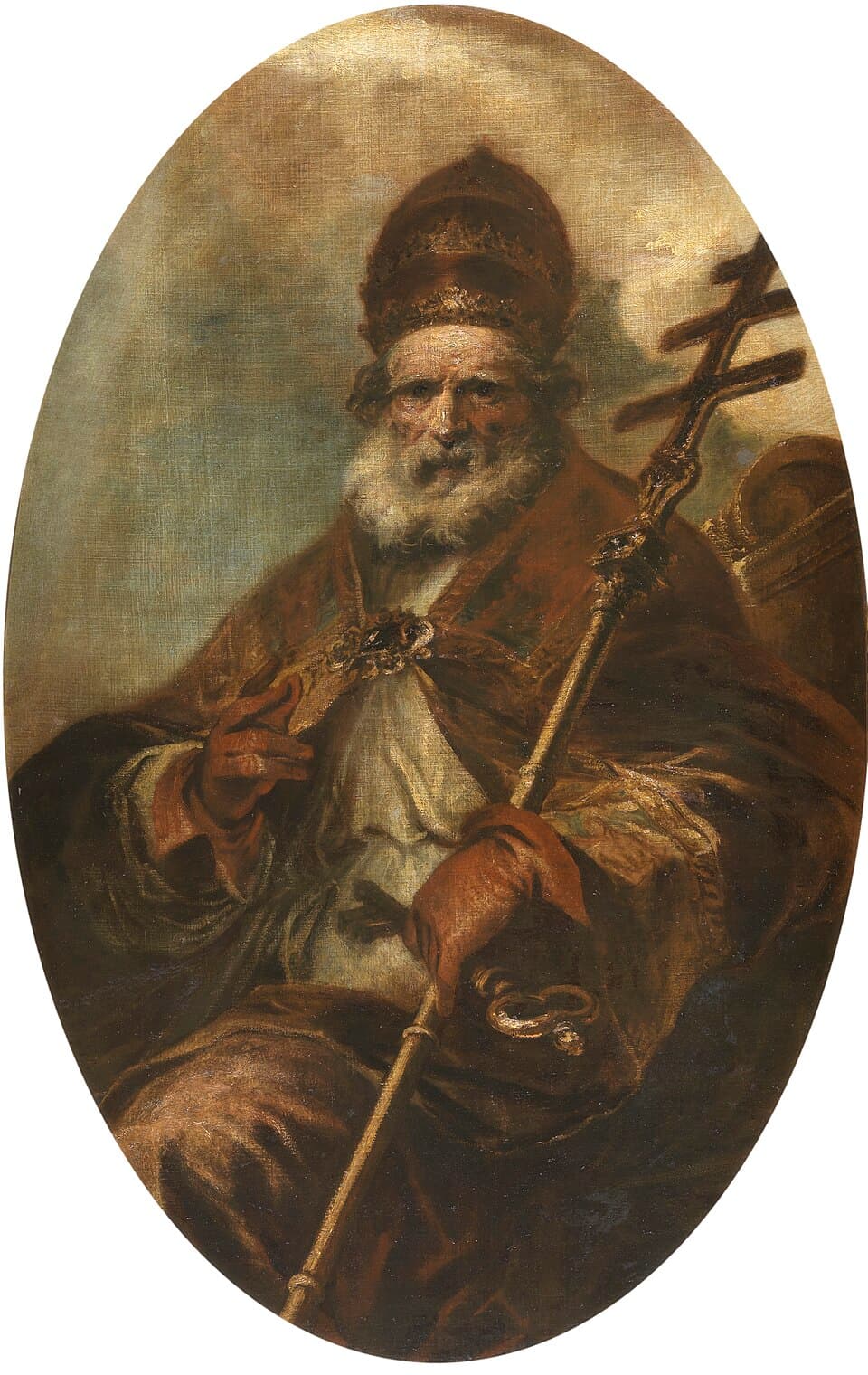
- Feast day
- November 10, the day he died 23. Kirsch, in 1910, gives 11 April in the Latin Church and 18 February in the Eastern 1
- Born
- Place and date unknown. The Liber Pontificalis makes him a Tuscan, son of a man named Quintianus 12
- Wrote
- Almost 100 surviving sermons and about 150 letters 2
- Council of Chalcedon
- 451, with 350 bishops. His Tome to Flavian was read there and acclaimed: "Peter has spoken through the mouth of Leo" 2
Saint Leo the Great went out unarmed to meet Attila in 452 and talked him out of the rest of Italy. 2 Three years later he went out again, to Genseric's Vandals at the gates of Rome, and that time he failed - the city was plundered for two weeks. 2 He is on this page for neither of those. He is here because of a letter about who Jesus Christ is, which 350 bishops at Chalcedon heard read aloud and answered in one voice. 2
A deacon who was elected while he was out of the country
Almost nothing is known about where he came from. Kirsch opens the encyclopedia article with "Place and date of birth unknown," and the only lead is the Liber Pontificalis, which makes him a native of Tuscany whose father was called Quintianus. 1 The first reliable sighting is as a deacon of the Roman Church under Pope Celestine I, somewhere between 422 and 432. 1
He was known well beyond Rome by then. Cassian wrote a book against Nestorius at Leo's suggestion in 430 or 431 and dedicated it to him; Cyril of Alexandria appealed to Rome in a dispute with the Bishop of Jerusalem, and Kirsch notes it is not entirely clear whether Cyril was writing to Leo as deacon or to the pope. 1 In 440 his standing was such that Galla Placidia, then governing the Western empire, sent him to Gaul to repair a difficult situation. 2
Pope Sixtus III died that summer while Leo was still away, and Leo was elected in absentia. Benedict XVI notes that he heard the news while carrying out his peace mission in Gaul. 2 He came back and was consecrated on 29 September 440, beginning a pontificate of more than twenty-one years that Benedict calls "undoubtedly one of the most important in the Church's history." 2
Attila, and then Genseric
The times made a pope into a civil authority whether he wanted it or not. Benedict lists the pressures: constant barbarian invasions, the steady weakening of imperial power in the West, and a long social crisis. 2 The same thing would happen to Gregory the Great a century and a half later, and for the same reasons.
In 452 Leo went with a Roman delegation to meet Attila at Mantua, and dissuaded him from continuing an invasion that had already devastated the northeast of Italy. 2 Benedict calls the episode emblematic of a pontiff acting for peace, and the fame of it has lasted. 2
Kirsch supplies the details that keep the scene honest. Leo went at the emperor's wish, and he did not go alone: the Consul Avienus and the Prefect Trigetius went with him, and the meeting took place at the Mincio near Mantua. 1 What he obtained was a promise that Attila would withdraw from Italy and negotiate peace with the emperor. 1 This was a diplomatic embassy with a bishop at the head of it, which is both less miraculous and more interesting than the version where a pope stops an army by standing in front of it.
The second time is the one worth dwelling on, because it did not work. In the spring of 455 Genseric's Vandals reached an undefended Rome. Leo, in Benedict's description "defenceless and surrounded by his clergy," went out to meet the invader and implore him to desist, and he could not stop the city being plundered for two weeks. 2 What the attempt did achieve was that Rome was not burned, and that the basilicas of St Peter, St Paul and St John, where much of the terrified population had taken refuge, were spared. 2 Benedict calls it "a sign of courage that still amazes us." 2 A saint tried something, mostly failed, and saved what could be saved.
The Tome, and what Chalcedon settled
The doctrinal crisis of his pontificate concerned the humanity of Christ. Eutyches denied the true human nature of the Son of God; the Council of Chalcedon in 451, with 350 bishops present and the majority of them from the East, rejected that and affirmed the union in one Person of two natures, human and divine, "without confusion and without separation." 2 Benedict calls Chalcedon the most important assembly ever held in the Church's history, and the sure goal of the Christology of the three councils before it. 2
Leo's contribution was a doctrinal letter to the Bishop of Constantinople, the Tome to Flavian. It was read out at the council, and the record of the proceedings preserves what the fathers said when it finished: "Peter has spoken through the mouth of Leo." 2 Benedict adds a detail about how highly those four councils came to be held - by the sixth century they were already being compared to the four Gospels, and Gregory the Great wrote that he revered them "as the four books of the Gospel," because on them "as on a four-square stone, rises the structure of the holy faith." 2
Leo's sense of his own office runs through this. He understood himself as the authentic heir of Peter, and quoted in a sermon for the feast of Peter and Paul the principle that "to one Apostle alone was entrusted what was communicated to all the Apostles." 2 Benedict's judgment is that he exercised that responsibility, East and West, "with caution, firmness and lucidity." 2
The preaching, and the city
Leo is the first pope whose preaching to the people has come down to us, which Benedict points out with evident pleasure at a Wednesday audience. 2 Almost a hundred sermons survive, in what Benedict calls "a splendid and clear Latin," along with about 150 letters. 2
The pastoral work was unglamorous and local. He kept charity alive in a Rome tried by famines, an influx of refugees, injustice and poverty; he opposed pagan superstitions and the Manichaean groups; and he tied the liturgy to ordinary life, pairing fasting with almsgiving at the Quattro tempora that marked the turn of the seasons. 2
He also went after heresy with an administrator's thoroughness, and Kirsch tracks the reach of it. Prosper records in his Chronicle that Leo's energetic measures drove the Manichaeans out of the provinces, and that Eastern bishops copied the pope's handling of the sect. 1 When Bishop Turibius of Astorga traveled around Spain gathering detailed information on the survival of Priscillianism, compiled its errors and wrote a refutation, one of the copies went to Rome. 1 A bishop in Galicia collecting evidence and sending it to a pope who would act on it is a picture of a Church that still worked as one thing while the empire around it came apart.
The teaching Benedict says still applies is about what liturgy is. For Leo, Christian worship is not the memory of past events but "the actualization of invisible realities which act in the lives of each one of us," and Easter is to be celebrated in every season of the year "not so much as something of the past as rather an event of the present." 2 The fit with the rest of his life is exact: a man whose whole pontificate was spent insisting that God really took on a human nature was not going to let worship become a commemoration of something over and done.
He died on 10 November 461 and was buried near the tomb of St Peter; his relics are now in one of the altars of the Vatican Basilica. 12 Benedict XIV made him a Doctor of the Church in 1754. 12
What is Saint Leo the Great the patron saint of?
None of the three sources used here states a patronage for Saint Leo the Great, and this profile does not supply one. 123 Franciscan Media, which usually lists patronages and is the reason it is cited on many of these pages, lists none for him. 3 What the record gives instead is the title itself: Kirsch says that next to Gregory I, Leo's pontificate "is the most significant and important in Christian antiquity." 1
Saint Leo the Great's feast day
The feast of Saint Leo the Great is November 10, the day he died. 23 The encyclopedia gives different dates, and the difference is worth seeing rather than hiding. Writing in 1910, Kirsch states that "In the Latin Church the feast day of the great pope is held on 11 April, and in the Eastern Church on 18 February." 1 Both of those were accurate when he wrote them. The Latin observance was later moved to the anniversary of the death, which is where Franciscan Media finds it and where an American parish will keep it. 3 An older book is not wrong about its own day; it is simply not reporting yours.
Praying with Saint Leo
The two meetings outside the walls are the reason most people know his name, and they are more useful together than apart. One worked and one did not. Leo had no way of knowing in advance which would be which, and he went out both times. The sources do not read the failure as a lesser act than the success; Benedict reserves the phrase about courage that amazes for the Vandals, the time it went wrong. 2
What he was defending at Chalcedon was not a technicality either, though the vocabulary is technical. Eutyches was prepared to lose the human nature of Christ in order to protect the divine one, and Leo would not have it, because the whole point is that God and man in Christ "are not foreign to the human race but alien to sin." 2 A Jesus who is not really human is no use to anybody who is.
There is a quieter thing to take from him, which is how he treated the calendar. He connected fasting to almsgiving, attached the liturgy to the seasons people were actually living through, and insisted that Easter is a present event rather than an anniversary. 2 For a pope managing famine, refugees and an empire coming apart, that is not decoration. It is the claim that the thing being celebrated is currently happening.
Benedict ends by saying that through his Christological faith Leo was "a great messenger of peace and love," and draws out the order: "in faith we learn charity." 2 Leo would have recognized the order. He spent twenty-one years on a doctrine about who Christ is, and the practical consequence was a man walking out an undefended gate toward people who had every reason to kill him.
Saint Leo the Great, pray for us.
Sources
Saints to turn to next
Others in this collection who are turned to for some of the same things.