Saint Leo IX
June 21, 1002 - April 19, 1054
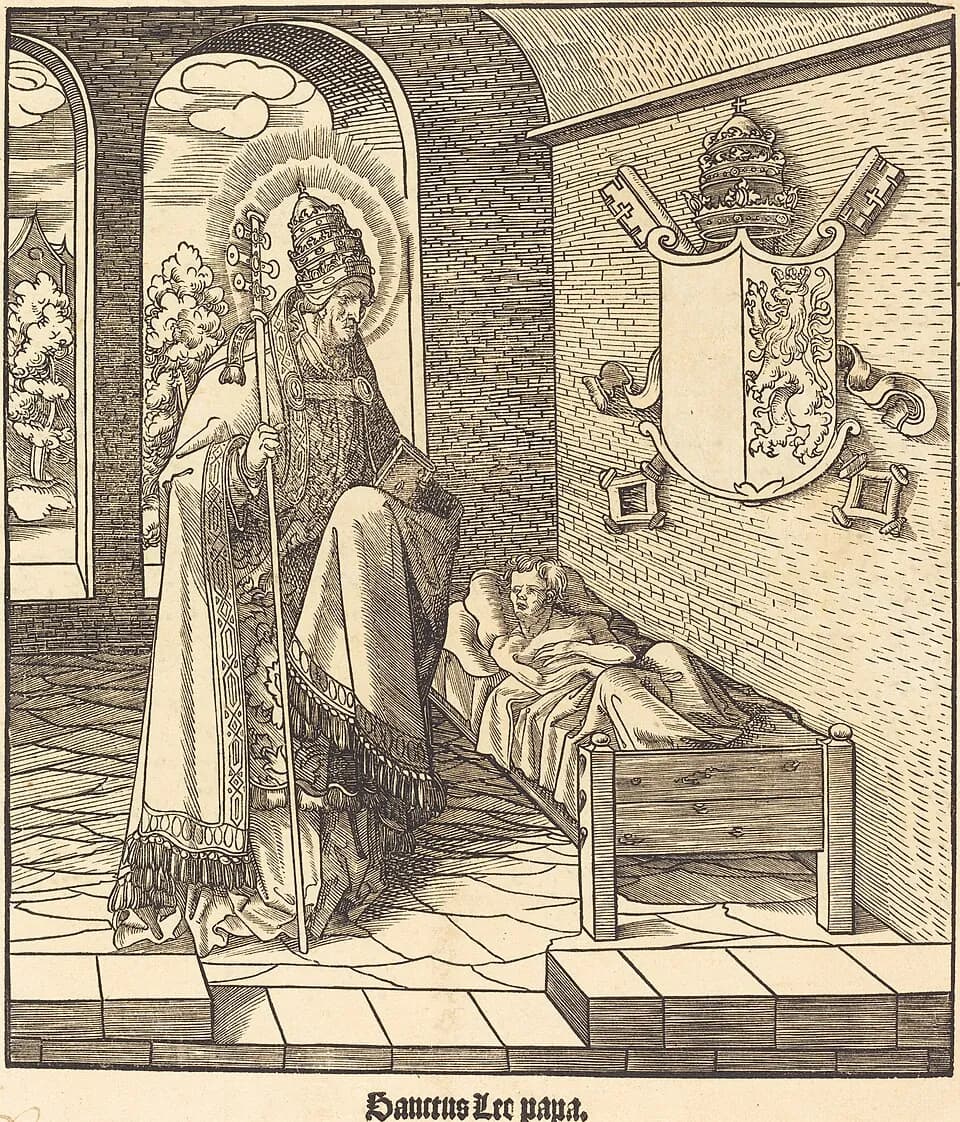
- Feast day
- April 19, according to Vatican News 2; Catholic Culture calls it "historically" his feast and lists him among the day's commemorations from the Roman Martyrology 3
- Born
- Bruno, at Egisheim near Colmar in Alsace, June 21, 1002 1; the Holy See gives his name as Bruno of Eguisheim-Dagsburg 4
- Bishop of Toul
- Elected in 1026 and consecrated in 1027, according to the 1910 Catholic Encyclopedia 1; made bishop in 1026, according to Catholic Culture 3
- Fought
- Simony and clerical incontinence, both condemned at his first Roman synod in April 1049 1
- Captured
- In Norman hands after his defeat at Civitella in June 1053 1; taken prisoner at Benevento, according to Catholic Culture 3
- Patron saint of
- Musicians, and the town of Sessa Aurunca in Italy, according to Catholic Culture 3
- Buried
- In St. Peter's, Rome 1
Saint Leo IX was Bruno, a bishop from Alsace who walked into Rome in 1049 barefoot and dressed as a pilgrim, and would accept the papacy only if the Roman people chose him themselves. 1 They did, and in five years he condemned simony and clerical incontinence at synod after synod across Europe, so tirelessly that he was called the Apostolic Pilgrim. 13 He also led an army against the Normans, lost, and ended up in their hands. 13 He died in April 1054, three months before his legates in Constantinople excommunicated the patriarch, an act the 1910 Catholic Encyclopedia counts as the moment the East "was finally cut off." 1
"The good Bruno"
He was born at Egisheim, near Colmar on the borders of Alsace, on June 21, 1002, into a family which, in Horace Mann's words, "had given or was to give saints to the Church and rulers to the Empire." 1 His father Hugh was a first cousin of the future Emperor Conrad, and Mann describes both his parents as "remarkable for their piety and learning." 1
At five he was sent to the school Bishop Berthold of Toul kept for the sons of the nobility, where, "intelligent, graceful in body, and gracious in disposition, Bruno was a favourite with his schoolfellows." 1
As a young man home for the holidays he was badly hurt in his sleep. Mann says he was "attacked when asleep by some animal"; the Tan Books calendar quoted by Catholic Culture says he was "bitten by a poisonous reptile." 13 He lay for some time between life and death, and saw a vision of Saint Benedict, who cured him by touching his wounds with a cross. 13
He became a canon at Toul in 1017 and was then sent to his cousin Conrad's court "to serve in his chapel," where his companions, to tell him apart from others of the same name, called him "the good Bruno." 1
A deacon at the head of an army
In 1026 Conrad marched into Italy, and because the aged Bishop of Toul could not lead his own contingent, the command was given to Bruno, still a deacon. 13 As Mann puts it, "There is reason to believe that this novel occupation was not altogether uncongenial to him, for soldiers seem always to have had an attraction for him." 1
While he was with the army the bishop died and Bruno was elected to succeed him. 1 Conrad wanted more for him, but Bruno, "wholly disinclined for the higher things," wished "to live in as much obscurity as possible," and got his way. 1
He governed Toul for more than twenty years, a frontier town that suffered both famine and war. 1 He made a lasting peace between the Empire and France, and held his city against a rebel count. "He knew how to make peace, and, if necessary, to wield the sword in self-defence." 1 Amid it all, Mann notes, he "found some consolation in music, in which he proved himself very efficient." 1
Barefoot into Rome
When Pope Damasus II died in 1048, the Romans asked the Emperor Henry III for one of two men they knew from their pilgrimages to Rome: Halinard of Lyons, or Bruno. 1 Henry chose Bruno, who "did all he could to avoid the honour"; Catholic Culture says he was "constrained to accept the papal office in 1048." 13
He gave way on one condition: he would go to Rome and accept "if freely elected thereto by the Roman people." Mann explains why: "He wished, at least, to rescue the See of Peter from its servitude to the German emperors." 1 He traveled in company with Hildebrand, the future Pope Gregory VII. 1 When he presented himself to the people of Rome "clad in pilgrim's guise and barefooted, but still tall, and fair to look upon, they cried out with one voice that him and no other would they have as pope." 1 He took the name Leo and was enthroned on February 12, 1049. 14
The papal finances were in "a deplorable condition," and he handed them to Hildebrand, "a man capable of improving anything." 1
The Apostolic Pilgrim
In April 1049 he held a synod in Rome "at which he condemned the two notorious evils of the day, simony and clerical incontinence." 1 Mann calls this the start of "the work of reform which was to give the next hundred years a character of their own, and which his great successor Gregory VII was to carry so far forward." 1
Then he took it on the road. On his first journey he held a council at Pavia, met the emperor at Cologne, held a great synod at Reims that bishops and abbots from England attended, and another at Mainz on the way home. 1 At Reims an enormous crowd gathered to see him, "Spaniards, Bretons, Franks, Irish, and English." 1 It was these journeys that gave him the title Peregrinus Apostolicus, the Apostolic Pilgrim. 13
He crossed the Alps three times in five years, and condemned the teaching of Berengarius of Tours, who, the Tan Books calendar explains, denied transubstantiation. 13
Civitella, and the Normans
The Normans were the problem he could not solve. They were oppressing the people of southern Italy, and his personal appeals got promises that were not kept. 1 By 1052, Mann writes, "he began to be convinced that appeal would have to be made to the sword." 1 The emperor promised him German troops and then withdrew the promise. 1
He raised what forces he could among the Italian princes and declared war. In June 1053 the Normans beat first the Greeks and then the pope at Civitella. 1 Catholic Culture's Tan excerpt adds that he "was criticized by St. Peter Damian when he went to battle." 3
What happened next is told two ways. Mann says that "after the battle Leo gave himself up to his conquerors, who treated him with the utmost respect and consideration, and professed themselves his soldiers," and that he then went to Benevento. 1 Catholic Culture says that "while at Benevento, a city belonging to the Holy See, he was taken prisoner by the Normans." 3 Catholic Culture adds that he was released. 3
Mann is clear about what it cost him. "Though he gained more by defeat than he could have gained by victory, Leo betook himself to Benevento, a broken-hearted man. The slain at Civitella were ever before him." 1
Constantinople, and what came after him
At Benevento he was also troubled by the Patriarch of Constantinople, Michael Cerularius, who, according to Mann, had attacked the Latin use of unleavened bread at Mass and closed the Latin churches in Constantinople. 1 Leo answered with a strong letter in September 1053, and, Mann records, "began to study Greek in order the better to understand the matters in dispute." 1
In January 1054 Leo sent a further reply with two cardinals, Humbert and Frederick. 1 He did not live to see the result. "He had departed this life before the momentous issue of his embassy was known in Rome. On 16 July, 1054, the two cardinals excommunicated Cærularius, and the East was finally cut off from the body of the Church." 1 The Tan Books calendar on Catholic Culture says of his opposition to the patriarch that "this began the complete separation of Rome from the Eastern Church." 3
Ill, he had himself carried back to Rome in March 1054, and died there on April 19. 1 Catholic Culture says he died "before the high altar in St. Peter's." 3 Mann calls him "a worker of miracles both in life and in death." 1 The Tan calendar records seventy cures through his intercession within forty days of his death. 3
What is Saint Leo IX the patron saint of?
Saint Leo IX's feast day
His feast is April 19, the day he died in 1054. Vatican News lists him for that date in its Saint of the Day calendar. 2 Catholic Culture says that "historically today is the feast of St. Leo IX" and lists him among the day's "Other Commemorations" from the Roman Martyrology. 3
The encyclopedia gives April 19 as his death date and says that he "found a place in the Roman Martyrology." 1 None of the sources used here gives the date of his canonization.
Praying with Saint Leo IX
Most of the record of him is about refusing things. He talked his cousin the emperor into letting him take an insignificant see, and did all he could to avoid the papacy. 1 When he did go, he went barefoot and set a condition: the Romans had to choose him. 1 The encyclopedia reads it as an attempt to free the papacy from the emperors, the work of reform Hildebrand would carry forward as Gregory VII. 1
The war is harder to admire. The same source that finds soldiers "not altogether uncongenial" to him reports that he never recovered from the dead at Civitella. 1 Peter Damian, a saint himself, criticized him for going to battle. 3 The sources do not tidy that into a lesson, and it is not tidied here.
Faced with a patriarch who had shut the Latin churches of his city, he wrote, and set himself to learn Greek to understand the dispute. 1 The excommunication that followed was pronounced by others, after his death. 1
The other thing the record keeps returning to is that he went in person, to councils in Italy, Germany and France, and the crowds who came to Reims came, Mann says, "to see the famous pope." 1
Saint Leo IX, pray for us.
Sources
- 1.Horace Mann, "Pope St. Leo IX," The Catholic Encyclopedia, Vol. 9 (New York: Robert Appleton Company, 1910).
- 2."St. Leo IX, Pope," Saint of the Day, 19 April, Vatican News.
- 3."April 19, 2013," Liturgical Year calendar, Catholic Culture, including an excerpt from Saints Calendar and Daily Planner (TAN Books).
- 4."Leo IX," Supreme Pontiffs, The Holy See.
Saints to turn to next
Others in this collection who are turned to for some of the same things.
- Saint Augustine of CanterburyBirth unknown - 604 or 605CourageWork and vocationDiscernment
- Saint FabianBirth unknown - January 20, 250CourageDiscernmentWork and vocation
- Saint Fidelis of Sigmaringen1577 - April 24, 1622CourageWork and vocationDiscernment
- Saint Gregory VIIAbout 1020 - May 25, 1085CourageWork and vocationDiscernment