Saint Leo IV
Died July 17, 855
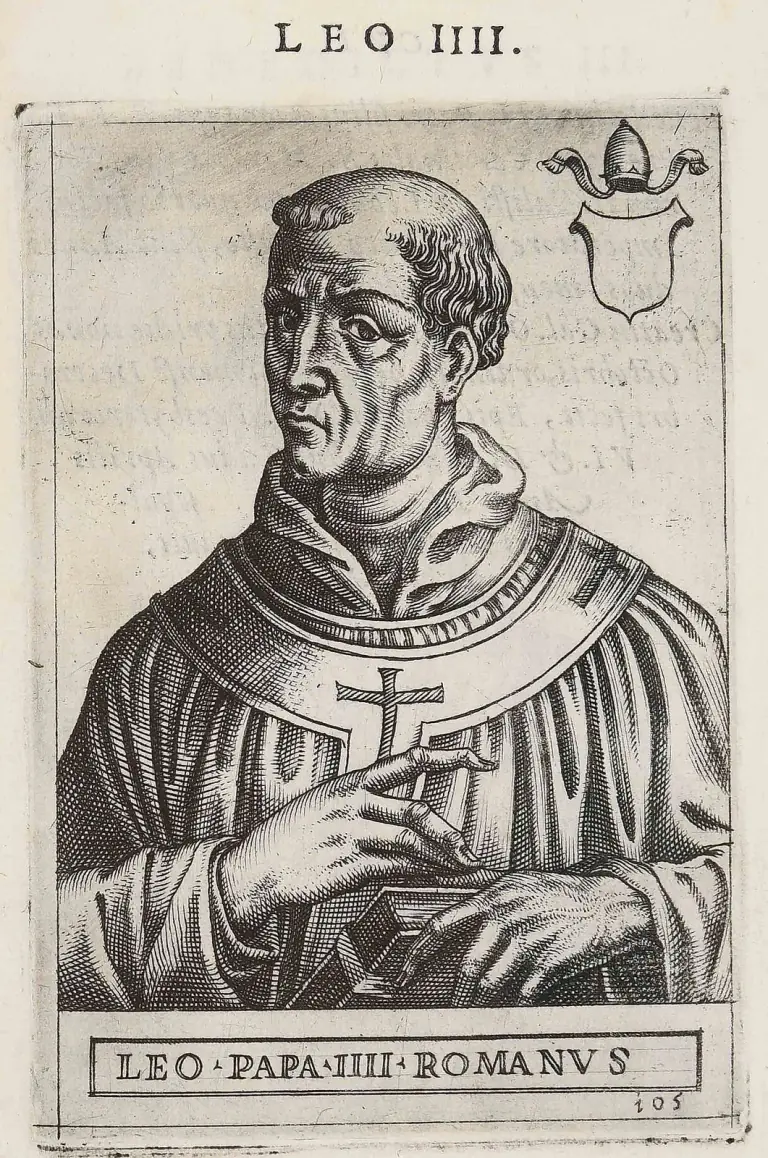
Saint Leo IV was elected pope in 847, months after Saracen raiders had sailed up the Tiber and plundered the basilicas of Saint Peter and Saint Paul. 12 He spent his reign making sure it could not happen again: he walled in the Vatican hill, still called the Leonine City after him, and he said Mass for the fleet that destroyed the next Saracen armada off Ostia in 849. 15 The Roman Martyrology keeps him on July 17 as a defender of Rome and of the primacy of Peter. 3
A monk's education
Leo was a Roman, the son of Radoald. 1 Horace Mann, in his history of the popes, says the name suggests, without proving, a Lombard family; katolsk.no, the Norwegian bishops' saints database, calls Lombard descent probable. 25 He was educated at the monastery of Saint Martin beside Saint Peter's, and his biographer in the Liber Pontificalis says his behavior there was, in Mann's translation, "not like that of a boy, but of a perfect monk." 15
Gregory IV brought him to the Lateran and made him a subdeacon, and Sergius II made him cardinal-priest of the church of the Four Crowned Martyrs on the Caelian Hill. 12 As pope he rebuilt that church and searched out the relics of its four martyrs to lay beneath its altar. 5
Elected after the raid of 846
In August 846 a Saracen fleet came up the Tiber and sacked the basilicas of Saint Peter and Saint Paul. 2 When Sergius II died suddenly on January 27, 847, katolsk.no says, Leo was elected the same day. 2 Mann's fuller history, following the Liber Pontificalis, says the people had lost heart and feared for their lives, and that even before Sergius was buried they went to Leo's titular church and carried him off to the Lateran against his will. 5
Normally a new pope waited for the emperor to confirm his election. The Romans waited for more than two months and then consecrated Leo on April 10, 847, without the emperor's consent, for fear of what the Saracens might do in the meantime. 15 They took care to say that they meant no disloyalty by it. 5
The Leonine City
Leo repaired the walls of Rome first, rebuilding fifteen of the great towers entirely. 1 Mann's fuller history adds two towers on either bank of the Tiber where it left the city, with chains to stretch across the river. 5 Then he began the larger work: a wall around Saint Peter's and the Vatican hill, which had always stood outside the city defenses. 12 Leo III had begun such a wall and never finished it. 25 The Emperor Lothair sent money, and the towns, estates and monasteries of the Roman duchy each built their share. 15 By the biographer's account Leo was out on horseback or on foot in every kind of weather, urging the work on. 5
It took four years. 1 katolsk.no dates the dedication to June 27, 852. 2 The clergy walked the circuit of the new walls barefoot, with ashes on their heads, singing litanies, psalms and hymns, and at each of the three gates the pope prayed. 5 At the Postern of the Saxons, the gate of the English quarter, he asked that "this city, which I, Thy servant, Leo IV., bishop, have by Thy help newly dedicated, may be ever preserved intact." 5 The enclosed quarter was called the Leonine City after him. 1
The battle of Ostia
While the walls were still going up, news came that a great Saracen fleet was gathering off Sardinia. 15 The seaports of Naples, Amalfi and Gaeta joined their fleets and sailed to the mouth of the Tiber. 12 Rome was unsure at first whether they had come to help or to attack, until their commander, Caesarius, satisfied the pope. 25 Leo then marched to Ostia with a Roman force, said Mass in the church of Saint Aurea, and gave Communion to the sailors, who had asked to receive it from his hands before the battle. 25
The Saracen fleet arrived the next day. The battle had hardly begun when a storm arose, a wind, the biographer says, "which God produced from his treasury," and it wrecked the Saracen ships along the shore. 5 In the Catholic Encyclopedia Mann says the Saracen fleet was destroyed by the allied ships "and by a tempest." 1 Many of the prisoners were hanged at Ostia as pirates, Mann's fuller history adds, and the rest were set to work building the pope's walls. 5
Leo went on to rebuild Portus at the Tiber's mouth and gave it to Corsicans driven from their island by the Saracens. 15 In 854 he founded a new town on safer ground for the people of ruined Centumcellae, and named it Leopolis. 25
Pope of the Franks, of Alfred and of the East
At Lothair's wish, Leo crowned his son Louis II co-emperor in 850. 12 In 853 the West Saxon king Ethelwulf sent his young son Alfred to Rome. Mann quotes an old English historian: Leo "hallowed the child Alfred to king by anointing; and receiving him for his own child by adoption, gave him confirmation." 1 It was the future Alfred the Great. 25
The same year Leo held a synod in Rome that passed decrees on discipline and learning and condemned Anastasius, the cardinal-priest of Saint Marcellus, who had defied him. 1 He went in person to Ravenna to bring its archbishop to obedience. 1 When Saint Ignatius, patriarch of Constantinople, deposed the bishop of Syracuse and asked Rome to confirm it, Leo refused, because the bishops had been judged "in the absence of our legates or of letters from us." 1
Near the end, a military officer named Daniel told the Emperor Louis that Leo meant to throw off Frankish rule by allying with the Greeks. Leo convinced the emperor the charge was false, and Daniel was condemned to death and spared only because the emperor asked for his life. 15 Mann's fuller history, following the Liber Pontificalis, says the accusation was made against Gratian, one of the pope's counselors, rather than against Leo himself. 5
The fire in the Borgo
The Liber Pontificalis credits Leo with miracles, and so, Mann notes, did the Greek patriarch Photius. 1 The best known is a fire that broke out in 847 in the quarter in front of Saint Peter's. The Vatican Museums, following the Liber Pontificalis, say Leo put it out by giving his blessing from the loggia of the basilica; Mann's history says by making the sign of the cross. 57
Seven centuries later Pope Leo X had Raphael's workshop paint the Fire in the Borgo and the Battle of Ostia in a room of the Vatican palace, with the face of Leo IV painted as a portrait of Leo X himself. 6 An older likeness survives in the lower church of San Clemente, near Leo's titular church: a fresco of the Assumption with a pope in a square halo labeled as Leo IV. 25 Mann allows that it may be the work of another priest named Leo. 5
He cared about that feast. katolsk.no says Leo gave the Assumption a vigil and an octave, the octave kept until 1955; Mann's history says he ordered the octave day observed in Rome, where until then only August 15 had been kept. 25
What is Saint Leo IV the patron saint of?
Saint Leo IV's feast day
Saint Leo IV's feast day is July 17, the day he died in 855. 12 The Roman Martyrology, in the text published by the Italian bishops, enters him at Saint Peter's on that day as defender of the City and upholder of the primacy of Peter. 3 Vatican News lists him on July 17. 4
Mann wrote in 1902 that July 17 was still the day his feast was kept. 5 katolsk.no adds that the July 17 commemoration has since been dropped, though the Martyrology still names him on that date. 23
Praying with Saint Leo IV
Leo came to the papacy in a city that had just watched its holiest churches plundered and could do nothing about it. 25 What he did was practical. He rode around the walls in the rain, raised money, settled refugees, and moved a whole town to a place with better water. 5
He also prayed, and the sources do not separate the two. Before Ostia he said Mass for the sailors and gave them Communion; when the walls were done he walked them with his clergy in ashes and asked God to keep the city safe. 5 Mann, in his fuller history, calls him a pontiff "as ready, when duty called, to wield the spear as the crozier." 5
The walls he built still stand in part in the Vatican gardens. 5 The prayer he said at the Saxon gate asked for something no wall can guarantee, that the city be "ever preserved intact." 5
Saint Leo IV, pray for us.
Sources
- 1.Horace Mann, "Pope St. Leo IV," The Catholic Encyclopedia, vol. 9 (New York: Robert Appleton Company, 1910).
- 2."Den hellige pave Leo IV," compiled by Per Einar Odden, Helgener, salige og andre, katolsk.no, the Catholic Church in Norway (in Norwegian).
- 3.Roman Martyrology, entry for July 17, "San Leone IV, papa," Santo del giorno, Conferenza Episcopale Italiana (in Italian).
- 4."St. Leo IV, Pope," Saints of the day, July 17, Vatican News.
- 5.Horace K. Mann, The Lives of the Popes in the Early Middle Ages, vol. 2 (London: Kegan Paul, Trench, Trübner, 1902), "S. Leo IV," as digitized on the Internet Archive.
- 6."Room of the Fire in the Borgo," Raphael's Rooms, Vatican Museums.
- 7."Fire in the Borgo," Room of the Fire in the Borgo, Raphael's Rooms, Vatican Museums.
Saints to turn to next
Others in this collection who are turned to for some of the same things.