Saint Agericus of Verdun
c. 521 - December 1, 588 or 591
- Born
- About 521 1
- Ordained
- Priest at thirty, by Bishop Desideratus of Verdun 1
- Died
- December 1, 591, by tradition, though some write 588, says katolsk.no 1; the encyclopedia gives his episcopate as 554-91 4
- Emblem
- A barrel of wine 1
Saint Agericus, called Airy in French, was bishop of Verdun from 554 and a friend of Gregory of Tours and the poet Fortunatus. 14 He stood godfather to the Frankish king Childebert II and spent his last years pleading with that king and his court for the lives of men they meant to kill. 13 Gregory, who knew him, records that he died grieving over the two he could not save. 3
A priest of Verdun
The Norwegian bishops' saints database (katolsk.no) dates his birth to about 521 and says that King Theodoric I of Austrasia stood godfather at his baptism and later saw that his godson was well educated. 1 He went to the cathedral school at Verdun from the age of seven, was taken early into the clergy, and was known for his seriousness, his reserve and his study of the Scriptures. 1 Bishop Desideratus of Verdun ordained him priest when he was thirty, and he served as one of the priests of the cathedral. 1
Desideratus is himself remembered in Gregory's History of the Franks. Gregory says that King Theodoric "had done many wrongs" to him, and that when he became bishop and found the people of Verdun "very poor and destitute," he borrowed seven thousand gold pieces from King Theodobert to set them up in trade, and the king would not take the money back. 3 That was the church Agericus grew up in.
When Desideratus died in 554, Agericus succeeded him as the tenth bishop of Verdun, at thirty-three. 1 Georges Goyau, in the 1912 Catholic Encyclopedia, lists him among the bishops "worthy of mention" and dates his episcopate 554-91. 4 katolsk.no says he kept, as bishop, the simplicity of food, furniture and dress he had lived with before. 1
Bishop at the Austrasian court
Verdun lay in the Frankish kingdom of Austrasia, and its bishop was close to its kings. 1 katolsk.no says Sigebert I and his son Childebert II listened to his advice, and that in 570 Agericus stood godfather to the infant Childebert. 1 In 587 he was among those who signed the treaty of Andelot, by which King Gunthram of Burgundy adopted his nephew Childebert as his heir. 1
Goyau calls him a "friend of St. Gregory of Tours and of Fortunatus." 4 katolsk.no says Gregory visited him and praised him, and that Venantius Fortunatus addressed him in verse. 1 He built churches, among them a chapel of Saint John the Baptist raised from ruins and a church of Saint Medard, in which he laid three early bishops of Verdun when, katolsk.no says, the place of their remains was revealed to him. 1 The Martyrology remembers him as the bishop who built churches and baptisteries. 2
Gregory gives one episode of his ministry at length. A freed slave woman at Verdun had grown rich by telling people where their stolen goods had gone, and was thought by many "to be something divine." 3 Agericus had her brought to him, and he "perceived, according to that which we read in the Acts of the Apostles, that there was in her an unclean spirit of divination." 3 He said a formula of exorcism over her and anointed her forehead with holy oil; Gregory says the demon cried out and named itself, "But since he could not drive it from the woman she was allowed to go." 3 She left Verdun and went into hiding with Queen Fredegund. 3
Gunthram Boso and Bertefred
The events Agericus is best remembered for are failures. Gunthram Boso was a Frankish duke who had made enemies of Queen Brunhild and the young King Childebert. 13 katolsk.no says that when Brunhild reopened the case against him in 587 he fled to Agericus, and that the bishop went to his godson the king and asked for a pardon. 1 The king agreed only that Boso should come before the two kings, and asked the bishop to answer for his appearance. 1
Gregory tells what happened next. Boso came to the meeting of the kings, "whom bishop Ageric of Verdun had received in custody. But the bishop who had pledged his faith for him was not present," because the terms required Boso to appear "without any defender" so that the bishop could not beg him off. 3 He was condemned to death. He ran to the lodging of Bishop Magneric of Trier and threatened to kill him unless he won a pardon. 3 In Gregory's account King Gunthram answered, "Set fire to the house"; the clergy broke down the door to get their bishop out, and Boso was killed with lances as he stepped across the threshold. 3 katolsk.no says it was Childebert, misinformed about Magneric, who had the house set on fire. 1
The second failure was worse. Bertefred, a nobleman who had joined a revolt against the king, took refuge in the bishop's own chapel when the revolt collapsed. 13 The king's men broke the right of asylum and killed him there, and Agericus saw it done. 1 Brehaut's summary of Gregory's ninth book reads: "Ageric, bishop of Verdun, dies of chagrin because Gunthram Boso, whose safety he had pledged, had been killed, and because Bertefred had been killed in his oratory." 3 The Martyrology tells the asylum story in its own way: it says he suffered much from King Theodoric for having made his church a refuge for fugitives. 2
Death and memory
katolsk.no gives his death, by tradition, as December 1, 591, and notes that some write 588. 1 It adds that the tenth-century chronicle of the bishops of Verdun, written by Bertharius, puts him at a council called in 590 to judge Bishop Egidius of Reims, which would rule out the earlier date. 1 Goyau confirms that the chronicle was begun by Bertharius at Bishop Dado's order. 4
He was buried in the house where he had lived, which became a church. 1 katolsk.no says his cult stayed within the diocese of Verdun, and that about 1037 a Benedictine abbey of Saint-Airy grew up around his tomb; Goyau dates its founding between 1025 and 1042 and says it opened public schools about 1100 that were renowned for some years. 14 The abbey was destroyed in the Revolution, and his body now rests in Verdun cathedral. 1
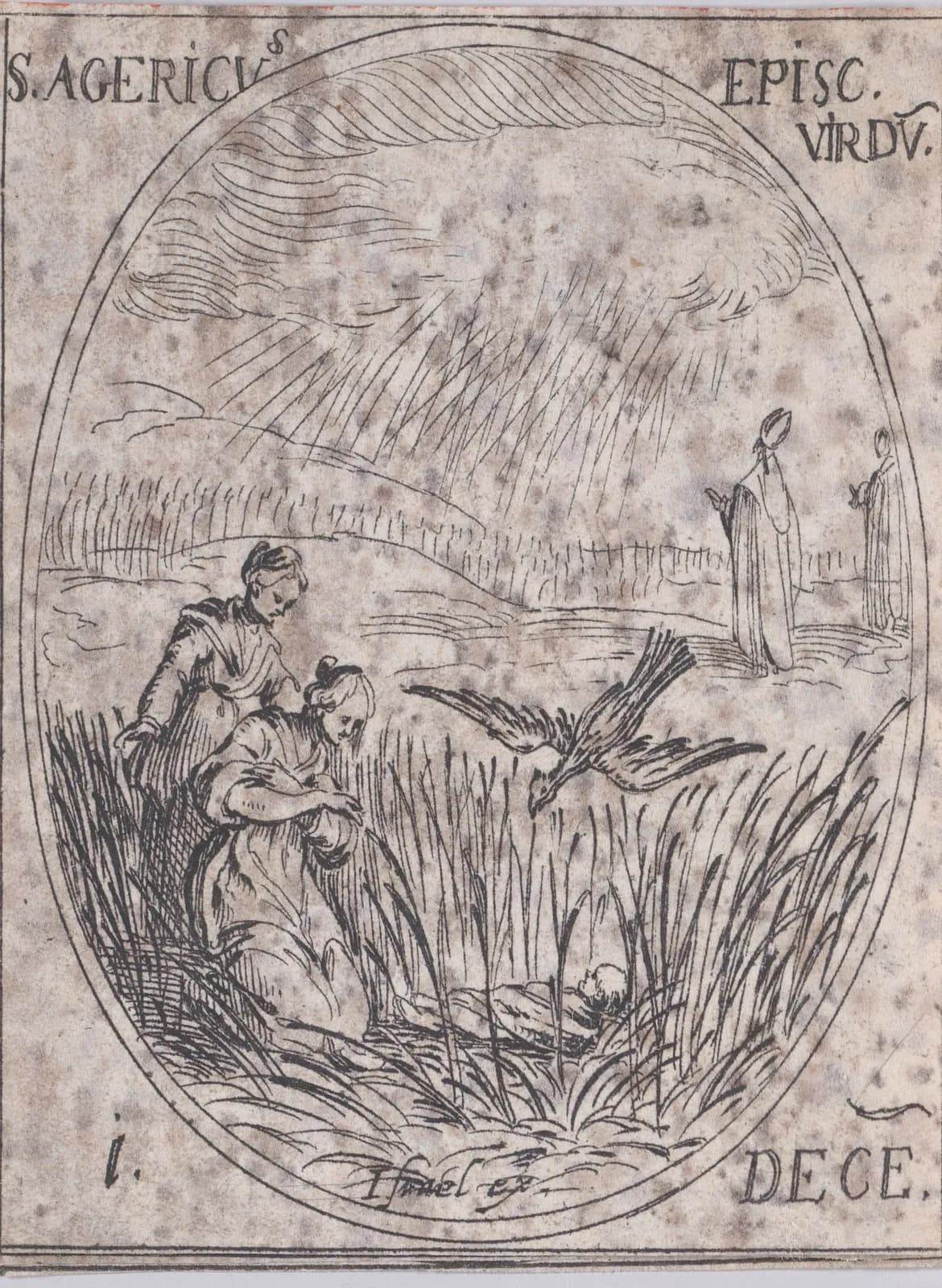
One legend is attached to him. katolsk.no calls it very old: the young King Childebert and his court came to dine with him, and the warriors drank until the wine ran out. 1 Agericus blessed the last cask, and it poured for the rest of the meal without emptying. 1 He has been shown with that barrel ever since. 1
What is Saint Agericus the patron saint of?
Saint Agericus's feast day
Saint Agericus's feast day is December 1. 12 The current Roman Martyrology keeps him on that day, as a bishop at Verdun in Austrasia. 2 katolsk.no adds that since 1976 the diocese of Verdun has celebrated him on February 8, together with his successor Saint Paul, while elsewhere the day remains December 1. 1
Praying with Saint Agericus
Agericus had every advantage a bishop of his time could have. He was the godson of one king and the godfather of another, and Gregory and Fortunatus both counted him a friend. 14 He used that standing to ask for mercy for men who had little claim on it. 13
It mostly did not work. Gunthram Boso, whom Gregory plainly despised, died under the lances anyway, and Bertefred was killed in the bishop's own chapel in front of him. 13 Gregory does not soften the result; in Brehaut's summary, it broke the bishop's heart. 3
Even his one recorded exorcism ends without success: the spirit spoke, and the woman went away still possessed. 3 Gregory records it all the same.
What survives of Agericus is a bishop who kept asking. He did it for a duke nobody trusted and a rebel nobody could protect, and he grieved for them when it failed. 13
Saint Agericus of Verdun, pray for us.
Sources
- 1."Den hellige Agericus av Verdun (~521-591)," Den katolske kirke (katolsk.no), Catholic Diocese of Oslo (in Norwegian).
- 2.Roman Martyrology, entry for December 1, "Sant'Agerico, vescovo," as printed in "Santo del giorno," Conferenza Episcopale Italiana (in Italian).
- 3.Gregory of Tours, History of the Franks, Books III, VII and IX, trans. Ernest Brehaut (New York: Columbia University Press, 1916), Internet Medieval Sourcebook, Fordham University.
- 4.Georges Goyau, "Diocese of Verdun," The Catholic Encyclopedia, Vol. 15 (New York: Robert Appleton Company, 1912).
Saints to turn to next
Others in this collection who are turned to for some of the same things.