Saint Lebuin
Died c. 770-775
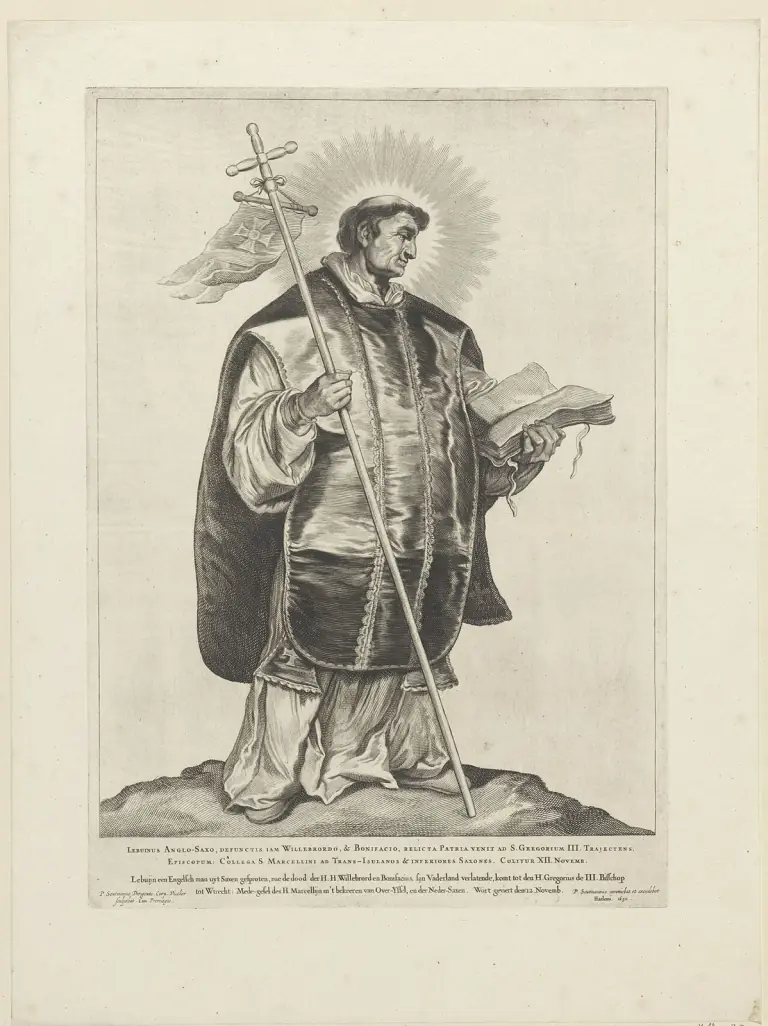
Saint Lebuin was an English priest who went to the eastern Netherlands in the eighth century, built the first church at Deventer on the IJssel, and walked into the yearly assembly of the pagan Saxons at Marklo in his vestments, carrying a cross and the Gospels, to tell them there was one God. 123 They cut stakes to kill him and he got away, and an old nobleman persuaded them to let God's ambassador preach. 13 He died at Deventer before 776, and his feast is November 12. 14
An Englishman in Frisia
He was born in England of Anglo-Saxon parents, at a date no source knows. 12 Butler says that "in his own language" he was called Liafwin. 3 katolsk.no adds that he became a Benedictine monk at Saint Wilfrid's monastery of Ripon in Yorkshire. 2
Like Boniface and Willibrord before him, he resolved to give his life to converting the peoples on the other side of the North Sea. 123 katolsk.no says he crossed in 754, the year Boniface was killed. 2 Butler gives no year for his arrival and puts the building of his first chapel "about the year 772." 3
At Utrecht he went to Gregory, Boniface's disciple, who was governing the church there. 123 Gregory welcomed him and gave him as a companion Marchelm, or Marcellinus, who had been a disciple of Willibrord from childhood, and sent the two of them to the country on the IJssel now called Overijssel, on the border with the still pagan Saxons of Westphalia. 123
Wilp and Deventer
A woman named Abachilda took him in. The encyclopedia calls her a widow; Butler says he was "received as an angel from heaven" by her. 13 He preached, and many were converted, and he built a little chapel at Wilp, on the west bank of the IJssel. 123
The encyclopedia credits "the venerable personality and deep learning of the missionary" with winning many people, even nobles, so that a larger church was soon needed. 1 He built it at Deventer on the east bank, and a house for himself beside it. 12 katolsk.no calls Deventer the center of all his work. 2
Not everyone was won. According to the encyclopedia and katolsk.no, the pagans put his success down to witchcraft, made common cause with the Saxons, burned the church at Deventer and scattered his converts, and Lebuin barely escaped. 12 Butler tells it in a different order and places the burning of the church later, after Marklo, when the Saxons were at war with Charlemagne. 3
At the assembly of the Saxons
The Saxons held a yearly assembly at Marklo to decide the affairs of their nation. Butler says they were divided into three ranks, nobles, freemen and the servile class, and that twelve men were chosen from each rank in every village to attend. 3 The encyclopedia and Butler place Marklo near the Weser in Saxony; katolsk.no identifies it with Markelo in the Netherlands. 123
Lebuin decided to go there himself. A nobleman named Folchert, apparently a Christian, gave him lodging and tried in vain to talk him out of it. 12 He entered the assembly while the Saxons were offering their sacrifices, dressed in his priestly vestments, the cross in one hand and the Gospels in the other. 123 Butler gives the opening of his words: "Hear me, all of you: listen to me, or rather to God who speaks to you by my mouth. Know that the Lord, the Maker of the heavens, the earth, and all things, is one only true God." 3
He warned them, in the encyclopedia's words, that if they kept to their idols "a bold, skilful, and mighty king would advance upon them like a raging torrent, destroy everything with fire and sword." 1 The Saxons were enraged. Men ran to the hedges, pulled up stakes and sharpened them to kill him, but he passed through them and escaped. 13
Then an old nobleman, whom the encyclopedia names Buto, reminded the assembly that they had always received ambassadors from the Normans, the Slavs and the Frisians with honor and let them go in peace, and here they were threatening the ambassador of the highest God, whose power had just saved his servant. 12 Butler's version has the speaker say that if they honored ambassadors from men, they owed more to an ambassador from God. 3 The Saxons agreed that he should be free to go and preach where he pleased. 23
His death and his church
Lebuin went back to Deventer, rebuilt the church, and died there. 123 The encyclopedia puts his death about 770; katolsk.no about 773, perhaps 775; Butler says only that he finished his course "by labours and austerities before the close of the eighth century." 123 He was buried in the church he had built. 123
The encyclopedia and katolsk.no say his death must have been before 776, because in that year the Saxons raided the district again and burned the church, and searched for three days for his body without finding it. 12 A few years later Saint Ludger rebuilt the church and found his remains. 12 Butler says his relics became "famous for miracles," and that Bishop Bertulf of Utrecht later founded a collegiate church of canons at Deventer with Lebuin as its titular saint. 3
His life was written by Hucbald, a monk of Saint-Amand. 123 katolsk.no adds that Hucbald worked from an older Life, the Vita Lebuini antiqua, from about the middle of the ninth century. 2
katolsk.no is careful to say what he was not: not a bishop, and not the Bishop Leofwine who wrote with Boniface to King Ethelbald of Mercia. 2 It also notes that the Martyrology keeps another saint on the same day, Livinus of Ghent, and that many historians think the two may be one. 2
What is Saint Lebuin the patron saint of?
Saint Lebuin's feast day
Saint Lebuin's feast day is November 12. The current Roman Martyrology, as the Italian bishops print it, enters him that day at Deventer as a priest and monk from England who worked to bring the people of the region "the peace and salvation of Christ." 4 The encyclopedia, Butler and katolsk.no give the same day. 123
katolsk.no notes that the day is kept especially in the Netherlands, and that Utrecht also keeps the translation of his relics on June 25. 2
Praying with Saint Lebuin
Most of his work was ordinary: a widow's house, a chapel, a larger church when the first was too small, a house beside it. 12 It was burned, and he built it again. 13
Marklo was the one dramatic hour, and the sources tell it as a man with nothing but vestments, a cross and a book walking into a gathering that was in the middle of its sacrifices. 13 Butler says he seemed to gather more courage from persecution, and his host had begged him not to go. 13
What saved him, in the story, was not his speech but an old pagan who remembered how his people treated ambassadors. 12 The sources give that man a name.
He died without seeing the Saxons converted, and the church he built was burned again within a few years. 12 Someone else rebuilt it, and found him. 12
Saint Lebuin, pray for us.
Sources
- 1.Thomas Kennedy, "St. Lebwin," The Catholic Encyclopedia, Vol. 9 (New York: Robert Appleton Company, 1910).
- 2.Per Einar Odden, "Den hellige Lebuin av Deventer (d. ~773)," Den katolske kirke (Catholic Church in Norway), katolsk.no (in Norwegian).
- 3.Alban Butler, "Saint Lebwin, Patron of Daventer, C.," November 12, in The Lives of the Fathers, Martyrs, and Other Principal Saints, Vol. XI (Derby: Thomas Richardson and Son, 1846).
- 4.Roman Martyrology, entries for November 12, Santo del giorno, Conferenza Episcopale Italiana (in Italian).
Saints to turn to next
Others in this collection who are turned to for some of the same things.