Saint Lawrence Justinian
1381 - January 8, 1456
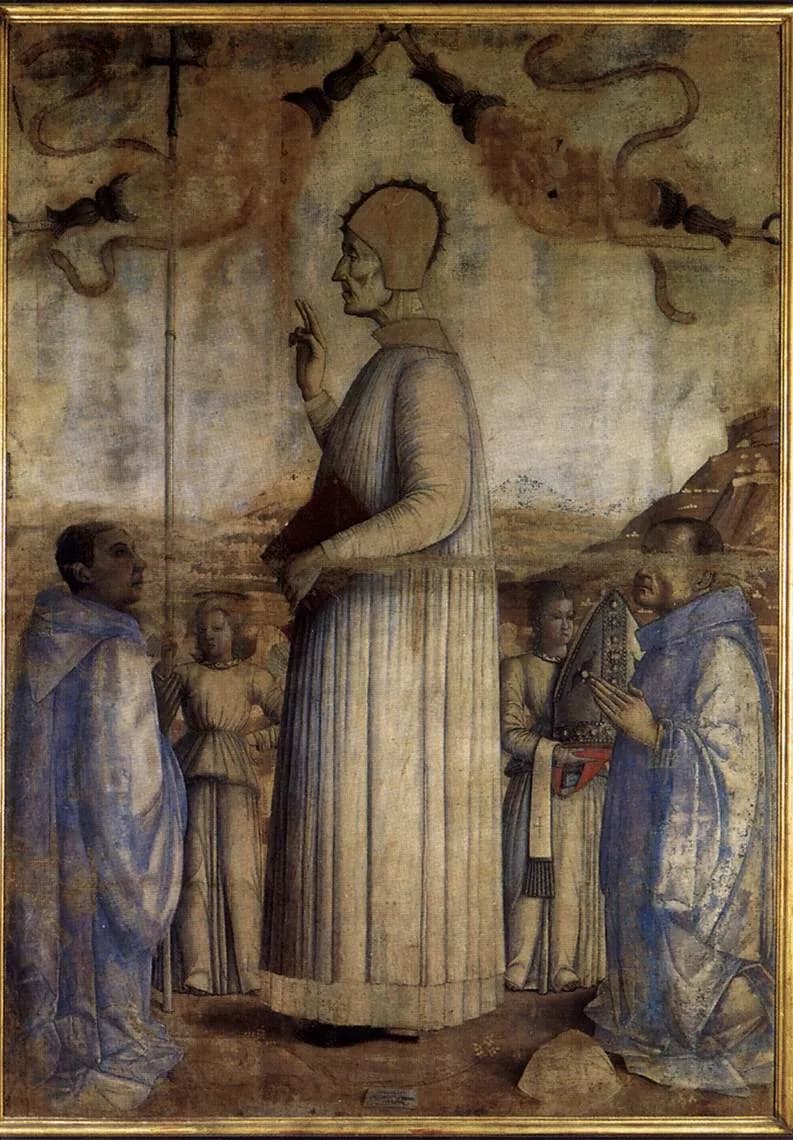
- Born
- 1381, of the Giustiniani, a patrician family of Venice 1
- Entered religious life
- 1400, at about nineteen, on the island of Alga near Venice 1
- Ordained
- 1406 1
- Bishop of Castello
- May 12, 1433, named by Pope Eugene IV 1
- First Patriarch of Venice
- October 8, 1451, under Pope Nicholas V 1
- Canonized
- 1690, by Pope Alexander VIII 1
- Patronage
- Venice, Italy, as Catholic Culture lists it 2
Saint Lawrence Justinian was a Venetian nobleman who at nineteen joined a community of canons on an island near Venice, and who ended his life as the first Patriarch of Venice. 1 As bishop he gave away whatever money came to him and lived poorly himself, and on his deathbed he refused a softer bed. 12 He is remembered on January 8, the day he died. 26
A Giustiniani of Venice
He was born in 1381 into the Giustiniani, a patrician family of Venice which, the Catholic Encyclopedia notes, "numbered several saints among its members." 1 The Holy See and Vatican News use the Italian form of his surname, Giustiniani, and English sources spell his first name both Lawrence and Laurence. 2356
The two main sources give his mother different parts. The encyclopedia says she "sowed the seeds of a devout religious life in the boy's youth." 1 Catholic Culture says she "had planned a glorious career for him, but he preferred a simple and holy life." 3
The turning point came when he was nineteen. Pius Parsch, whom Catholic Culture excerpts, tells it as a vision of Eternal Wisdom "in the guise of a maiden encircled with light," who invited him to seek her and not his own pleasure. 2 The encyclopedia does not mention a vision. It says only that in 1400, "when he was about nineteen years old," he entered a monastery. 1
The canons of San Giorgio in Alga
The monastery was on the island of Alga, near Venice. 1 The encyclopedia describes it as a house of Canons Regular of Saint Augustine, and says that about this time it "was changed into a congregation of secular canons living in community." 1 Parsch calls him "a clerk regular of St. George," and Catholic Culture speaks of "the canons of St. George of Alga," among whom he lived "in constant prayer and penance." 23
Young as he was, the encyclopedia says, "he excited admiration by his poverty, mortifications, and fervour in prayer." 1 He was ordained a priest in 1406. After that he was chosen prior of the community, and soon afterward general of the congregation. 1 He gave the canons their constitution, and he worked so hard to spread their way of life that "he was looked upon as the founder." 1
Bishop of Castello
His holiness and his zeal for souls came to the notice of Pope Eugene IV, who made him bishop of Castello on May 12, 1433. 1 Catholic Culture says it was Eugene who called him the "ornament and glory of bishops." 2
Castello was a diocese within Venice itself. Its see had been set up in 775 on the island of Olivolo, afterward called Castello, and it belonged to the Patriarchate of Grado. 14
The encyclopedia lists what he did there. He "restored churches, established new parishes in Venice, aided the foundation of convents, and reformed the life of the canons." 1 It puts something else first, though: "above all he was noted for his Christian charity and his unbounded liberality. All the money he could raise he bestowed upon the poor, while he himself led a life of simplicity and poverty." 1 Catholic Culture adds that he "maintained his austerity" in office and "combated the excesses of humanism." 3
He was respected well beyond his diocese, by the leaders of Church and state in Italy and elsewhere. 1 Parsch credits him with the gift of tears and the gift of prophecy, and says that one Christmas night the Christ Child appeared to him. 2
The first Patriarch of Venice
On October 8, 1451, by the encyclopedia's date, Pope Nicholas V united the see of Castello with the Patriarchate of Grado and moved the patriarch's seat to Venice. Lawrence was named the first Patriarch of Venice. 1 The encyclopedia's separate article on Venice names the bull, Regis aeterni, and says Venice thereby inherited the whole metropolitan jurisdiction of Grado; it prints the year as 1457, which would fall after his death. 4
He held the office "till his death somewhat more than four years later." 1 Parsch observes that Venice was then at the height of its wealth and influence, and that God made the proud city understand "that her greatness resulted more from the sanctity of her poor patriarch Lawrence than from the diplomacy of her doges and the power of her galleys." 2
He also wrote. The encyclopedia says he tried to foster the religious life "by his sermons as well as by his writings," and that his ascetical works were printed often after his death, first at Brescia in 1506, then at Paris in 1524 and Basel in 1560. 1
Death and canonization
Parsch tells the story of his last illness. When those around him tried to move him to a more comfortable bed, he refused, saying, "My Savior died not on feathers but on the hard wood of the Cross," and asked to be laid on the couch he always used. 2 As the end came he raised his eyes and said, "I am coming, good Jesus, to You." 2
He died on January 8. The encyclopedia gives the year as 1456; Parsch and Catholic Culture give 1455. 123 His relics are in San Pietro di Castello, which the encyclopedia calls one of the oldest churches in Venice. 4
His life was written by his nephew, Bernardo Giustiniani. 1 Clement VII ratified his beatification in 1524, and Alexander VIII canonized him in 1690. 1 Almost five hundred years later he was still a model for his successors: the Holy See's biography of John XXIII says that as Patriarch of Venice the future pope followed "in the footsteps of the holy Bishops whom he had always venerated: Saint Lawrence Giustiniani, the first Patriarch of Venice, and Saint Pius X." 5
What is Saint Lawrence Justinian the patron saint of?
Saint Lawrence Justinian's feast day
Saint Lawrence Justinian is commemorated on January 8, the day of his death. Vatican News lists him on that day as "St. Lawrence Giustiniani, Patriarch of Venice," and Catholic Culture marks him there as a commemoration of the Roman Martyrology. 26
For a long time his feast was September 5. The encyclopedia says Pope Innocent XII appointed that date, and Catholic Culture notes that it is still his feast in the 1962 Missal. 13
Praying with Saint Lawrence Justinian
He came from a patrician family in a city at the height of its wealth, and he spent his life giving away what came to him. 12 The encyclopedia's picture of him does not change from the island to the patriarch's chair: poverty and prayer at nineteen, and "a life of simplicity and poverty" as a bishop with money passing through his hands to the poor. 1
He did not treat administration as beneath him. He wrote a constitution, restored churches, established parishes and reformed his canons. 1 The sources show the same man doing both things, and they do not suggest he found them at odds.
The deathbed line is characteristic. He was not making a speech. Somebody had offered him a softer bed, and he answered that his Savior had not died on feathers. 2 Then he asked for his own couch back. 2
Saint Lawrence Justinian, pray for us.
Sources
- 1.Johann Peter Kirsch, "St. Lawrence Justinian," The Catholic Encyclopedia, vol. 9 (New York: Robert Appleton Company, 1910).
- 2."St. Lawrence Justinian," Liturgical Year calendar for January 8, Catholic Culture; excerpted from Pius Parsch, The Church's Year of Grace.
- 3.Liturgical Year calendar for September 5, Catholic Culture (note on St. Laurence Justinian and the 1962 Missal).
- 4.Umberto Benigni, "Venice," The Catholic Encyclopedia, vol. 15 (New York: Robert Appleton Company, 1912).
- 5."Biographical Profile of His Holiness Pope John XXIII," The Holy See.
- 6."St. Lawrence Giustiniani, Patriarch of Venice," Saint of the Day, 8 January, Vatican News.
Saints to turn to next
Others in this collection who are turned to for some of the same things.
- Saint André BessetteAugust 9, 1845 - January 6, 1937PrayerWork and vocationPoverty and simplicity
- Saint Benedict the Moor1524 or 1526 - April 4, 1589Work and vocationPoverty and simplicityPrayer
- Saint Crispin of ViterboNovember 13, 1668 - May 19, 1750Work and vocationPoverty and simplicityPrayer
- Saint Didacus of Alcalác. 1400 - November 12, 1463Work and vocationPoverty and simplicityPrayer