Saints Justus and Pastor
d. 304
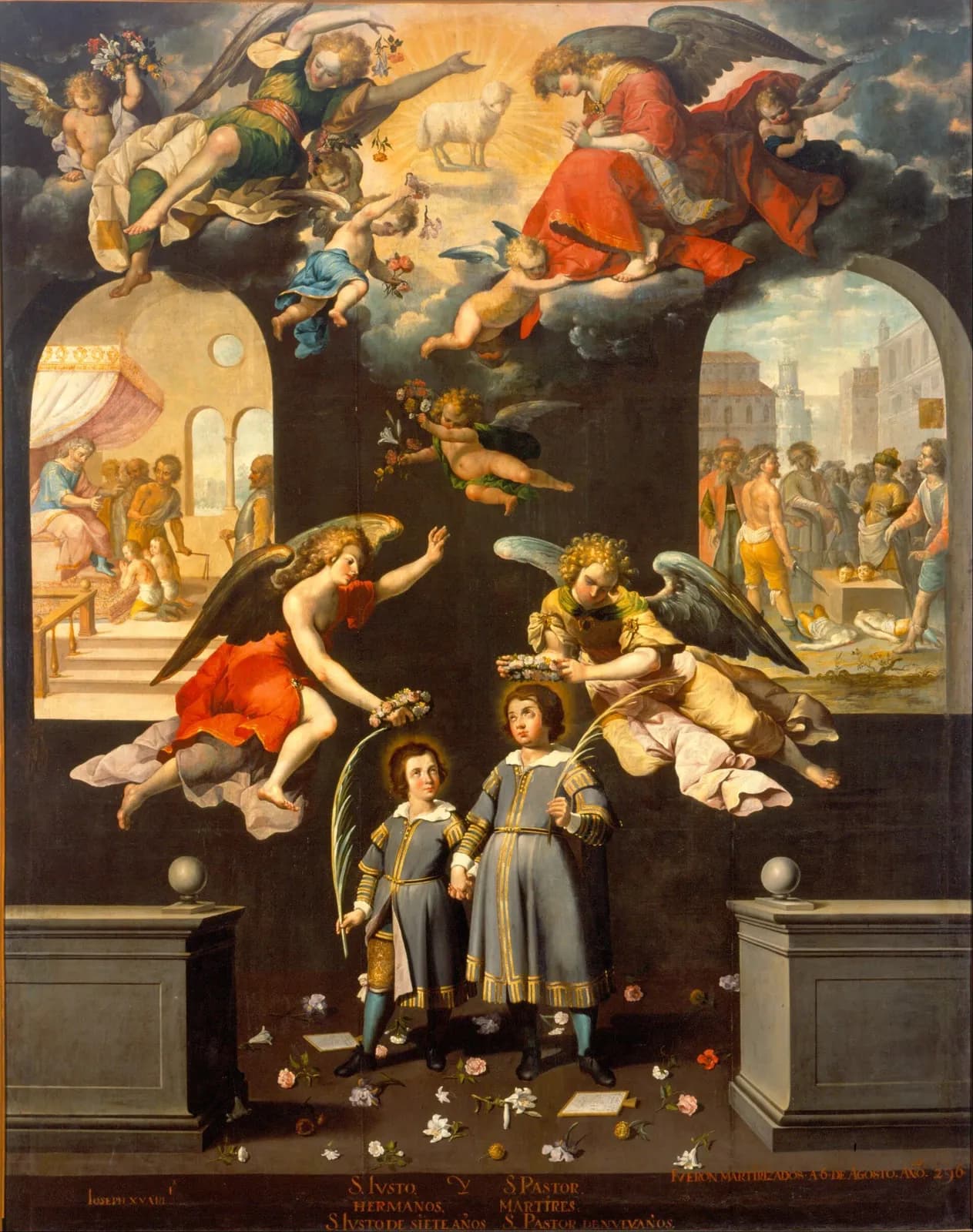
Saints Justus and Pastor were two brothers, still schoolboys, who were beheaded at Complutum, now Alcalá de Henares, in the year 304. 124 The Roman Martyrology says they left their writing tablets at school and ran of their own accord to martyrdom, and that they encouraged each other while they were flogged and put to death. 1 Their Acts are late and unreliable, but their cult is old, and they are the patrons of Alcalá. 23
Complutum under Diocletian
Complutum was a Roman town on the Henares, some twenty miles from where Madrid now stands. 5 James Grey, writing on the diocese of Madrid-Alcalá in the 1910 Catholic Encyclopedia, notes that the Moors later fortified it and called it Alcalá, "the stronghold or castle," and calls it "one of the first bishoprics founded in Spain." 5
The Archdiocese of Madrid's daily santoral sets the boys' story inside the great persecution of the early fourth century, when Diocletian, urged on by his fellow rulers, issued decree after decree against the Christians. 3 In the far west of the empire he was represented by a governor named Dacian, and the santoral counts Vincent and Eulalia among the martyrs of the same campaign in Spain. 3 The Norwegian bishops' saints database (katolsk.no) describes Dacian traveling through the country in a frenzy of violence, and says he reached Complutum in 304, where proclamations ordered every Christian to renounce the faith on pain of death. 2
Two boys and their tablets
Justus and Pastor were brothers, born in Complutum, according to katolsk.no. 2 Their ages are given differently. katolsk.no makes Justus thirteen and Pastor nine, with births around 291 and 295. 2 The Madrid santoral says only that they were two children of about seven and nine. 3
The Roman Martyrology tells what happened in one sentence. Still children, they left their writing tablets at school and ran of their own accord to martyrdom; they were seized at once, beaten with rods on the governor's orders, and both put to death by the sword for Christ, encouraging each other as they died. 1 katolsk.no fills this out: hearing of the proclamations, the two decided to show that their faith was as strong as any adult's, ran from school and declared themselves Christians. 2 Dacian expected two schoolboys to give way easily and had them flogged, but neither yielded, to the astonishment of the onlookers, and the brothers called encouragement to each other. 2
Shamed by their courage, Dacian still wanted them dead but had the sentence carried out in secret. 2 katolsk.no says they were beheaded outside the town with no spectators, and that fellow Christians found the bodies and buried them where they had died. 2 The Madrid santoral agrees that they were probably beheaded outside the walls of Complutum. 3
What can be known
The sources are frank about how little of this is history. The Madrid santoral calls the Acts late, inauthentic and not at all credible: they gather an oral tradition handed down for generations, which an anonymous writer set down and adapted, or invented, for the sake of good catechesis. 3 What can be known, it says, is that they were two children who presented themselves to Dacian of their own accord as disciples of Christ and were beheaded for it. 3 katolsk.no reaches the same verdict in fewer words: the Acts are doubtful, the cult is genuine and old. 2
The witnesses to that cult are early. The Madrid santoral notes that Prudentius named the two boys in his poems on the martyrs of Spain and their cities, that Venantius Fortunatus mentioned them, and that they stand in the Visigothic calendars, in Isidore of Seville's writings and in the Mozarabic liturgy. 3 It adds that Ildefonsus of Toledo, in the seventh century, reworked the dialogue between the brothers in an appendix of his own, so that a version of their last conversation was already being handed on three hundred years after it was supposed to have taken place. 3 The Spanish text of the Martyrology on Catholic.net places Complutum in the Roman province of Carthaginensis. 4 katolsk.no adds that Saint Paulinus of Nola had his infant son buried near their bodies at Complutum in 392, and that their names appear in the Martyrology of Jerome on August 25. 2
The relics and the cathedral
According to the Madrid santoral, Asturius, bishop of Toledo, would not leave Complutum once their remains had been found there. 3 The town became a see with Asturius as its first bishop, and he built the first basilica in their honor on the spot. 3 katolsk.no tells a different story of the relics: the bodies said to be theirs were discovered in the eighth century and carried to Huesca. 2
Both sources bring part of the relics home again. Catholic.net reports that Pope Pius V ordered their return from Huesca to Alcalá in a bull of 1567, and that King Philip II and his son, Prince Charles, each wrote to the bishop of Huesca that November to see it done. 4 katolsk.no gives the year of the return as 1568, and says the relics lie under the high altar of the collegiate church in Alcalá. 2 James Grey records that the chapel of Alcalá's famous university was also dedicated to "Saints Just and Pastor." 5
The cult did not stay in Castile. katolsk.no says it spread to France and Sardinia, and that Narbonne keeps a feast of the translation of their relics on February 26. 2 The Madrid santoral says devotion to the two boys soon spread across Christian Spain and beyond the Pyrenees. 3
What are Saints Justus and Pastor the patron saints of?
They are the patron saints of Alcalá de Henares. 23 The Madrid santoral calls them patrons of Alcalá and of the whole archdiocese of Madrid; katolsk.no counts them among the patrons of Alcalá and Madrid. 23 Catholic.net notes that in Alcalá they are simply called the Holy Children, the Santos Niños. 4 No source consulted names a patronage beyond these places.
Saints Justus and Pastor's feast day
The feast of Saints Justus and Pastor is August 6. 12 The current Roman Martyrology enters them on that day, at Alcalá de Henares, as brothers and martyrs. 1 katolsk.no adds that the older Martyrology of Jerome lists them on August 25, and that Narbonne keeps the translation of their relics on February 26. 2
Praying with Saints Justus and Pastor
The one detail every source keeps is the school tablets. The Martyrology has the boys leave them behind and run; it does not say anyone sent for them. 1 Whatever their exact ages, they were young enough that their courage surprised the people who watched. 2
They were brothers, and they went together. The Martyrology and katolsk.no both remember that they spoke to each other under the rods, each keeping the other steady. 12 Neither is ever described alone.
Most of what is told about them cannot be checked, and the Church's own sources say so. 23 What remains is a name on a very old list, two boys who would not deny Christ, and a town that has kept their memory for some seventeen centuries. 13 Less than a century after their deaths, Paulinus of Nola had his small son buried near them. 2
Saints Justus and Pastor, pray for us.
Sources
- 1.Roman Martyrology, entry for August 6, "Santi fratelli Giusto e Pastore, martiri," as printed in "Santo del giorno," Conferenza Episcopale Italiana (in Italian).
- 2."De hellige Justus og Pastor," Den katolske kirke (katolsk.no), Catholic Diocese of Oslo (in Norwegian).
- 3."Justo y Pastor, mártires († 304)," Oración y Liturgia, Archdiocese of Madrid, August 6 (in Spanish).
- 4."Justo y Pastor, Santos," Catholic.net (in Spanish).
- 5.James Grey, "Madrid-Alcalá," The Catholic Encyclopedia, Vol. 9 (New York: Robert Appleton Company, 1910).
Saints to turn to next
Others in this collection who are turned to for some of the same things.
- Saint Adelaide931 - December 16, 999Marriage and familyCourage
- Saint Adrian of Nicomediad. c. 304-306CourageMarriage and family
- Saints Chrysanthus and Dariad. about 283CourageMarriage and family
- Saint EustaceMartyred at Rome, in 118 by tradition; other accounts give 140 or 188CourageMarriage and family