Saint Juliana Falconieri
1270 - June 1341
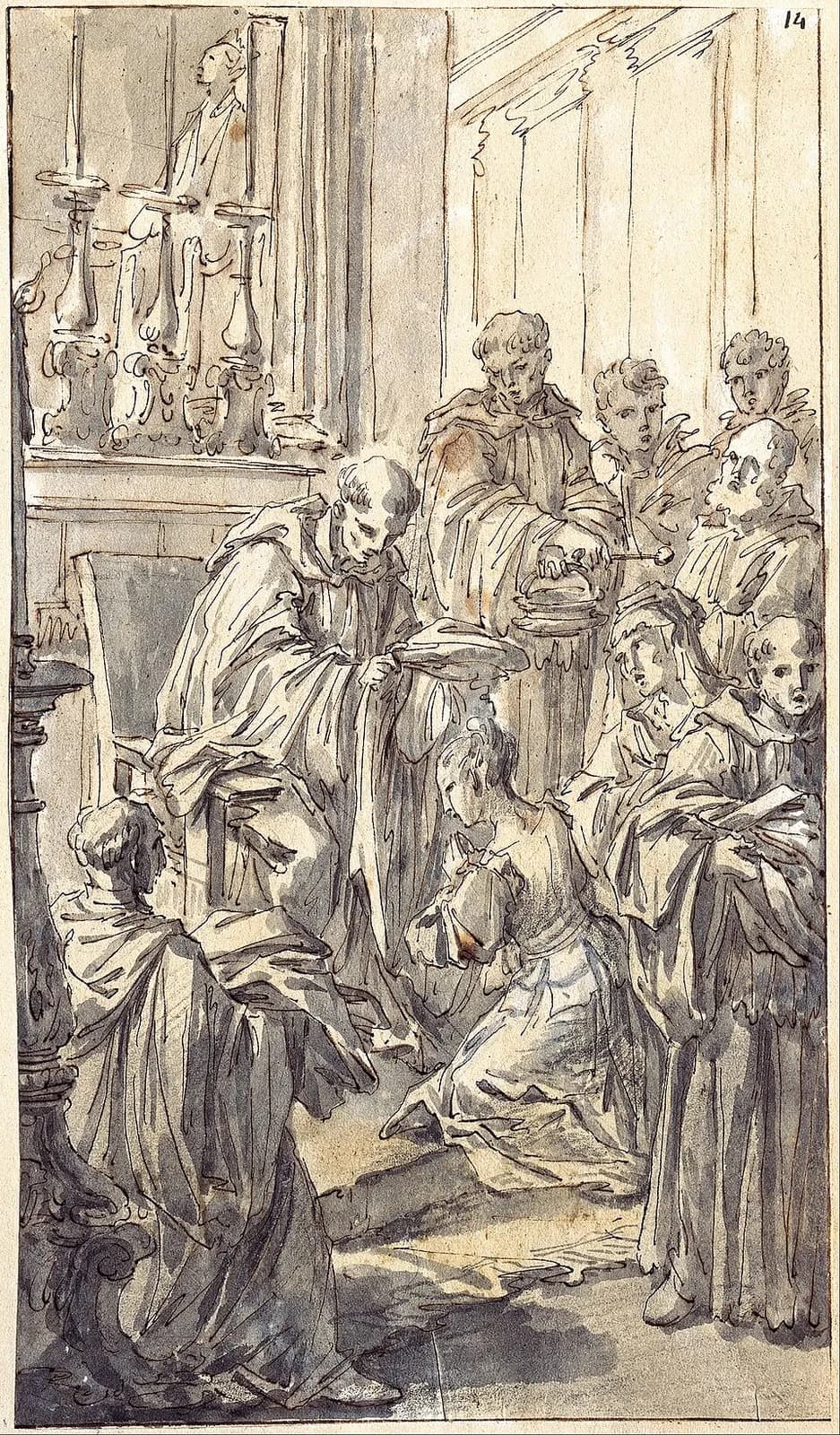
- Clothed
- With the Servite Third Order habit by Saint Philip Benizi, about 1285 (Kirsch) or 1284 (Servants of Mary) 15
- Founded
- The Sisters of the Third Order of Servites, the Mantellate, in their first convent in 1305 15
- Beatified
- July 26, 1678, by Pope Innocent XI 3
Saint Juliana Falconieri was a Florentine noblewoman, niece of one of the seven founders of the Servites, who took the habit of the order's Third Order from Saint Philip Benizi as a girl and in 1305 founded the community of Servite sisters called the Mantellate, which she led for the rest of her life. 15 She is known for the way she died in 1341: too ill to swallow the Host, she asked that it be laid on her breast, and the 1913 Catholic Encyclopedia and Vatican News record that it disappeared and that the image of a cross was found there. 12 Her feast is June 19. 123
A Falconieri of Florence
Juliana was born in 1270 into the Falconieri, a noble Florentine family that the Dicastery for the Causes of Saints describes as rich merchants. 13 Vatican News sets her life in a city torn between the Guelphs, who backed the popes, and the Ghibellines, who backed the emperors, and says her family was deeply involved in its affairs. 2
Her father's brother was Alexis Falconieri, one of the seven young Florentines who founded the Servants of Mary. 13 Kirsch, writing in the Catholic Encyclopedia in 1910, says it was through his influence that she gave herself to religious life from her earliest youth. 1 Vatican News says she turned down offers of marriage and preferred the Servite habit to the fashions of her peers. 2
The order she was drawn to was still young. The encyclopedia's article on the Servants of Mary says it began on the feast of the Assumption in 1233, when the seven, members of a lay confraternity devoted to Mary, saw a vision of the Virgin and left the world, later withdrawing to Monte Senario outside Florence. 5 Its habit was black: in the vision as that article tells it, the Virgin herself gave the founders the habit and said its dark color would recall her sorrow at the cross; the order's distinctive devotion was meditation on the Passion of Jesus and the Sorrows of Mary. 5 Griffin adds that of the seven founders, Alexis alone lived to see their foundation raised to the dignity of an order, and that he died in 1310, five years after his niece opened her first convent. 14
The habit from Philip Benizi
After her father died she received the habit of the Servite Third Order from Saint Philip Benizi, then the order's prior general. 1 Kirsch dates it about 1285; the encyclopedia's article on the Servants of Mary says 1284. 15 McGinnis, the encyclopedia's writer on Philip, counts her as perhaps the greatest of those he brought into the order. 6
She did not leave home at once. Until her mother died she lived in her parents' house under the rule Philip had given her, which Kirsch lists as perfect chastity, strict mortification, severe penance, zealous prayer and works of charity. 1
The Mantellate
After her mother's death, in 1305, she and several companions moved into a house of their own, which Kirsch calls the first convent of the Sisters of the Third Order of Servites. 1 She was its superior for the rest of her life, thirty-five years by his count. 1 The sisters wore a black gown with a leather girdle and a white veil. 1
People called them the Mantellate, and the sources explain the name in two ways. Kirsch says the gowns had short sleeves to make work easier, and the name came from that. 1 Vatican News and the Dicastery say it came from the dark cloaks the women wore in imitation of the Servite friars. 23
Their work was the care of the sick and other works of mercy, and Kirsch says Juliana led it by her own example. 1 Vatican News adds that they fasted completely on Wednesdays and Fridays and lived on bread and water on Saturdays, and that in a city of deadly vendettas they became known for promoting peace, offering their sacrifices for an end to the hatred. 2 Martin V sanctioned the order of Servite tertiaries in 1420. 1 They were distinct from the cloistered Servite nuns of the Second Order, which the same article says was probably founded shortly after Philip Benizi's death by Blessed Helen and Blessed Rose. 5
Her last Communion
For many years, Vatican News says, she suffered from a stomach illness that made it hard to eat solid food, and in time she could not swallow even the little she needed to live. 2 At the end she could not receive Communion; Kirsch gives the reason as constant vomiting. 12
She asked the priest to spread a corporal on her breast and lay the Host on it. 12 Kirsch tells what followed: shortly afterward the Host disappeared and Juliana died, and the image of a cross, like the one on the Host, was found on her breast. 1 Vatican News tells it the same way and says it was widely acclaimed as a Eucharistic miracle. 2 The Dicastery introduces the account as something that is told, and describes a violet mark the size of the Host over her heart. 3
Kirsch notes that the event is mentioned in the collect of her feast. 1 Her sisters, according to Vatican News and the Dicastery, still wear the sign on their habit in memory of it, and Kirsch says she is usually painted in her habit with a Host on her breast. 123
She died in June 1341: on June 12 by Kirsch's date, on June 19 by the Dicastery's. 13
Canonization and the spread of her sisters
Kirsch says she was honored as a saint immediately after her death. 1 The Dicastery records her beatification by Innocent XI on July 26, 1678. 3 Kirsch says Benedict XIII granted the Servites permission to celebrate her feast, and that Clement XII canonized her and extended the feast to the whole Church; the Dicastery dates the canonization June 16, 1737. 13
Her community outlived her by centuries. The encyclopedia's article on the Servants of Mary says the Mantellate spread from Italy through Europe, reached England in 1850, and by 1910 had a novitiate at Cherokee, Iowa, and were teaching and caring for orphans and the sick in the United States; it adds that, in imitation of their foundress, they tried above all to instill a great love for Jesus in the Blessed Sacrament. 5 Griffin, writing in 1912, lists houses in the dioceses of Sioux City and Belleville. 4
What is Saint Juliana Falconieri the patron saint of?
Saint Juliana Falconieri's feast day
Saint Juliana Falconieri's feast is June 19, the date given by the 1913 Catholic Encyclopedia, Vatican News and the Dicastery for the Causes of Saints alike. 123 Griffin lists it among the feasts of the Servite saints. 4 Kirsch says Clement XII extended the June 19 celebration to the entire Church when he canonized her in 1737. 1
Praying with Saint Juliana Falconieri
For twenty years after taking the habit she stayed at home, living a religious rule in her parents' house until her mother died. 1 Only then did she found anything. 1 The sources pass over that time quickly, but it was most of her youth.
The work itself was ordinary and hard: nursing, works of mercy, fasting, and, by Vatican News's account, a deliberate effort at peace in a city where families killed one another. 12 She did it for thirty-five years as the person in charge. 1
At the end she was kept from the one thing she wanted by a body that could no longer swallow. 12 What she asked for instead was simple, to have the Host near her, and the sources tell what they say followed. 123 The illness was real and long, and none of them pretends otherwise. 2
Saint Juliana Falconieri, pray for us.
Sources
- 1.Johann Peter Kirsch, "St. Juliana Falconieri," The Catholic Encyclopedia, Vol. 8 (New York: Robert Appleton Company, 1910).
- 2."St. Juliana Falconieri, Virgin, Foundress of the Mantellate," Saint of the Day, June 19, Vatican News.
- 3."Giuliana Falconieri (1270-1341)," Santi e Beati, Dicastery for the Causes of Saints (in Italian).
- 4.Philip Griffin, "Order of Servites," The Catholic Encyclopedia, Vol. 13 (New York: Robert Appleton Company, 1912).
- 5."Servants of Mary (Order of Servites)," The Catholic Encyclopedia, Vol. 9 (New York: Robert Appleton Company, 1910).
- 6.Charles F. McGinnis, "Philip Benizi, Saint," The Catholic Encyclopedia, Vol. 12 (New York: Robert Appleton Company, 1911), reprinted by Catholic Answers.
Saints to turn to next
Others in this collection who are turned to for some of the same things.
- Saint Bernardo TolomeiMay 10, 1272 - August 20, 1348DiscernmentPrayerSuffering and illness
- Saint Carmen RendilesAugust 11, 1903 - May 9, 1977PrayerDiscernmentSuffering and illness
- Saint Clare of Montefalcoc. 1268 - August 1308PrayerSuffering and illnessDiscernment
- Saint Claude de la Colombiere1641 - February 15, 1682DiscernmentPrayerSuffering and illness