Saint Julian of Cuenca
d. January 20, 1208
- Earliest record
- An Arabic deed of 1197 naming him archdeacon of Calatrava, "Julián ben Tauro" 1
- Died
- January 20, 1208, according to the cathedral's obituary; by tradition aged 80 1
- Cult
- Continuous in Cuenca cathedral since 1471; Roman canonization in 1595 1
- Relics
- Burned in 1936; thirty-seven fragments authenticated in 1944 1
- Patron saint of
- The Diocese of Cuenca 1
- Feast day
- January 28 2
Saint Julian of Cuenca was the second bishop of Cuenca, a frontier see in Castile carved out of territory taken from the Moors, from 1198 until his death in 1208. 12 The Roman Martyrology remembers him for giving the goods of his church to the poor and earning his own daily bread with his hands. 2 His diocese, which keeps him as its patron, is unusually candid about him: it says that only a handful of documents survive, all of them administrative, and it separates those from the stories that grew up later. 1
A new diocese on the frontier
Cuenca had been Christian only a short time when Julian came there. Alfonso VIII took the city from the Moors on September 21, 1177, the diocese writes, and on June 1, 1182, Pope Lucius III issued the bulls that made it a bishopric, heir to the old Visigothic sees of Ercávica and Valeria. 1 The Catholic Encyclopedia, writing in 1908, gives 1183 for the new diocese and names its first bishop, Juan Yáñez. 3 The country was still being organized: settlers were arriving, and the economy was built on livestock, farming, weaving and the timber of the pine forests in the hills. 1
What the documents show
The earliest trace of him is a deed of sale from July 1197, kept in the cathedral archive of Toledo. 1 In it the archdeacon of Calatrava buys an estate called Hazaña from Gonzalo Pérez, abbot of Santa María de Husillos in Palencia, for 600 gold mizcales. 1 The deed is written in Arabic, although the abbot had no Arabic-speaking background, and it calls the buyer Julián ben Tauro. 1 That surname, the diocese says, points to Mozarabic ancestry, and it is the reason some have thought him a Toledan. 1
Juan Yáñez probably died at Cuenca on December 15, 1197. 1 Julian had already succeeded him as archdeacon of Calatrava, and now he succeeded him as bishop: he appears as bishop of Cuenca in the first months of 1198, presented by the king, as was the custom, and ordained in Toledo by Archbishop Martín López de Pisuerga. 1 The Martyrology describes him as the second bishop after the city's liberation from the Moors. 2
The documents that survive in Cuenca show a capable governor and a peacemaker in a frontier society. 1 In 1201 he gave the cathedral chapter its first statute, which the diocese says shows real concern for the welfare of its members alongside its rules of discipline; it is the only document in Cuenca that bears his signature. 1 Through his mediation, the chapter and the town council signed agreements governing relations between the canons' servants and the townspeople, and others between the chapter and the clergy of the city and its villages, which tried to soften the canons' power over them. 1
The diocese adds what can reasonably be imagined. New rural parishes were needed in the newly conquered lands, where settlers from the north kept arriving, and many modest churches and a long series of baptismal fonts survive from his time. 1 It is likely, it says, that he had a hand in choosing the new Gothic design of the cathedral, beside whose first courses of stone he would be buried. 1 According to the cathedral's obituary, he died on January 20, 1208, by tradition at the age of eighty. 1
What the legend adds
Everything else in the familiar life comes, the diocese says plainly, from pious memory "coined definitively by the hagiography of the period," in its words translated here. 1 A long tradition makes him a native of Burgos, born in 1128 to honest and devout parents, with signs at his birth of the holiness and the episcopal dignity to come. At his baptism an angel is said to have appeared wearing a miter and carrying a crozier and told those present to name the child Julian. 1 After his mother died he is said to have retired into solitude beside the river Arlanzón, near Burgos. 1
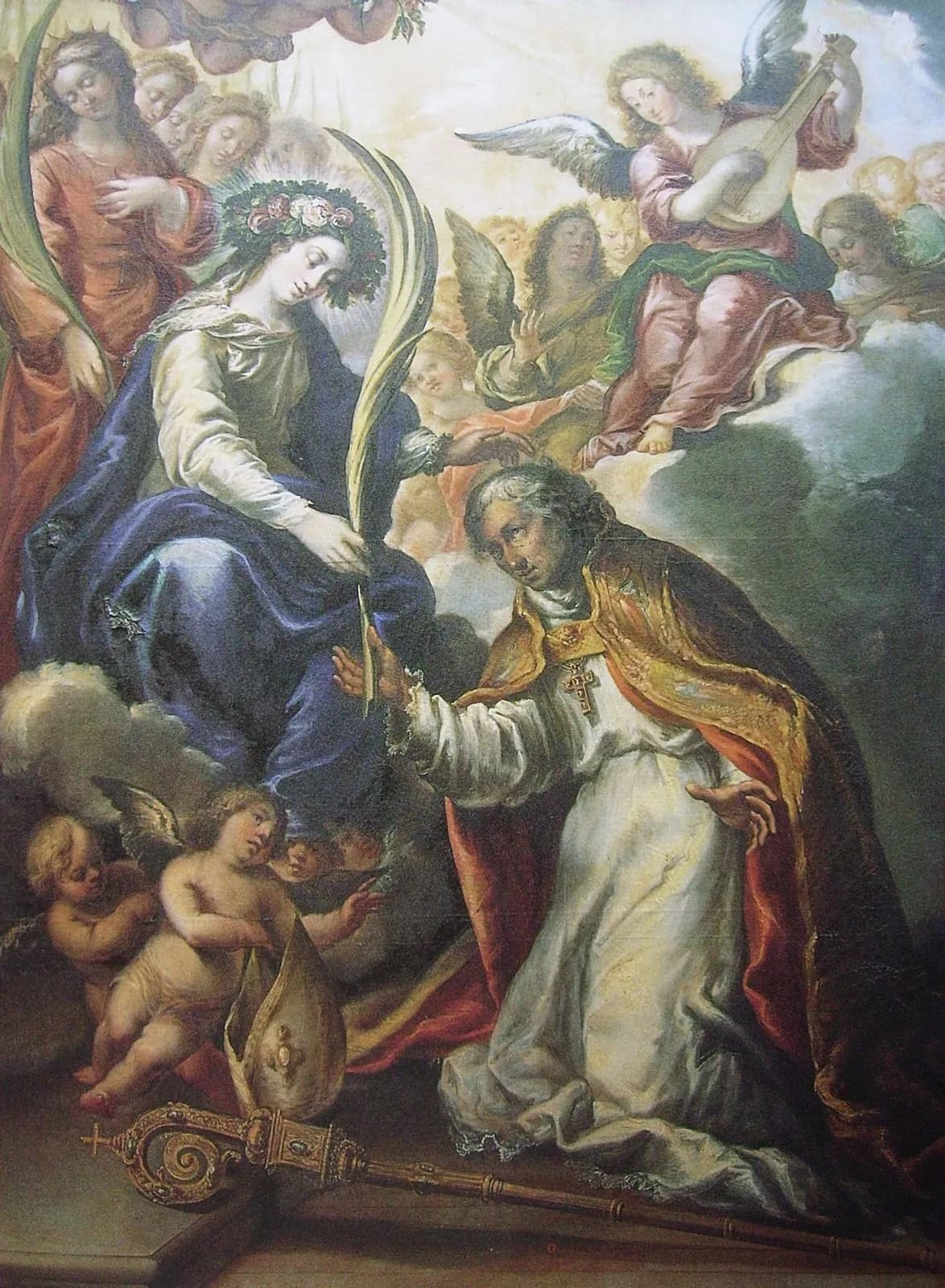
Some biographers describe him preaching across Spain, in the Christian kingdoms of the north and in Muslim lands alike, until his fame reached the archbishop of Toledo, who offered him the archdeaconry of Calatrava. 1 As bishop, the story goes, nothing was left of his revenues after he had shared them among the poor, especially in times of famine and epidemic. Like Saint Paul he worked so as not to be a burden to anyone, weaving wicker and making little baskets in his hours of solitude, and the sale of them kept him and helped to feed the poor. 1 The baroque legend ends, the diocese says, with the Virgin herself giving him at the end of his life a palm like those carried by the martyrs. 1
The Martyrology's entry keeps the core of this. It says he brought honor to the Church by giving her goods to the poor and providing his daily food by the work of his own hands. 2 The diocese, for its part, prints the passage from the Acts of the Apostles in which Paul says that his own hands had served his needs and that "it is more blessed to give than to receive." 1
The cult, the Transparente and the fire of 1936
After a brief attempt in 1447, he has been venerated without interruption in Cuenca cathedral since 1471, when, the diocese says, his body was certainly raised from the grave, the form canonization then took. 1 The chapter set up, in his memory, a charitable fund for the destitute known as the Ark of Saint Julian, or the Ark of Alms. 1 In 1518 his body was moved to what is now called the old chapel of Saint Julian, and many miracles were reported at the tomb. 1 The Roman canonization came in 1595, with a proper office approved for the diocese. 1
On September 8, 1760, the remains were moved with great solemnity to a new altar, the Transparente, designed by the architect Ventura Rodríguez with sculptures of the virtues and scenes from the saint's life by Francisco de Vergara. 1 For almost two centuries the incorrupt body lay there in a chest of precious wood covered with embossed silver. 1 Then, on a day in October 1936, during the Civil War, the chest was destroyed and the body burned in the courtyard of the bishop's palace. 1 Thirty-seven fragments of bone were recovered from the ashes and authenticated in 1944, and in 1947 they were placed in a new chest paid for by a popular subscription, where they are venerated today. 1
What is Saint Julian of Cuenca the patron saint of?
Saint Julian is the patron of the Diocese of Cuenca. 1 When John XXIII confirmed Our Lady of Anguish as the principal patroness of the diocese in a bull of April 13, 1962, he named her its patroness "together with San Julián, second bishop of the same diocese," in the words the diocese quotes, translated here. 1
Saint Julian of Cuenca's feast day
Praying with Saint Julian of Cuenca
Two portraits of him exist, and his own diocese hands both over without pretending they are the same. One is a frontier bishop in the records, buying land, signing statutes, settling quarrels between canons and townspeople. 1 The other is a man weaving baskets by hand to feed the poor, with angels at his baptism and the Virgin bringing him a palm. 1 The Church's official summary rests on the second picture's central point, the poverty and the work of his hands. 2
They are less far apart than they look. A bishop who gave his chapter rules with real concern for its members, who brokered agreements to soften the canons' power over the village clergy, and who, as his diocese imagines him, saw to new parishes for the settlers, was already doing in ink what the legend shows him doing in wicker. 1 The baskets may be pious memory. The charity was remembered by a diocese that named its fund for the poor after him. 1
There is one more thing his story holds. The incorrupt body that Cuenca venerated for centuries was burned in 1936, and what the diocese now keeps is thirty-seven fragments gathered from the ashes. 1 It put them in a new chest paid for by ordinary people, and it has gone on honoring him. 1
Saint Julian of Cuenca, pray for us.
Sources
- 1."Nuestro patrón: San Julián," Diocese of Cuenca (in Spanish).
- 2.Roman Martyrology, entry for January 28, "San Giuliano, vescovo," as printed in "Santo del giorno," Conferenza Episcopale Italiana (in Italian).
- 3.Eduardo de Hinojosa y Naveros, "Cuenca," The Catholic Encyclopedia, Vol. 4 (New York: Robert Appleton Company, 1908).
Saints to turn to next
Others in this collection who are turned to for some of the same things.
- Saint Albert ChmielowskiAugust 20, 1845 - December 25, 1916Poverty and simplicityWork and vocation
- Saint Alexander Sauli1533 or 1534 - October 11, 1592Work and vocationPoverty and simplicity
- Saint André BessetteAugust 9, 1845 - January 6, 1937Work and vocationPoverty and simplicity
- Saint Andrew Corsinic. 1302 - January 6, 1374Poverty and simplicityWork and vocation