Saints Julian and Basilissa
d. early fourth century
- Died
- At Antinoe in Egypt, under Diocletian 123; about 302, says katolsk.no 2; perhaps 313 under Maximin II, says Butler 4
- Basilissa
- Died in peace before the persecution, say the encyclopedia and Butler 14; martyred first, by the original passio 2
- Historical record
- "No historically certain data"; the cult was well established before the eighth century 1
- Also called
- Julian "the Hospitalarian," in Butler 4
Saints Julian and Basilissa were husband and wife, venerated together as martyrs of Antinoe in Egypt under Diocletian. 13 Their Acts say that they vowed on their wedding day to live as brother and sister, turned their house into a hospital for as many as a thousand of the sick and poor, and later governed a monastery each. 24 Julian died a martyr; Basilissa, by most accounts, died in peace before the persecution came. 14 The 1910 Catholic Encyclopedia says plainly that there are "no historically certain data" about either of them, and that their cult was nonetheless well established before the eighth century. 1
A marriage kept in virginity
katolsk.no, the Norwegian bishops' saints database, tells the story from their Greek passio. Julian was a well-educated young man who had resolved to live a consistently Christian life, chastity included. 2 His parents pressed him to marry, and at eighteen, out of obedience, he married Basilissa, who was as fervent a Christian as he was. 2 On the wedding day itself, the passio says, they made mutual vows of lifelong continence. 2 The encyclopedia puts it briefly: "Forced by his family to marry, he agreed with his spouse, Basilissa, that they should both preserve their virginity." 1
Such marriages were fairly common among Christians of the time, katolsk.no says, perhaps as a reaction to the moral decay of the late empire, and the pattern recurs in other lives of the saints. 2 It cites the Bollandist Baudouin de Gaiffier, who showed that the legend of Saint Alexius was built on the story of Julian and Basilissa, and names Chrysanthus and Daria of Rome as another such couple. 2
A house for a thousand
After his parents died, katolsk.no continues, the couple used their large inheritance to help anyone in need, and each founded a monastery, Julian for men and Basilissa for women. 2 In the encyclopedia's telling, Julian "encouraged her to found a convent for women, of which she became the superior, while he himself gathered a large number of monks and undertook their direction." 1
They made their great house into a hospital for the sick and the poor. Butler writes that "if we may credit their acts, they sometimes entertained a thousand indigent persons," Basilissa caring for the women in separate lodgings and Julian for the men. 4 katolsk.no adds that each took the gravest cases in their own wing. 2 For that charity, Butler says, Julian was surnamed "the Hospitalarian," and katolsk.no notes that he is often confused with Saint Julian the Hospitaller for the same reason. 24
Butler sets them in the Egypt of their day, which "had then begun to abound with examples of persons, who, either in cities or in deserts, devoted themselves to the most perfect exercises of charity, penance, and contemplation." 4
Basilissa's death and Julian's martyrdom
The accounts part ways over Basilissa. The encyclopedia says she "died a very holy death, but martyrdom was reserved for Julian," and Butler that she died in peace "after having stood severe persecutions." 14 katolsk.no reports that the original passio has her suffer martyrdom first, in rather mysterious circumstances, and that a later version of the legend has her die a holy death late in the third century, worn out by her work for the needy, before the persecutions began. 2 The current Roman Martyrology lists both of them as martyrs. 3
Julian was arrested in the persecution of Diocletian and his co-emperor Maximian, tortured, and put to death on the order of the governor Martian. 12 Butler and katolsk.no name the companions who died with him: Antony, a priest; Marcionilla and her young son Celsus; and Anastasius, newly baptized. 24 Some sources, katolsk.no says, add Marcionilla's seven small brothers and a group of twenty soldiers. 2 All were beheaded, and the passio says that as their heads fell the city was shaken by an earthquake that killed thousands. 2
katolsk.no dates Julian's death to about 302, noting one source that gives January 9, 311. 2 Butler thinks they "seem to have suffered in the reign of Maximin II., in 313, on the 6th of January." 4
Antioch or Antinoe
For centuries the Latin West placed them at Antioch. 12 Both katolsk.no and Butler explain the error: early manuscripts abbreviated the town's name, and the abbreviation, which stood for Antinoe in the Thebaid of Egypt, was read as Antioch. 24 Butler points out that the Latin Acts even speak of "Antioch in Egypt," though "no town of that name is ever mentioned in that country." 4 The encyclopedia gives both readings and judges Antinoe, the Greek tradition, "more probable." 1 The Roman Martyrology of 2001 corrected the place to Antinoe in the Thebaid, and that is how it reads today. 23
How much of it is history
Very little, on the encyclopedia's account. "We have no historically certain data relating to these two holy personages," Clugnet writes, and their Acts belong to "those pious romances so much appreciated in early times, whose authors, concerned only for the edification of their readers, drowned the few known facts in a mass of imaginary details." 1 With thirty-nine Julians in the Roman Martyrology, eight of them in January, this one has more than once been confused with Julian of Cilicia. 1
katolsk.no says many doubt that the couple are historical at all. 2 They are unknown in the Coptic calendars, and the Alexandrian synaxaries ignore them completely. 2 There were several women martyrs named Basilissa, and nothing certain is known about any of them. 2
Yet the cult is old. "In any case these two saints must have enjoyed a great reputation in antiquity," the encyclopedia concludes, and the Martyrologium Hieronymianum already names them under January 6. 12 Constantinople had a church dedicated to them, whose dedication the Greek calendar keeps on July 5. 12 Butler counts many churches and hospitals of the name in the East and the West, in Rome, Paris and the Low Countries. 4 He also records that in the time of Gregory the Great Julian's skull was brought from the East to France and given to Queen Brunhild, who gave it to the convent she founded at Étampes. 4
What are Saints Julian and Basilissa the patron saints of?
None of the sources consulted names a patronage for Saints Julian and Basilissa. The nearest thing is a title: the encyclopedia's bibliography lists an 1873 book from Genoa that calls them "sposi, vergini e martiri, protettori dei conjugati," spouses, virgins and martyrs, protectors of married people. 1 Butler, for his part, records the many hospitals placed under Julian's name. 4
Saints Julian and Basilissa's feast day
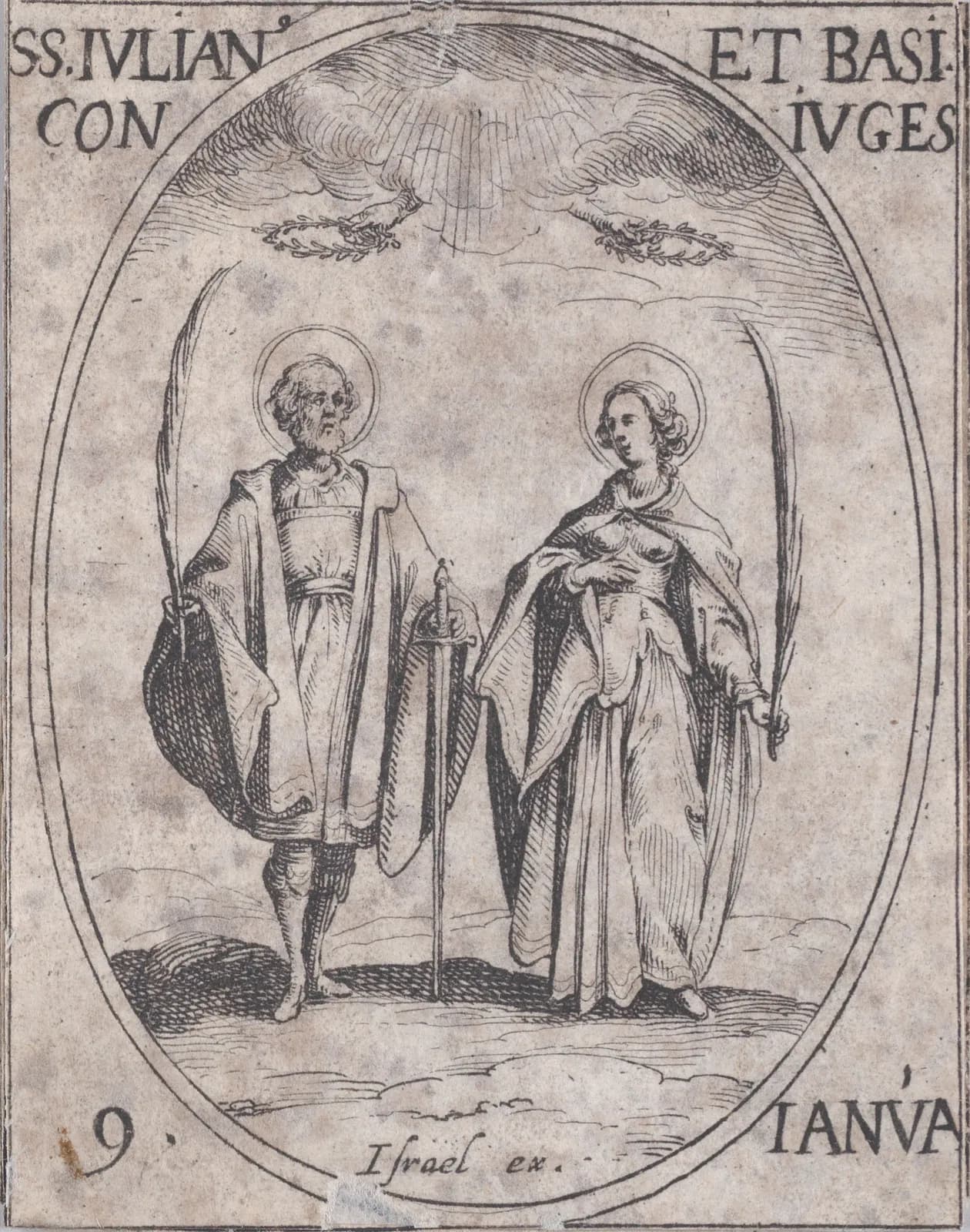
The feast of Saints Julian and Basilissa is January 6 in the current Roman Martyrology. 23 That is the oldest date, the one in the Martyrologium Hieronymianum. 12 Usuard, Ado and Notker placed them on January 9, and the Roman Martyrology before the council followed Ado there, so January 9 is the date in many older calendars and on Callot's plate. 12 Butler explains the scatter of other dates by the Epiphany: because of it the feast "was deferred in different churches" to days across January, February, June and August. 4 The Greek Menaea keep Julian on January 8, and the Byzantine synaxaries also on June 21. 12
Praying with Saints Julian and Basilissa
What the Church remembers about Julian and Basilissa is mostly what their legend says they did with a marriage and a fortune. 24 They gave the house over to strangers, and divided the work between them, he with the men and she with the women. 24
The vow at the center of their story is not the ordinary path of Christian marriage, and the sources do not pretend it is. katolsk.no treats it as a feature of the age and of the genre. 2 What remains when the romance is set aside is a husband and wife remembered together, under one feast, since before the eighth century. 13
Their story also ends apart. Basilissa died first, by most accounts, and Julian went on without her into the persecution. 14 The calendars have kept them on one day, and the current Martyrology still does. 13
Saints Julian and Basilissa, pray for us.
Sources
- 1.Léon Clugnet, "Sts. Julian and Basilissa," The Catholic Encyclopedia, Vol. 8 (New York: Robert Appleton Company, 1910).
- 2."De hellige Julian og Basilissa av Antinoë og deres ledsagere (d. ~302)," Den katolske kirke (katolsk.no), Catholic Diocese of Oslo (in Norwegian).
- 3.Roman Martyrology, entry for January 6, "Santi Giuliano e Basilissa, martiri," as printed in "Santo del giorno," Conferenza Episcopale Italiana (in Italian).
- 4.Alban Butler, "SS. Julian and Basilissa, MM.," January 9, The Lives of the Fathers, Martyrs, and Other Principal Saints, Vol. I.
Saints to turn to next
Others in this collection who are turned to for some of the same things.
- Saint Adelaide931 - December 16, 999Marriage and familyCourage
- Saint Adrian of Nicomediad. c. 304-306CourageMarriage and family
- Saints Chrysanthus and Dariad. about 283CourageMarriage and family
- Saint EustaceMartyred at Rome, in 118 by tradition; other accounts give 140 or 188CourageMarriage and family