Saint Julia of Corsica
d. 3rd to 6th century; the date is uncertain
- Died
- Crucified at Cap Corse, at Nonza 12; in 303, says Vatican News 2; most scholars place her later, says katolsk.no 1
- Relics
- Gorgona, then Brescia from 763; Livorno also claims them 1
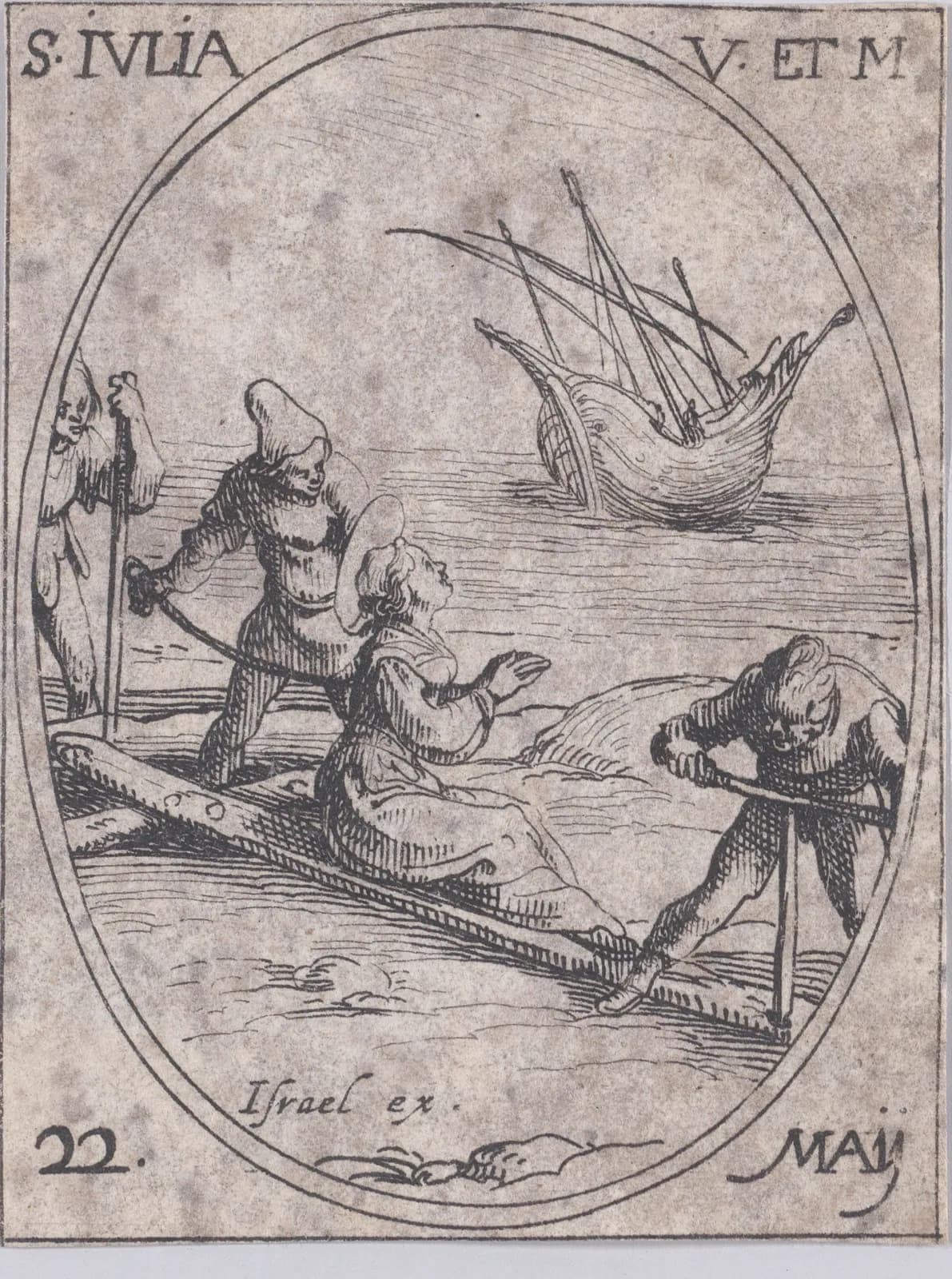
Saint Julia of Corsica was a virgin and martyr, crucified on or near Cap Corse, the northern tip of the island, for refusing to give up her faith. 12 Her legend makes her a Christian of Carthage sold into slavery, who would not join a pagan festival when her master's ship put in at Corsica. 12 When she lived is uncertain, and the sources offer dates three centuries apart. 12 She is patroness of Corsica, and her relics made her the saint of Brescia in northern Italy. 14
A slave from Carthage
The Roman Martyrology's entry for May 22 is brief: on the island of Corsica, the commemoration of Saint Julia, virgin and martyr. 3 Everything else comes from a legend. katolsk.no, the Norwegian bishops' saints database, says the embroidered story of her life had already appeared by the seventh century, prompted no doubt by the wish to know more about a saint who was only a name. 1 It adds that her name in the ancient martyrology attributed to Saint Jerome suggests, at the least, that she really existed. 1
In the legend Julia came from a noble family of Carthage. 1 katolsk.no says that when the Arian Vandal king Geiseric took Carthage and North Africa in 439, she was sold as a slave to a pagan Syrian merchant named Eusebius. 1 Vatican News says she was bought by a man named Eusebius at the time when Carthage was attacked. 2
She worked hard for him and did not give up her faith. 1 Vatican News fills in the picture: her master, though a pagan, admired the courage with which she went about her work. 2 When her tasks were done and she was allowed to rest, she read or prayed, and she fasted so often that he never managed to stop her fasting on any day except the Sunday of the Resurrection. 2
At Cap Corse
Eusebius was sailing to Gaul with Julia on board when his ship put in at Cap Corse, where the people were celebrating a pagan feast. 1 Vatican News places the stop at Nonza, on Cap Corse. 2 Eusebius went to the festival, and Julia refused to go with him. 1
From here the two tellings differ. In katolsk.no's, the island's governor, Felix, heard of her refusal, took it as an insult, and offered to buy her for four other slave women, but Eusebius would not part with her. 1 Eusebius got drunk at the feast and fell asleep, and Felix tried to make Julia sacrifice to the gods, then offered her freedom if she would deny Christ. 1 In the Vatican News telling, the pagans put Eusebius to sleep and used the chance to carry off Julia, who had stayed on the ship. 2
She refused. Vatican News gives her answer: "My freedom is to serve Christ," she said, "whom I love every day in all the purity of my soul." 2 She was tortured and scourged, and katolsk.no says her hair was torn out. 12 Vatican News gives her words under torture: "For if my Lord was crowned with thorns for me, was nailed to the tree of the Cross, wherefore ought I refuse to let my hair be torn from my head as price for the confession of my faith, that I might be worthy to seize the palm of martyrdom?" 2
Then she was crucified. 12 katolsk.no adds the legend's last detail, that when she died her soul rose from her body in the form of a dove. 1
When did she live?
The sources do not agree, and katolsk.no is candid about it. 1 Vatican News says she was tortured and crucified in 303, "though the precise date is uncertain." 2 The legend itself, as katolsk.no tells it, sets her after the Vandal conquest of Carthage in 439. 1
katolsk.no then says that most scholars believe she lived a century or two later still, and that she was killed on or near Cap Corse in the sixth century, probably by Saracen raiders. 1 Others have suggested that she was martyred at Carthage itself about 250, in the persecution of the emperor Decius, and that her relics came to Corsica afterward; katolsk.no notes that Saint Cyprian of Carthage mentions a Julia who died in prison there at that time. 1
Gorgona, Brescia and Livorno
Monks later took her relics to the small Italian island of Gorgona, off Corsica, and a lively pilgrimage grew up at the place of her crucifixion, where a healing spring flowed and pilgrims carried the water home. 1 In 763, katolsk.no says, King Desiderius of the Lombards had her relics brought to Brescia, and the Benedictine monastery that kept them became a place of pilgrimage in the Middle Ages. 1
In 1600 the relics were laid in the newly built church of Santa Giulia in Brescia, but in later disturbances they were moved several times, and katolsk.no says they are now in the seminary there. 1 Livorno, on the Tuscan coast, also claims to have them. 1
What is Saint Julia the patron saint of?
Saint Julia is patroness of Corsica, of Brescia, and of Livorno, the city English writers once called Leghorn. 1 Alexandre Guasco, writing on Corsica in the 1908 Catholic Encyclopedia, records that "Sts. Julia and Devota were declared patronesses of the island by decree of the S. C. of Rites, 5 August, 1809, and 14 March, 1820." 4 katolsk.no says she is most often shown as a virgin with a palm and a staff topped with a cross, and often crucified. 1
Saint Julia's feast day
Praying with Saint Julia
In every version of her story Julia is someone else's property. 12 She did her work well enough that a pagan master admired her and would not sell her, and she kept her own fasts and prayers in the time that was left to her. 12
Her answer to the offer of freedom is the center of the legend. Vatican News gives it as "My freedom is to serve Christ." 2 She had been a slave for years and was offered liberty at the price of her faith, and she turned it down. 12
Historians cannot say with confidence when she lived, or exactly where. 12 The Church keeps her name all the same, and the islands and cities that hold her memory have kept it for well over a thousand years. 13
Saint Julia of Corsica, pray for us.
Sources
- 1."Den hellige Julia av Corsica (500-t?)," Den katolske kirke (katolsk.no), Catholic Diocese of Oslo (in Norwegian).
- 2."St. Julia, Virgin and Martyr of Corsica," Saint of the Day, May 22, Vatican News.
- 3.Roman Martyrology, entry for May 22, "Santa Giulia, vergine e martire," as printed in "Santo del giorno," Conferenza Episcopale Italiana (in Italian).
- 4.Alexandre Guasco, "Corsica," The Catholic Encyclopedia, Vol. 4 (New York: Robert Appleton Company, 1908).
Saints to turn to next
Others in this collection who are turned to for some of the same things.
- Saint Andrew Kim TaegonAugust 21, 1821 - September 16, 1846CourageSuffering and illnessWork and vocation
- Saint Blandina and the Martyrs of Lyond. 177CourageSuffering and illnessWork and vocation
- Saints Cosmas and DamianMartyred c. 287, or in the early fourth centuryWork and vocationSuffering and illnessCourage
- Saint Damien of MolokaiJanuary 3, 1840 - April 15, 1889Suffering and illnessCourageWork and vocation