Saint Blandina and the Martyrs of Lyon
d. 177
- Companions
- Forty-eight martyrs of Lyon and Vienne in all, among them Bishop Pothinus, the deacon Sanctus, Maturus, Attalus, Alexander, Biblis and the boy Ponticus 1345
- Our record
- A letter from the churches of Lyon and Vienne to those of Asia and Phrygia, preserved by Eusebius 125
- Patron of
- Lyon, servants and virgins, according to katolsk.no 3
- Emblems
- A bull; a net or a grill; also a book, a palm and lions 3
Saint Blandina was a slave in Lyon who died in the amphitheater there in 177, the last of a band of martyrs from Lyon and Vienne. 12 Her fellow Christians were afraid she was too frail to hold out under torture; instead, says the letter in which they told her story, she wore out the men who tortured her and answered every question with the same words. 1 That letter, which Eusebius copied into his Church History, is one of the earliest records of the Church in Gaul. 15
Lyon in 177
Lyon and Vienne faced each other across the Rhone, and Eusebius calls them "the principal and most celebrated cities" of Gaul. 1 The church of Lyon had many members from Asia Minor. 35 Georges Goyau, writing on Lyon in the 1910 Catholic Encyclopedia, says that half of its martyrs were of Greek origin and half Gallo-Roman, and that its first bishop, Pothinus, had been sent to Gaul by Saint Polycarp. 5
The trouble began in the street. The letter says the Christians were shut out "from houses and baths and markets," and then suffered blows, robbery, stoning and imprisonment at the hands of the crowd. 1 They were brought into the forum by the chiliarch and the city authorities, questioned in front of everyone, and held for the governor. 1 J. P. Kirsch, in the 1907 Catholic Encyclopedia, notes that the arrests were made while the imperial legate was away, by a military commander and a civil magistrate. 2
When the governor came, a young man named Vettius Epagathus asked to speak in their defense. 1 He was asked only whether he too was a Christian, said so, and was taken into their number. 1 About ten of the prisoners gave way under the strain, which the letter says caused the others "great grief and sorrow beyond measure." 1 Some of the Christians' pagan servants, frightened by what they saw, accused their masters of cannibal feasts and incest. 12 katolsk.no explains the charges as pagan misunderstandings of the Eucharist and of believers calling one another brother and sister. 3
The slave who would not be broken
Blandina appears in the letter among four on whom the anger of the crowd and the governor fell hardest: Sanctus, a deacon from Vienne; Maturus, a recent convert; Attalus, a native of Pergamum; and Blandina, "through whom Christ showed that things which appear mean and obscure and despicable to men are with God of great glory." 1 Her earthly mistress was herself among the confessors, and feared that Blandina was too weak in body to confess boldly. 12
She was tortured by relays of men "from morning till evening," the letter says, until they admitted they could do nothing more to her and wondered that she was still alive. 1 Her answer to everything was the same: "I am a Christian, and there is nothing vile done by us." 1 Kirsch gives the words in his own English as "I am a Christian and we commit no wrongdoing." 2 Sanctus would not tell them even his name or his city, and to every question answered in Latin, "I am a Christian." 1
Others came back. A woman named Biblias, who had denied Christ, was brought out again so that she would accuse the rest, and instead she asked how people could eat children who did not think it lawful "to taste the blood even of irrational animals," and confessed herself a Christian. 1 Pothinus, the bishop, was more than ninety and could barely breathe. 1 Asked by the governor who the God of the Christians was, he said, "If you are worthy, you shall know." 1 He was beaten by the crowd and died in prison two days later. 13 Many others died in the stocks and the dark of the prison. 1
In the amphitheater
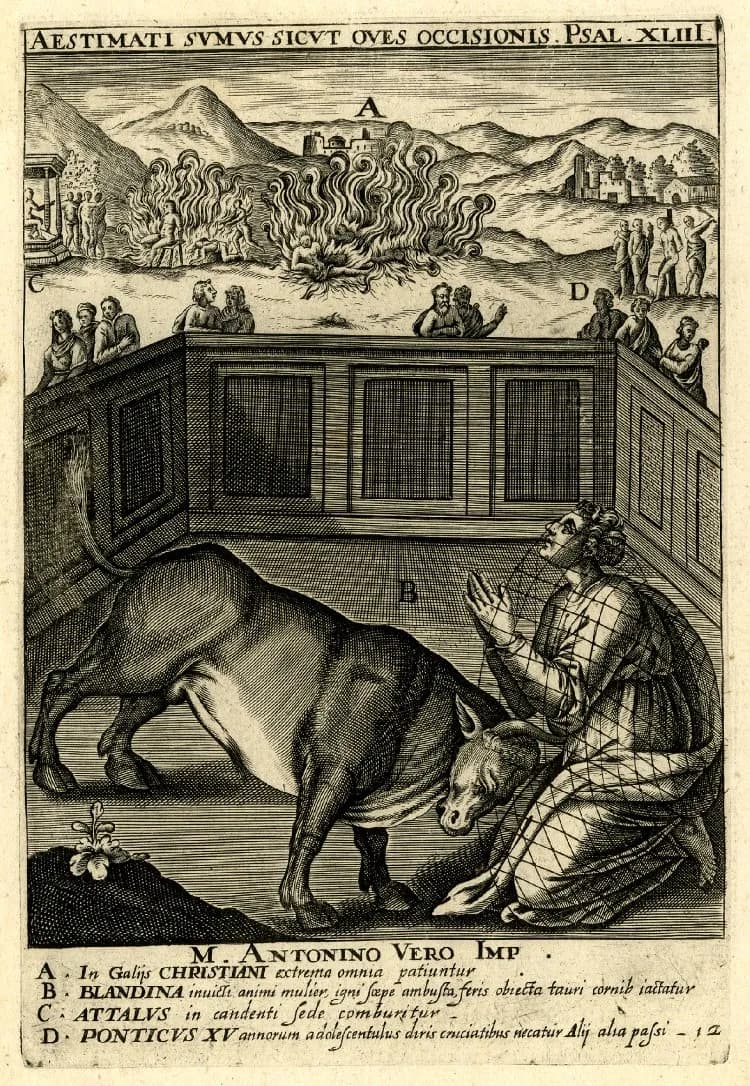
Maturus, Sanctus, Blandina and Attalus were led into the amphitheater on a day of games held on the Christians' account. 1 Maturus and Sanctus died there. 1 Blandina was hung on a stake to be attacked by the beasts, and the letter says that because she seemed to hang on a cross, her companions saw "in the form of their sister, him who was crucified for them." 1 None of the beasts touched her, so she was taken down and returned to prison. 12 katolsk.no adds that the lions lay down at her feet. 3
Attalus was a Roman citizen, so the governor sent him back to prison too and wrote to the emperor. 1 The reply was that those who confessed were to die and those who denied were to go free. 1 At the great festival, when the prisoners were examined again, many who had denied now confessed. 1 The letter puts it as a birth: "the virgin mother had much joy in receiving alive those whom she had brought forth as dead." 1 A Phrygian physician named Alexander, standing by and encouraging them with signs, was seized and sent to the beasts with Attalus. 1 In the fire Attalus told the crowd it was they who were devouring men, and, asked what God's name was, answered, "God has not a name as man has." 1
The last day
Blandina and a boy of about fifteen named Ponticus had been brought in every day to watch the others die and to be pressed to swear by the idols. 1 On the last day of the games they were put through every torture together. 1 Ponticus died first; even the pagans, says the letter, could see that his sister in the faith was strengthening him. 1 Blandina, "as a noble mother, encouraged her children and sent them before her victorious to the King," and followed them. 1
The sources tell her end in slightly different ways. Eusebius's letter says that after the scourging, the beasts and the iron seat she was wrapped in a net and thrown to a bull, and then "sacrificed." 1 Kirsch says she was "at last killed with a dagger." 2 The Roman Martyrology says her throat was cut with a sword, and katolsk.no that she was beheaded. 34 The letter adds that the pagans themselves admitted that no woman among them had ever endured so much. 1
Even then the bodies were not given up. They were guarded and left exposed for six days, then burned, and the ashes were swept into the Rhone so that "no trace of them might appear on the earth." 1 katolsk.no says that what the faithful managed to save is kept in the church of Saint-Leu at Amiens, and that the prison where the martyrs were held lies beneath the church of Ainay in Lyon. 3
The letter and what it preserved
Everything known about Blandina comes from the letter. 12 Eusebius copied long extracts into his Church History and kept the full text, with the list of martyrs, in a collection of martyrdoms that is now lost. 1 Goyau reports Ernest Renan's judgment that the letter "is the baptismal certificate of Christianity in France." 5
The martyrs also wrote from prison to Pope Eleutherus in Rome, and asked their priest Irenaeus to carry the letter. 16 Albert Poncelet, in the encyclopedia's article on Irenaeus, says he returned to succeed Pothinus as bishop of Lyon. 6 katolsk.no says Irenaeus also carried the letter to Asia and may have written it. 3
The letter remembers the confessors for their humility as much as their courage. Brought back from the beasts covered in wounds, they would not let anyone call them martyrs, keeping that word for Christ and for those who had already died, and called themselves "lowly and humble confessors." 1 They prayed for their persecutors, and the letter says, "They defended all, but accused none." 1
katolsk.no counts forty-eight martyrs and gives the later lists of their names, which it warns are not reliable, having been gathered into the martyrologies long afterward. 3 The Roman Martyrology names Pothinus, Blandina and forty-six companions. 4
What is Saint Blandina the patron saint of?
Saint Blandina's feast day
Saint Blandina's feast day is June 2. 23 The current Roman Martyrology keeps the martyrs of Lyon on that day, under the names of Pothinus, Blandina and forty-six companions, and says their trials are attested in the letter of the Church of Lyon to the Churches of Asia and Phrygia. 4 katolsk.no adds that June 2 is the day their relics were enshrined, and that the Orthodox remember Blandina on July 25. 3
Praying with Saint Blandina
Blandina had no standing in the world. She was a slave, her own mistress expected her to fail, and the letter that remembers her says plainly that she was "small and weak and despised." 1 It is the same letter that makes her its central figure. 1
What she said under questioning was one sentence, repeated. She did not argue with her judges or explain the faith; she said who she was and denied what she was accused of. 1 Sanctus did the same, refusing to give even his name. 1
The letter is honest that not everyone held out. Ten gave way at the start, and some who denied were brought back to confession by the patience of the others. 1 The confessors did not boast over the fallen but, in the letter's words, helped them in their need, "having the compassion of a mother." 1 Blandina's last act, as the letter tells it, was to encourage a frightened boy until he died, and only then to follow him. 1
Saint Blandina and the Martyrs of Lyon, pray for us.
Sources
- 1.Eusebius of Caesarea, Church History, Book V, chapters 1-4, trans. Arthur Cushman McGiffert, Nicene and Post-Nicene Fathers, Second Series, Vol. 1 (Buffalo, NY: Christian Literature Publishing Co., 1890), via New Advent.
- 2.Johann Peter Kirsch, "St. Blandina," The Catholic Encyclopedia, Vol. 2 (New York: Robert Appleton Company, 1907).
- 3."De hellige Blandina og Pothinus av Lyon og deres ledsagere (d. 177)," Den katolske kirke (katolsk.no), Catholic Diocese of Oslo (in Norwegian).
- 4.Roman Martyrology, entry for June 2, "Santi martiri Potino, vescovo, Blandina e quarantasei compagni," as printed in "Santo del giorno," Conferenza Episcopale Italiana (in Italian).
- 5.Georges Goyau, "Lyons," The Catholic Encyclopedia, Vol. 9 (New York: Robert Appleton Company, 1910).
- 6.Albert Poncelet, "St. Irenaeus," The Catholic Encyclopedia, Vol. 8 (New York: Robert Appleton Company, 1910).
Saints to turn to next
Others in this collection who are turned to for some of the same things.
- Saint Andrew Kim TaegonAugust 21, 1821 - September 16, 1846CourageSuffering and illnessWork and vocation
- Saints Cosmas and DamianMartyred c. 287, or in the early fourth centuryWork and vocationSuffering and illnessCourage
- Saint Damien of MolokaiJanuary 3, 1840 - April 15, 1889Suffering and illnessCourageWork and vocation
- Saint Daniel ComboniMarch 15, 1831 - October 10, 1881CourageWork and vocationSuffering and illness