Saint Daniel Comboni
March 15, 1831 - October 10, 1881
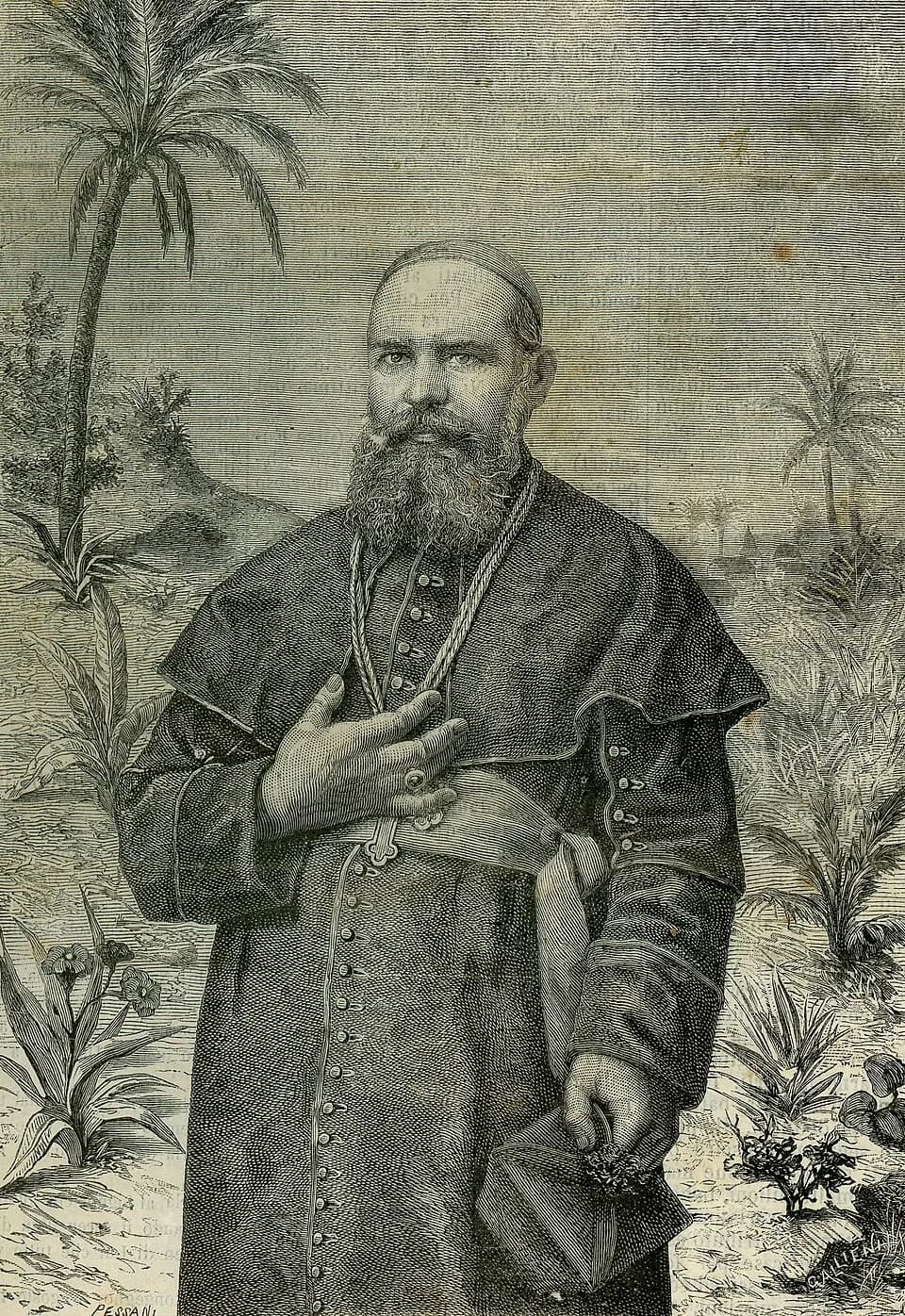
- Born
- March 15, 1831, at Limone sul Garda, near Brescia, Italy 1
- Ordained
- A priest on December 31, 1854, by Blessed John N. Tschiderer, Bishop of Trento 1
- Bishop
- Named Vicar Apostolic of Central Africa on July 2, 1877 1
- Died
- October 10, 1881, at Khartoum, Sudan, aged 50 1
- Called
- "protector of the 'Black Continent'" by John Paul II, in the canonization homily 2
Saint Daniel Comboni was an Italian priest from a family of poor gardeners who first reached Khartoum in 1857 and became, twenty years later, the first Catholic bishop of Central Africa. 1 His Plan for Africa was summed up in a phrase that Francis called "a powerful insight": "Save Africa with Africa," the conviction that the people being evangelized were "not only 'objects', but 'subjects' of mission." 3 He died at Khartoum in 1881, at 50, saying, as the Holy See records it, "I am dying, but my work will not die." 1
The one child who lived
He was born on March 15, 1831, at Limone sul Garda, near Brescia, into a family who cultivated land for one of the rich local proprietors. 1 His parents, Luigi and Domenica, had eight children. Daniel was the fourth and the only one to survive; six died in infancy. 1 The Holy See biography describes the three of them as a very close unit, "rich in faith and human values, but poor in material things." 1
It was that poverty, the biography says, that sent him away to school at Verona, to the institute founded by Father Nicola Mazza. 1 There he found his vocation to the priesthood, studied philosophy and theology, and heard missionaries back from Central Africa describe it. 1 In 1849 he consecrated his life to Africa. 1 He was ordained a priest on December 31, 1854, by Blessed John N. Tschiderer, Bishop of Trento. 1
Khartoum, 1857
In 1857 he left for Africa with five other missionaries of the Mazza Institute and with his mother's blessing, which the biography gives in her words: "Go, Daniel, and may the Lord bless you." 1 The journey took four months and ended at Khartoum. 1 What met him there, the biography says, was an unbearable climate, sickness, the deaths of several of his young companions, and the poverty and dereliction of the people. 1
From the mission of Holy Cross he wrote to his parents: "We will have to labour hard, to sweat, to die: but the thought that one sweats and dies for love of Jesus Christ and the salvation of the most abandoned souls in the world, is far too sweet for us to desist from this great enterprise." 1 After he watched one of his companions die, the Holy See biography says, he felt confirmed in staying, and it gives the cry he took as his motto: "O Nigrizia o morte!", which it translates "Africa, or death." 1
Francis, in his 2023 audience, tells the next part plainly. Comboni had to leave the mission for reasons of health; too many missionaries had died of malaria, "complicated by insufficient knowledge of the local situation." 3 "However, although others abandoned Africa, Comboni did not do so." 3
A plan made at Saint Peter's tomb
Back in Italy he worked out a different approach. In 1864, the Holy See biography says, he was praying at the tomb of Saint Peter in Rome when an inspiration came to him that led to the Plan. 1 The Comboni Missionaries date that experience to September 15, 1864. 5 The biography calls the result the "Plan for the Rebirth of Africa"; the Comboni Missionaries call it the Plan for the Regeneration of Africa. 15
Its motto also comes down in two English forms. The Holy See biography gives it as "Save Africa through Africa," and reads it as an indication of his "boundless trust in the human and religious capacities of the African peoples." 1 Francis gives it as "Save Africa with Africa," and adds: "there was nothing of colonialism in this." 3 In practice, Francis says, it meant involving the local clergy, promoting lay catechists, supporting the arts and professions, and fostering the role of the family and of women in the transformation of culture and society. 3
Begging for Africa
The idea needed Europe behind it, and he went to get it. The biography describes a tireless round of missionary appeals across Europe, asking for spiritual and material help from kings and queens, bishops and nobles, and from poor and simple people. 1 To carry the cause further he launched a missionary magazine, which the Holy See calls the first in Italy. 1
He founded two institutes: one of men in 1867 and one of women in 1872, known now as the Comboni Missionaries and the Comboni Missionary Sisters, or the Verona Fathers and Sisters. 1 The Holy See biography says he was the first to bring missionary sisters into the work in Central Africa, "with unusual courage for those days." 1 Vatican News reports that the Comboni Family, counting the later secular and lay groups, now numbers some 3,000 missionaries. 6
At the First Vatican Council he served as theologian to the Bishop of Verona. 1 Though still a simple priest, he petitioned the bishops there that every local Church be involved in the conversion of Africa, and the biography says he got seventy bishops to sign the petition, the Postulatum pro Nigris Africae Centralis, in 1870. 1
Bishop of Central Africa
On July 2, 1877, he was named Vicar Apostolic of Central Africa, and he was ordained bishop a month later. 1 The Holy See biography reads the appointment as a vindication of ideas that some had considered "foolhardy, if not crazy." 1 Then came 1877 and 1878, a drought followed by a famine the biography calls without precedent, which halved the local population and reduced the missionaries and their work almost to nothing. 1
Slavery runs through all of it. The biography counts among his endeavors a tireless struggle for the abolition of slavery, and says his last journey was made in part to continue the fight against what it calls "the pernicious Slave Trade." 1 Francis says Comboni witnessed "the horror of slavery," and understood that social slavery is rooted in a deeper one, "that of the heart, of sin." 3
He went back to Africa in 1880 for the eighth and last time, to stand with his missionaries and to strengthen missionary work carried out by Africans themselves. 1 Within a year, the biography says, he was worn down by work, by many deaths in quick succession among his collaborators, and by "a wave of calumnies and accusations," and he fell ill. 1 He died at Khartoum in the late hours of October 10, 1881, at 50. 1
Beatified and canonized
His heroic virtue was recognized on March 26, 1994. 1 The cure of an Afro-Brazilian girl was approved as a miracle through his intercession in 1995, and John Paul II beatified him in Saint Peter's on March 17, 1996. 16 A second cure, of a Muslim mother from Sudan, was later approved. 1 John Paul II canonized him on October 5, 2003, alongside Arnold Janssen and Joseph Freinademetz, naming him "an apostle of Christ among the Africans" who "relied on the resources of his rich personality and solid spirituality to make Christ known and welcomed in Africa, a continent he loved deeply." 2
The Archbishop of Khartoum told Vatican News in 2018 that in every center in Sudan prayer ends with the same words: "Saint Bakhita pray for us, Saint Comboni pray for us." 4
What is Saint Daniel Comboni the patron saint of?
None of the sources consulted gives him a formal patronage, so this page does not claim one. 145 The nearest thing is a line in his canonization homily. Speaking of Africa, "a land rich in human and spiritual resources" that "continues to be scarred by many difficulties and problems," John Paul II said: "I entrust my appeal to the intercession of St Daniel Comboni, an outstanding evangelizer and protector of the 'Black Continent'." 2 That is the homily's phrase, in the language of 2003, and it is reported here as what it is.
Saint Daniel Comboni's feast day
Praying with Saint Daniel Comboni
His letter home from Holy Cross already counts the cost: "to labour hard, to sweat, to die." 1 The cost then came. Companions died, he was sent home ill, and others gave the mission up. 13 What the sources record is that he went back, and kept going back, eight times in all. 13
Much of the work was asking. He begged from royalty and from the poor, gathered signatures from bishops, started a magazine, and spent years persuading a Church that Francis says "had forgotten Africa for too long." 13 Francis also insists the zeal behind all that was not his own courage or his values but "the joy of the Gospel." 3
At the center of the Plan was a judgment about other people: that Africans would be the leading agents of their own evangelization. 1 Francis read that as a refusal to treat anyone as an object of mission, and put it to the Church now. 3
His last year is not tidied up by the sources. Famine had halved the people he served, his collaborators were dying one after another, and he was carrying accusations the Holy See calls a bitter burden when he died at 50. 1 The sentence the biography gives him at the end, that his work would not die, was said in the middle of all that. 1
Saint Daniel Comboni, pray for us.
Sources
- 1."Daniel Comboni (1831-1881)," biography published by the Holy See for the canonization of October 5, 2003.
- 2.John Paul II, Homily for the Canonization of Three Blesseds (Daniel Comboni, Arnold Janssen and Joseph Freinademetz), October 5, 2003.
- 3.Francis, General Audience, September 20, 2023, "The passion for evangelization: the apostolic zeal of the believer. 21. Saint Daniel Comboni, apostle for Africa and a prophet of mission."
- 4."Sudan: A Church rooted in the Gospel and two famous saints," Vatican News (Dicastery for Communication), September 2018.
- 5."Feast of Saint Daniel Comboni: October 10, 2024," Comboni Missionaries of the Heart of Jesus.
- 6."Pope at Audience: St. Daniel Comboni was full of zeal for Africa," Vatican News (Dicastery for Communication), September 20, 2023.
Saints to turn to next
Others in this collection who are turned to for some of the same things.
- Saint Andrew Kim TaegonAugust 21, 1821 - September 16, 1846CourageSuffering and illnessWork and vocation
- Saints Cosmas and DamianMartyred c. 287, or in the early fourth centuryWork and vocationSuffering and illnessCourage
- Saint Damien of MolokaiJanuary 3, 1840 - April 15, 1889Suffering and illnessCourageWork and vocation
- Saint Gianna Beretta MollaOctober 4, 1922 - April 28, 1962Work and vocationCourageSuffering and illness