Saint Joseph Vaz
April 21, 1651 - January 16, 1711
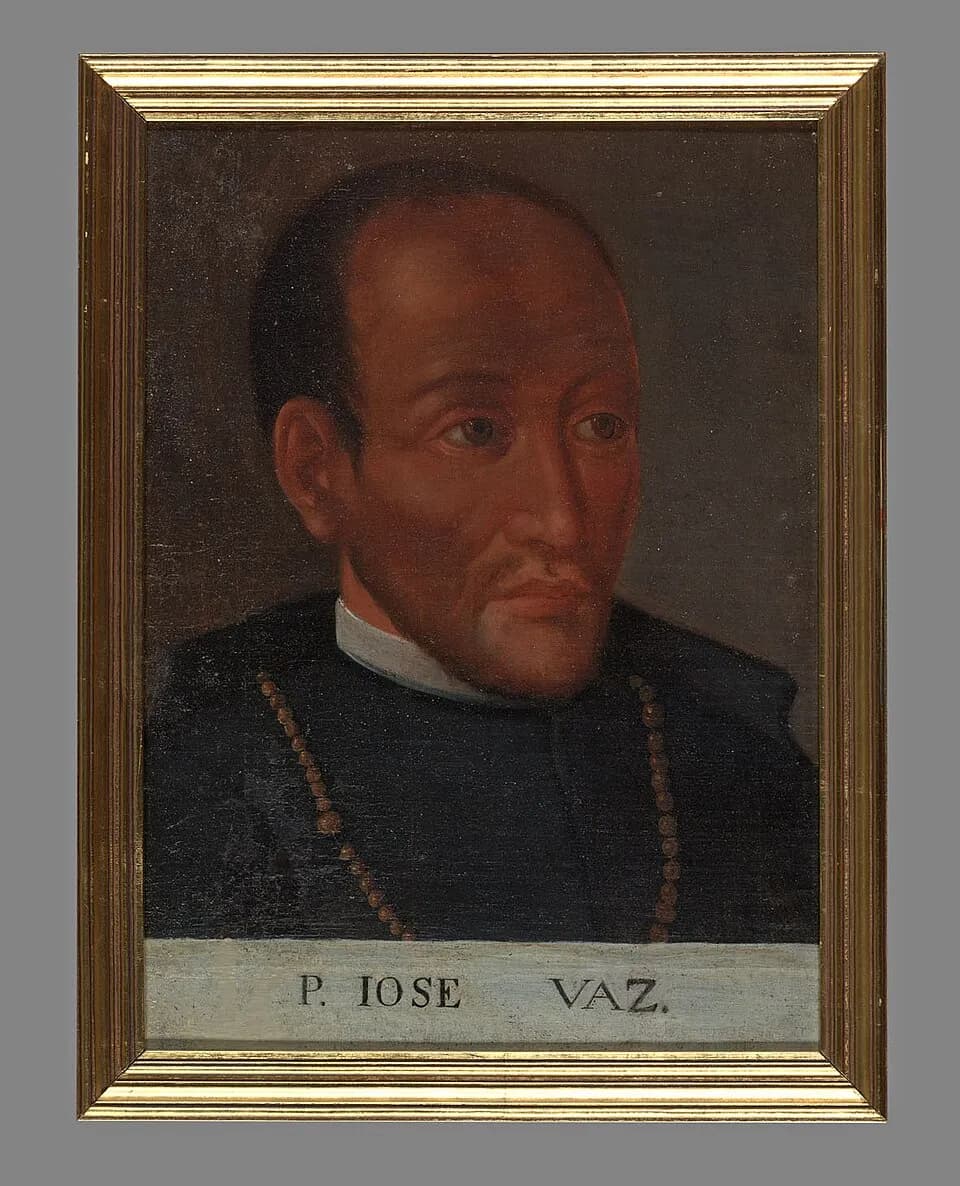
- Beatified
- January 21, 1995, by Pope John Paul II, in Colombo 3
Saint Joseph Vaz was a priest from Goa who slipped into Dutch-ruled Ceylon in 1687 dressed as a beggar, at a time when the Catholic faith was banned there and the island had been without a priest for about thirty years. 35 He spent twenty-four years rebuilding the Church in what is now Sri Lanka, most of them from the Buddhist kingdom of Kandy. 45 Pope Francis canonized him in Colombo on January 14, 2015, and his feast is January 16. 24
Goa
He was born on April 21, 1651, in Goa, then the capital of Portugal's possessions in the East. 14 The Oblates' biography places the birth at Benaulim and says he grew up between Benaulim and Sancoale. 5 His parents, the encyclopedia says, "were Christians of the Konkani Brahmin caste." 1 He learned Portuguese in his father's village and Latin in his mother's, studied with the Jesuits in the city of Goa, and went on to philosophy and theology at the College of Saint Thomas Aquinas. 15 He was ordained in 1676 and became a sought-after preacher and confessor. 1
Word had reached Goa of the Catholics of Ceylon, where the Dutch, fearing that Catholics would side with the Portuguese, had forbidden the practice of the Catholic faith in their territory. 15 The Oblates give the scale of it: in 1658 some 120 missionaries left the island, the churches were closed or destroyed, and the Catholics who remained had no priest and no sacraments. 5 Vaz asked to go. 5
Kanara and the Oratory
He was sent instead to Kanara, in southwestern India, as superior of the mission to the abandoned Catholics there. 15 The sources disagree on how long he stayed: three years in the encyclopedia, four in the Oblates' account, "nearly ten" in the Birmingham Oratory's. 145 The Oblates say he reached Mangalore in 1682, built churches and chapels, opened village schools and appointed catechists. 5
Back in Goa in 1684, he joined a small community of priests living at the church of the Cross of Miracles and was soon its superior. 15 The community was organized as an Oratory of Saint Philip Neri, with advice and help from the Oratorian houses in Portugal. 45 The encyclopedia speaks of Oratorians "then recently established in Goa" whom he joined; the Birmingham Oratory says he founded the Oratory there himself, in 1686. 14 The Oblates add that it is thought to have been the first fully native religious community of the Latin rite in Asia. 5
He gave up the office of superior and left for Ceylon. The encyclopedia dates the permission to 1686; the Oblates say he set out in March 1686 and landed in April 1687. 15
A beggar in Jaffna
He landed at Jaffna. 15 He had learned Tamil before he came. 3 He had no support of any kind, and the Oblates describe how he found his flock: "With a rosary on his neck he begged from door to door for his survival. That was how he made contact with Catholics." 5 Pope Francis put it this way: "Because of religious persecution, he dressed as a beggar, performing his priestly duties in secret meetings of the faithful, often at night." 2
He settled for a time in a village the encyclopedia calls Sillale, where the Catholics were many and determined. 1 The revival was noticed. On Christmas night of 1689 the Dutch commander of Jaffna moved against the Catholics and three hundred were imprisoned. Vaz was not among them, and the Oblates admit that no one knows how he got away. 5 He moved to Puttalam, outside Dutch control, and worked there for a year. 15
Kandy
He chose Kandy, the capital of an independent kingdom in the interior, as his base, to escape the vigilance of the Dutch. 145 He arrived to be denounced as a Portuguese spy, and the king, Vimaladharma Surya II, had him brought to prison in chains. 15 He used the time to learn Sinhala. 3 The Catholics of the town managed to reach him even in prison, so the work went on. 1
How he came out is told differently. The Oblates say the king freed him in 1693, and that he then had the Catholics build a simple church dedicated to Our Lady. 5 Three years later, in a long drought, the king asked him to pray for rain after the Buddhist ceremonies had failed, and the rain that followed his prayer in the public square won him the king's favor and leave to bring more priests from Goa. 5 The Birmingham Oratory tells it as one event: he was released after obtaining "what was regarded by all as a miraculous fall of rain." 4 The encyclopedia says only that in the end he "won the favour of the king" and regained his liberty. 1
An epidemic followed, in 1697 by John Paul II's date; Pope Francis calls it smallpox. 23 Vaz nursed the victims, and Francis says the king so valued it that the priest was given still greater freedom. 2 From Kandy he could now reach the rest of the island. 12
The whole island
Oratorians from Goa came to join him, in 1696 according to the Oblates and the Birmingham Oratory, and about 1699 according to the encyclopedia. 145 In February 1696 the Bishop of Cochin made him vicar general for all Ceylon. 5 He walked the island, John Paul II said, "often barefoot, with a rosary round his neck." 3 The Oblates list the journeys: Colombo twice, then Negombo, Mannar, Jaffna, Trincomalee and Batticaloa, and more in 1700, 1704 and 1705. 5 He trained lay leaders to hold the scattered communities together. 3 He translated a catechism and prayers into Sinhala and Tamil. 45
Rome noticed. The papal legate, de Tournon, was told to get in touch with him and thought of making Ceylon a diocese with Vaz as its first bishop. Vaz talked him out of it. 1 The Oblates and the Birmingham Oratory describe the post he refused as that of vicar apostolic, and the Oblates date the offer to 1703. 45
By 1710 he was worn out and could no longer leave Kandy. 15 On January 16, 1711, he received the last rites with his people around the bed. The Birmingham Oratory gives his words to them, "Always live according to God's inspiration," and says he died at midnight holding a candle and saying the name of Jesus. 4 He was fifty-nine. 25 He left, by the Oratory's and the Oblates' count, 70,000 Catholics, 15 churches and 400 chapels. 45
A long road to the altar
His cause was first pressed on Rome about 1737 by the Bishop of Cochin. A process opened in Goa and miracles were recorded, but formalities had been neglected, and Benedict XIV canceled the proceedings while ordering them begun again. 1 In 1894 the apostolic delegate to the East Indies wrote that Vaz had "unfortunately been almost entirely forgotten." 1
John Paul II beatified him in Colombo on January 21, 1995, calling him "the second founder of the Church in your country" and "a son of Asia who became a missionary in Asia." 3 Pope Francis canonized him in the same city on January 14, 2015. 2
What is Saint Joseph Vaz the patron saint of?
None of the sources consulted for this page names Saint Joseph Vaz as patron of anything, and the page does not supply a patronage. 124 What they give him is a title. The encyclopedia and the Birmingham Oratory call him the Apostle of Ceylon, and John Paul II called him "the apostle of Sri Lanka." 134
Saint Joseph Vaz's feast day
Praying with Saint Joseph Vaz
He went where he was not sent. The Oblates stress that no civil, royal or church authority sent him, and that he arrived "in simplicity and poverty, without the support or protection of an institutional Church." 5 He was also the first missionary to Ceylon who was not a European. 5 John Paul II drew the point out for his hearers in Colombo: the Church needs more people like him, from every continent. 3
His method was to be poor among people who were afraid. He begged at doors with a rosary showing, which told the Catholics behind those doors who he was. 35 He said Mass at night. 2 In prison he studied the language of his jailers. 3
The king who protected him was a Buddhist, and the favor was won by nursing the sick of the king's own city. 24 Pope Francis took this as the heart of the matter. Vaz, he said, "ministered to those in need, whoever and wherever they were," and showed "the importance of transcending religious divisions in the service of peace." 2
He refused to be made a bishop and went on administering the island as a priest. 15 The encyclopedia records how nearly he was forgotten, and for how long. 1 Francis, canonizing him three centuries after his death, called him "a living icon of God's mercy and reconciling love." 2
Saint Joseph Vaz, pray for us.
Sources
- 1.Ernest Hull, "Blessed Joseph Vaz," The Catholic Encyclopedia, vol. 15 (New York: Robert Appleton Company, 1912).
- 2.Pope Francis, Homily at the Holy Mass and Rite of Canonization of Blessed Joseph Vaz, Galle Face Green, Colombo, January 14, 2015.
- 3.John Paul II, Homily at the Beatification of Father Joseph Vaz, Galle Face Green, Colombo, January 21, 1995.
- 4."Saint Joseph Vaz," The Birmingham Oratory.
- 5."Saint Joseph Vaz (1651-1711)," Missionary Oblates of Mary Immaculate, OMI World.
- 6."Beato Giuseppe Vaz, sacerdote," Santo del giorno, 16 gennaio, from the Roman Martyrology, Conferenza Episcopale Italiana (in Italian).
Saints to turn to next
Others in this collection who are turned to for some of the same things.