Saint Joseph Pignatelli
December 27, 1737 - November 11, 1811
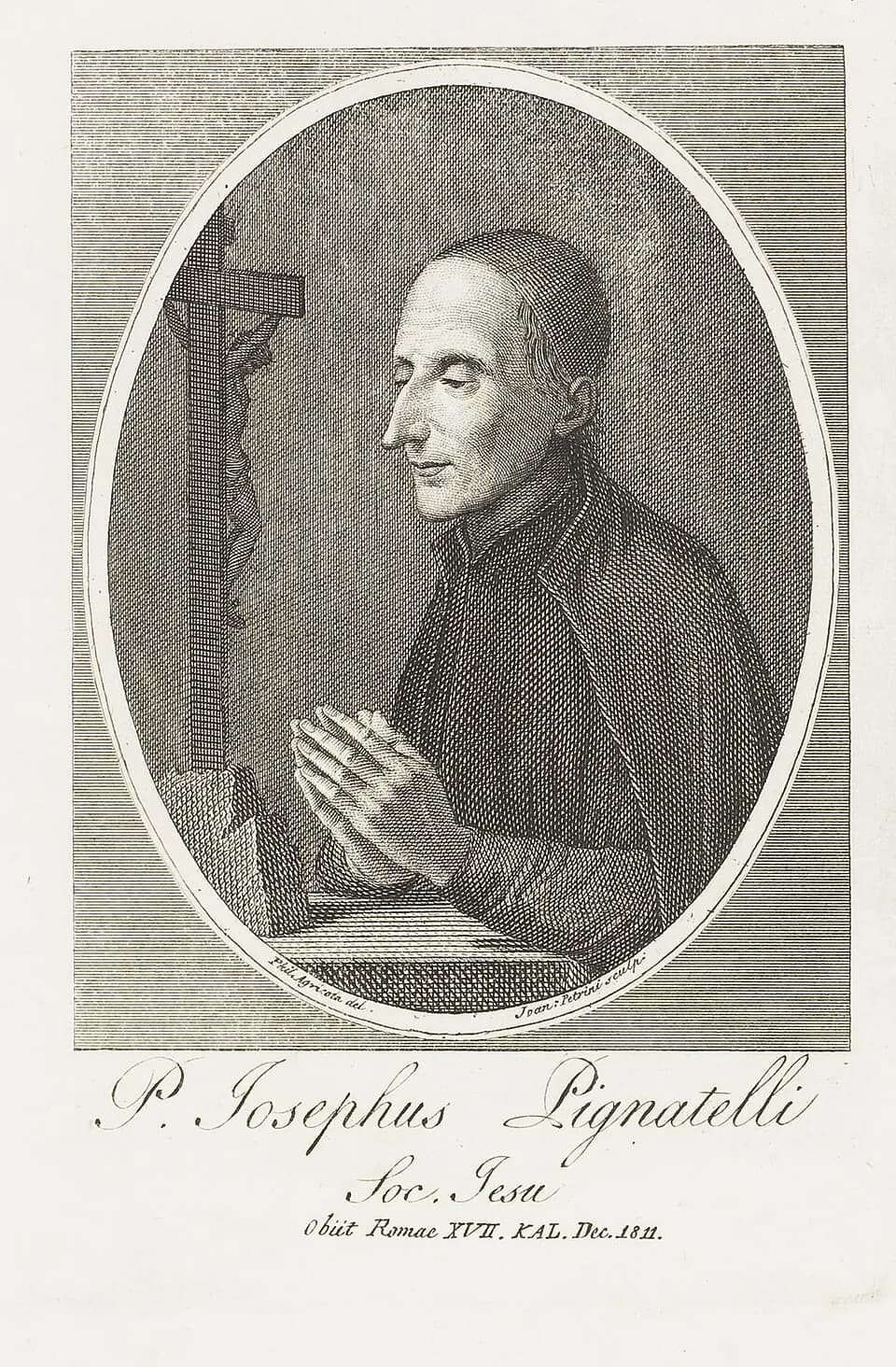
- Born
- December 27, 1737, at Saragossa, Spain, to a noble family of Neapolitan descent 1
- Entered the Society of Jesus
- May 8, 1753 1
- Exiled from Spain
- 1767, with the Jesuits of Aragon 1
- Renewed his vows
- July 6, 1797, in the duchy of Parma 1
- Patron saint of
- No patronage is named in the sources consulted
- Feast day
- November 15 3
- Died
- November 11, 1811 1
- Canonized
- June 12, 1954, by Pope Pius XII 2
Saint Joseph Pignatelli was a Spanish Jesuit of noble family who was driven into exile with his order in 1767, lived through its suppression in 1773, and spent his last years quietly gathering the scattered Jesuits of Italy back into a working community. 12 Pius XII, who canonized him in 1954, called him the restorer of the Society of Jesus in Italy and, in spirit, its second father, the most illustrious link joining the restored order to the one Ignatius founded. 2 His feast is kept on November 15. 3
Saragossa
Giuseppe Maria Pignatelli was born at Saragossa, in Aragon, on December 27, 1737, into a noble family of Neapolitan descent. 1 He studied at the Jesuit college in the city and entered the Society of Jesus on May 8, 1753, against his family's wishes. 1 After his studies he was ordained and taught at Saragossa. 1
Pius XII, at his canonization, said that by the time the Jesuits were expelled from Spain Pignatelli had already won his superiors' esteem for his elevation of spirit, his inventive charity toward the poor and toward prisoners condemned to death, and a personal authority that could calm a rioting crowd. 2 His noble birth, the pope added, might have drawn him toward worldly greatness, and it did not. 2
The riot was a real one. In 1766, according to the 1913 Catholic Encyclopedia, the people of Saragossa blamed the governor for a threatened famine and were about to burn down his palace, and Pignatelli talked them out of it. 1 King Charles III sent a letter of thanks. 1 All the same, the Jesuits were then accused of having stirred the riot up, and Pignatelli's answer to the charge was followed, on April 4, 1767, by the decree expelling the fathers of Saragossa. 1
Exile
The minister Aranda offered to let Giuseppe and his brother Nicola stay if they would leave the order. 1 Giuseppe was in poor health, but both refused. 1 When the Jesuits of Aragon were refused permission to land at Civitavecchia, he went with them to San Bonifacio, in Corsica. 1
There he showed what the encyclopedia calls "singular ability for organization," providing for five hundred priests and students, with money and supplies from his sister, the Duchess of Acerra. 1 He organized their studies and kept up the regular religious life. 1 When France took control of Corsica they had to move again, first to Genoa and then to the legation of Ferrara, where he was charged with finding a home for the Jesuits of Aragon and also for those of Peru and Mexico. 1
Pius XII described those years as a search for a refuge that never brought rest, in which Pignatelli was responsible for the spiritual and material care of the exiles, bore the worst hardships with serenity and patience, and tried everywhere to keep up the fervor of the men in his charge. 2
The suppression
In August 1773 their community was dissolved. 1 This was the suppression of the Society of Jesus by Pope Clement XIV, which Pope Francis, two centuries later, described in the words of John Paul II: "enemies of the Church succeeded in obtaining the suppression of the Society." 145
The two Pignatelli brothers settled in Bologna, where they lived in retirement and were forbidden to exercise their ministry as priests. 1 Giuseppe gave himself to study and collected books and manuscripts on the history of the Society. 1 Pius XII says he turned to a life of prayer, work and charity once he had a settled home. 2
The Society had not disappeared everywhere. Pope Francis notes that the Jesuits "still existed here and there, thanks to a Lutheran monarch and an Orthodox monarch." 5 When Pignatelli learned that the order survived in White Russia, he asked to be received there, but for various reasons he had to put off the journey. 1
Rebuilding in Italy
While he waited, Ferdinand, Duke of Parma, invited him to re-establish the Society in his states, and in 1793, with a few fathers obtained from Russia through Catherine II and other former Jesuits, a house was opened. 1 On July 6, 1797, Pignatelli renewed his vows there, and in 1799 he was made master of novices. 1 When Parma passed under French control after the duke's death, the Jesuits were left alone for eighteen months, and in that time he was appointed provincial of Italy. 1
He then secured the restoration of the Jesuits in the Kingdom of Naples, by a papal brief of July 30, 1804, which the encyclopedia says was "much more favourable than that granted for Parma." 14 Older Jesuits began asking to be received back, though many who had taken up other work in the Church stayed where they were. 1 Schools and a college were opened in Sicily. 1 What happened next is told two ways. Benigni says that when the kingdom fell to Napoleon the Jesuits were ordered dispersed but that the decree "was not rigorously executed"; Pollen, in the encyclopedia's history of the period, says that on the French invasion of 1806 all the houses were dissolved except those in Sicily. 14
He went on founding colleges at Rome, Tivoli and Orvieto, and other cities asked for the fathers. 1 Through the exile of Pope Pius VII and the French occupation, the encyclopedia says, the Society carried on undisturbed, "owing largely to the prudence and the merits of Pignatelli," and he managed to avoid taking the oath of allegiance to Napoleon. 1 In 1807 he secured the restoration of the Society in Sardinia. 1 Pollen names him as the superior of the Jesuits in Italy through all these changes. 4
Pius XII summed up the work: as soon as the dawn of the Society's resurrection appeared, Pignatelli set about gathering its scattered members, training new recruits, and restoring the order's way of life and its traditional spirit. 2
Death and canonization
He died on November 11, 1811, according to the encyclopedia. 1 He did not see the restoration of the Society throughout the Church, which came with the bull Pius VII signed on August 7, 1814, at the Basilica of Saint Mary Major. 5 The cause for his beatification was introduced under Gregory XVI. 1 Pius XII canonized him on June 12, 1954, in St. Peter's Square, together with Peter Chanel, Gaspar del Bufalo, Dominic Savio and Maria Crocifissa di Rosa. 2
What is Saint Joseph Pignatelli the patron saint of?
Saint Joseph Pignatelli's feast day
Praying with Saint Joseph Pignatelli
Pius XII introduced him at the canonization with a reflection on endurance: God often asks his chosen ones to do great things, he said, and also to know how to suffer in obedience and silence, and it takes no less generosity to hold firm in a shipwreck and prepare patiently for the hour when peace returns. 2
That describes most of Pignatelli's adult life. He spent years shepherding hundreds of exiled men from one temporary refuge to the next, and then years in Bologna forbidden to exercise his ministry, reading and collecting the history of an order that no longer officially existed. 12 He had been offered a way out at the start, if he would leave the Society, and refused it. 1
When the chance came he took it carefully. The encyclopedia credits the Society's survival under the French occupation largely to his prudence, and says he managed to avoid the oath of allegiance to Napoleon. 1 Pope Francis, speaking of the Jesuits of the suppression in general, said they were "fervent in the spirit and in the service of the Lord, rejoicing in hope, constant in tribulation, persevering in prayer." 5
He died three years before the restoration was complete. 15 Pius XII called him the most illustrious link connecting the Society, across the gap of the suppression, to its origins. 2
Saint Joseph Pignatelli, pray for us.
Sources
- 1.Umberto Benigni, "Ven. Giuseppe Maria Pignatelli," The Catholic Encyclopedia, Vol. 12 (New York: Robert Appleton Company, 1911).
- 2.Pope Pius XII, Address at the canonization of Saints Peter Chanel, Gaspar del Bufalo, Joseph Pignatelli, Dominic Savio and Maria Crocifissa di Rosa, St. Peter's Square, June 12, 1954 (Italian).
- 3.Saint of the Day, Calendar of Saints, November 15, Vatican News.
- 4.J. H. Pollen, "The Jesuits During the Interim (1773-1814)," The Catholic Encyclopedia, Vol. 14 (New York: Robert Appleton Company, 1912).
- 5.Pope Francis, Address at Vespers for the bicentenary of the re-establishment of the Society of Jesus, Church of the Gesù, Rome, September 27, 2014.
Saints to turn to next
Others in this collection who are turned to for some of the same things.
- Saint Andrew Kim TaegonAugust 21, 1821 - September 16, 1846CourageSuffering and illnessWork and vocation
- Saints Cosmas and DamianMartyred c. 287, or in the early fourth centuryWork and vocationSuffering and illnessCourage
- Saint Damien of MolokaiJanuary 3, 1840 - April 15, 1889Suffering and illnessCourageWork and vocation
- Saint Daniel ComboniMarch 15, 1831 - October 10, 1881CourageWork and vocationSuffering and illness