Saint Joseph Calasanz
September 11, 1556 - August 25, 1648
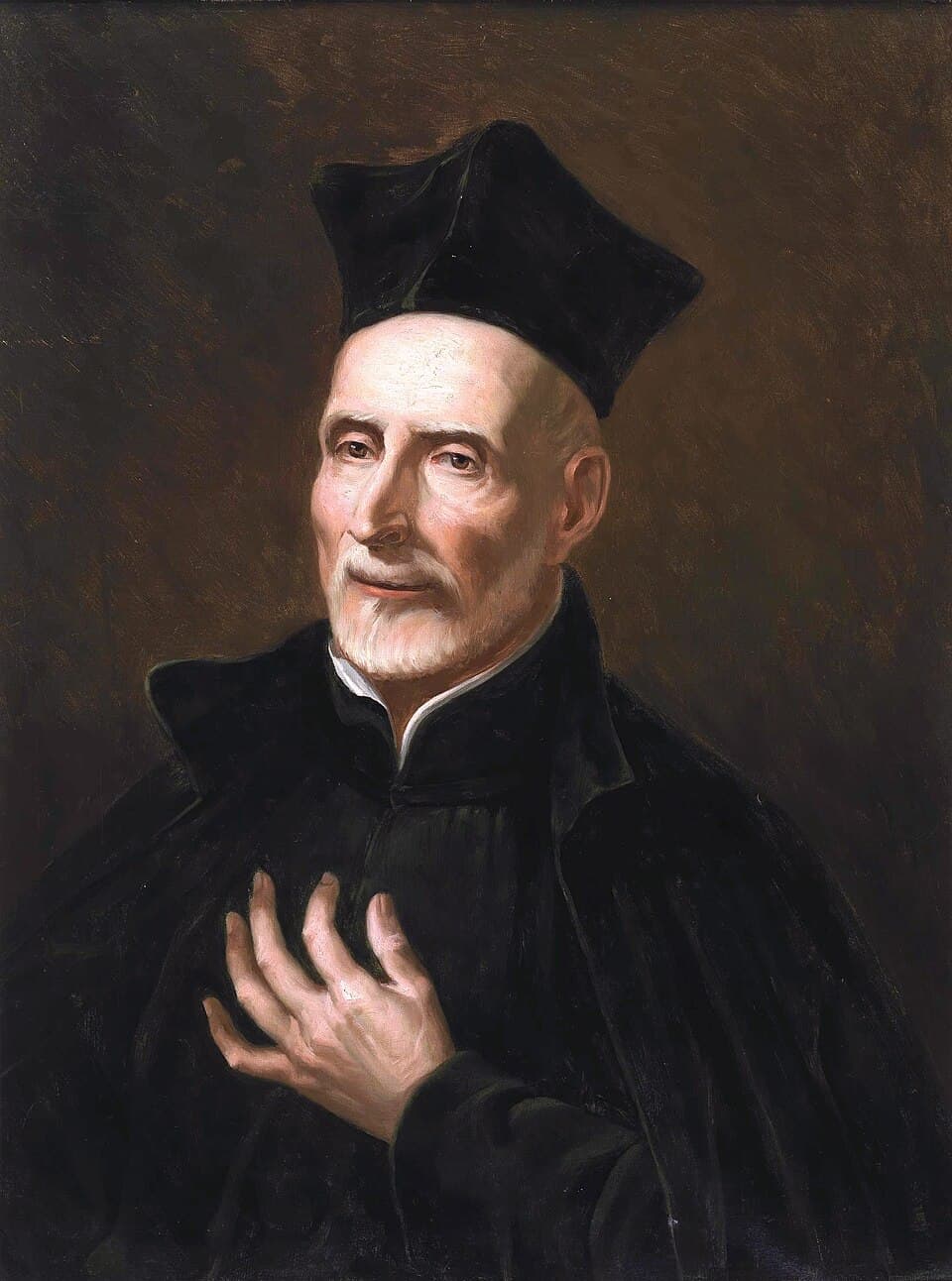
- Born
- At the castle of Calasanza in Aragon, September 11, 1556 1
- Opened
- The first public free school in Europe, at Rome, in November 1597 1
- Within a short time
- Had about a thousand children in his charge 1
- Was
- Investigated by papal commissions, demoted, and his order suppressed 2
- Died
- At ninety-one, with the Piarists dissolved. They were recognized again after his death 2
Saint Joseph Calasanz was a doctor of laws with a career in diocesan administration who gave it up to teach street children, and in November 1597 opened what his encyclopedia calls the first public free school in Europe. 1 Within a few years he had a thousand pupils. 1 He was then investigated by papal commissions, demoted from the order he had founded, and saw it suppressed outright - and died at ninety-one still expecting it to be restored. 2 It was, after he was dead. 2
The career he gave up
He was the youngest of five children of a noble Aragonese family, took a doctorate in laws at Lérida and completed theology at Valencia and Alcalá de Henares. 1 When his mother and brother died his father wanted him to marry and carry on the family; Mershman's account of how that ended is characteristically direct: "God interfered by sending a sickness in 1582 which soon brought Joseph to the brink of the grave." 1 He recovered and was ordained the following year.
What followed was a respectable administrative career - theologian and confessor to a bishop, synodal examiner, procurator, secretary on an apostolic visitation to Montserrat, and then vicar-general for a district. 1 Franciscan Media summarizes the position he was in: "A priest with university training in canon law and theology, respected for his wisdom and administrative expertise, he put aside his career because he was deeply concerned with the need for education of poor children." 2
He went to Rome in 1592 and found a cardinal to protect him. 1
Nobody else would do it
Rome was full of children with nobody to teach them. Mershman: it "offered a splendid field for works of charity, especially for the instruction of neglected and homeless children, many of whom had lost their parents." 1
His first attempt was to get the existing system to absorb them. He joined a Confraternity of Christian Doctrine "and gathered the boys and girls from the streets and brought them to school." 1 It did not work, for a reason Mershman states without editorializing: "The teachers, being poorly paid, refused to accept the additional labour without remuneration." 1 Franciscan Media puts it institutionally: "When he was unable to get other institutes to undertake this apostolate at Rome, Joseph and several companions personally provided a free school for deprived children." 2
So he did it himself. A parish priest gave him two rooms, two other priests promised help, and "Joseph, in November, 1597, opened the first public free school in Europe." 1
The demand was immediate. Clement VIII gave an annual contribution, others joined in, "so that in a short time Joseph had about a thousand children under his charge." 1 Franciscan Media: "So overwhelming was the response that there was a constant need for larger facilities." 2
In 1602 he rented a house and began living in community with his assistants, which is the foundation of the Piarists. 1 In 1621 the community was formally recognized as the Clerks Regular of Religious Schools, and Joseph was appointed superior for life. 2
What went wrong, and which source says so
Mershman's entire account of the next twenty-five years is one sentence: "Much envy and opposition arose against him and his new institute, but all were overcome in time." 1
Franciscan Media's is not. "A combination of various prejudices and political ambition and maneuvering caused the institute much turmoil." 2 And then it names the prejudices.
The first is the one worth sitting with. "Some did not favor educating the poor, for education would leave the poor dissatisfied with their lowly tasks for society!" 2 The objection to the school was that it worked.
The second is stranger and more specific: "Others were shocked that some of the Piarists were sent for instruction to Galileo - a friend of Joseph Calasanz - as superior, thus dividing the members into opposite camps." 2 He was sending his teachers to be taught by Galileo, and he was a friend of Galileo's, in Rome, in the years when that was the most dangerous friendship available.
The consequence is stated flatly. "Repeatedly investigated by papal commissions, Joseph Calasanz was demoted; when the struggle within the institute persisted, the Piarists were suppressed." 2 Not reformed or reorganized - dissolved.
"Only after Joseph's death were they formally recognized as a religious community." 2 He ran the school for half a century and did not live to see the order restored.
What he did about it
Franciscan Media's reflection is the best short account of obedience in any entry in this library, and it does not pretend the charges were fair.
"No one knew better than Joseph Calasanz the need for the work he was doing; no one knew better than he how baseless were the charges brought against him. Yet if he were to work within the Church, he realized that he must submit to its authority, that he must accept a setback if he was unable to convince authorized investigators." 2
That is a precise statement of the bargain: he thought they were wrong, he could not prove it to them, and he accepted the ruling anyway because the alternative was to leave.
And he did not conclude that it was over. "While the prejudice, the scheming and the ignorance of men often keep the truth from emerging for a long period of time, Joseph Calasanz was convinced, even under suppression, that his institute would again be recognized and authorized. With this trust he joined exceptional patience and a genuine spirit of forgiveness." 2
He died at Rome on August 25, 1648, aged ninety-one. 12 Mershman's summary of him is four words long and, given everything the article leaves out, oddly moving: "a true friend of forsaken children." 1 He was beatified in 1748 and canonized in 1767, more than a century after his death. 1
What is Saint Joseph Calasanz the patron saint of?
Neither source cited here gives him a patronage. 12 Mershman ends with his tomb and his canonization; Franciscan Media ends with a reflection. Neither names a cause he is invoked for, and this page does not supply one.
What he is credited with instead is a first: the first public free school in Europe, opened in two borrowed rooms in November 1597. 1
Saint Joseph Calasanz's feast day
The feast of Saint Joseph Calasanz is August 25, the day he died. Franciscan Media states it: "His liturgical feast is celebrated on August 25." 2
Two other dates attach to him. The 1910 encyclopedia gives "feast 27 Aug." in its opening line, which was correct then. 1 And Franciscan Media's own page is headed "Saint of the Day for August 26", which is the day their column ran him rather than a feast at all. 2
Three dates, one saint, one page each. Only the middle one is his.
Praying with Saint Joseph Calasanz
He is the saint for being punished for work that was obviously good. This is not a case of a founder whose methods were questionable or whose order had gone wrong in some arguable way. He taught poor children to read, for nothing, and one of the objections raised against him was that educating the poor would make them discontented with their place. 2 He was investigated, demoted, and his institute was abolished.
What makes him useful rather than merely sad is the exactness of his position. He knew the work was needed and he knew the charges were baseless - Franciscan Media says so twice in one sentence - and he submitted anyway, because he had decided that working within the Church meant accepting its rulings even when he could not convince the people making them. 2 That is not the same as agreeing. He never agreed.
And he expected to be vindicated without needing to see it. "Even under suppression" he was convinced the institute would be recognized again. 2 He was right and he was dead before it happened. Fifty years of teaching, and the last stretch of it spent running something the Church had formally dissolved.
The other thing to keep is how it started: he tried to get somebody else to do it first. He brought the children to the existing schools, and the teachers - underpaid already - would not take on more work for nothing. 1 Only then did he open his own. Most good work begins after the reasonable option has been exhausted.
Saint Joseph Calasanz, pray for us.
Sources
Saints to turn to next
Others in this collection who are turned to for some of the same things.
- Saint Albert the Greatc. 1206 - November 15, 1280Study and teachingWork and vocation
- Saint Angela MericiMarch 21, 1474 - January 27, 1540Study and teachingWork and vocation
- Saint Charles BorromeoOctober 2, 1538 - November 3, 1584Work and vocationStudy and teaching
- Saints Cyril and MethodiusCyril c. 827 - 869; Methodius c. 826 - April 6, 885Study and teachingWork and vocation