Saint John the Almsgiver
c. 550 - c. 616 or 619
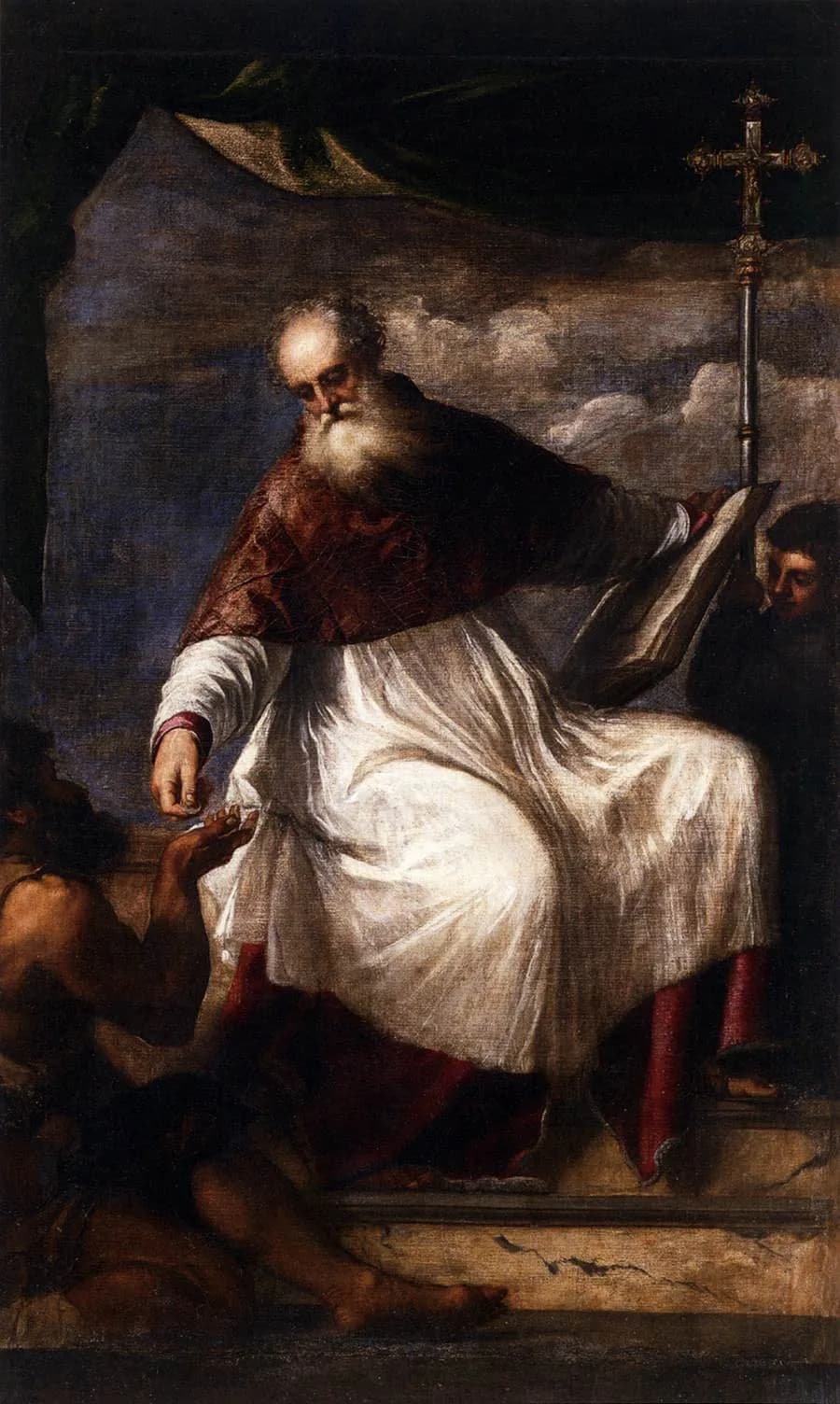
- Born
- About 550, at Amathus in Cyprus, son of the governor Epiphanius 1
- Patron saint of
- By the Catholic Encyclopedia, "the original patron saint of the Hospitallers" 1
Saint John the Almsgiver was a widowed Cypriot nobleman who became patriarch of Alexandria early in the seventh century and spent the wealth of the richest see in the East on the poor, whom he called his masters. 12 He kept a list of thousands of them, sat outside his church twice a week to hear complaints, and had his own grave left half dug as a reminder. 12 The Roman Martyrology remembers him on November 11. 3
A widower from Cyprus
John was born about 550 at Amathus in Cyprus, the son of Epiphanius, governor of the island, and of noble descent. 1 He married and had children. His wife and children all died, and afterward, the Catholic Encyclopedia says, "he entered the religious life." 1 Alban Butler describes him at this stage as a rich widower in Amathus who, "having buried all his children," used the whole income of his estate for the relief of the poor. 2
Both sources tell of a vision from his youth. He saw a beautiful young woman crowned with a garland of olive, who told him she was Compassion, "the eldest daughter of the Great King." 1 In Butler's version she goes on to promise that, if he keeps her favor, she will bring him to the king of the universe, since no one has so much influence with him as she does. 2 John told the story years later to his stewards in Alexandria, when they complained that he was impoverishing the Church. 2
How he came to Alexandria is told two ways. The encyclopedia says that when the patriarch Theodorus died, the people of the city asked the emperor Phocas to appoint John, and it dates his patriarchate from 606. 1 Butler says only that the reputation of his holiness raised him to the patriarchal chair, about 608, when he was past fifty. 2
His masters
On arriving, Butler writes, he ordered an exact list to be made of his "Masters." Asked who these were, he answered, "The poor." 2 The encyclopedia has him call them his "lords and masters," because of their influence in the court of heaven. 1 The list came to seven thousand five hundred people by Butler's count, "several thousand" by the encyclopedia's, and he took all of them under his care. 12
He found eighty thousand pieces of gold in the treasury of his church and gave it to hospitals and monasteries. 2 He visited the hospitals three times a week and freed a great many slaves. 1 The encyclopedia says he is said to have spent the entire revenue of his see on people in need. 1 When someone he had helped generously in private began to thank him at length, John cut him off: "Brother, I have not yet spilt my blood for you, as Jesus Christ, my master and my God, commands me." 2
He was not careful about who deserved it. A man who was not really in need applied for alms and was caught out by the palace staff, and John said only, "Give unto him; he may be Our Lord in disguise." 1 A merchant ruined by shipwreck was helped three times. The third time John gave him a ship loaded with grain, which was blown as far as Britain, where there was a shortage, and the cargo sold at a great profit. 12 Butler adds that the ship belonged to the Church and came back with half its price in money and half in pewter. 2
A reformer on a bench
His charity had an administrative side. On the day of his consecration, by Butler's account, he issued orders requiring just weights and measures, to stop the poor from being cheated, and forbade his officers and servants to accept any presents, "which are no better than bribes." 2 The encyclopedia likewise credits him with reorganizing the system of weights and measures for the sake of the poor and stopping corruption among officials. It calls him a reformer who attacked simony and fought heresy by improving religious education, and says he raised the number of churches in Alexandria from seven to seventy. 1
Every Wednesday and Friday he sat all day on a bench in front of the church, so that anyone could reach him with a grievance or a need. 2 Once, on his way into church, a woman stopped him to ask for justice against her son-in-law. Bystanders told her to wait until he came out. John overheard and said, "How can I hope that God will hear my prayer, if I put off the petition of this woman?" He dealt with it before he moved. 2
He could also stand up to the governor. When Nicetas planned a new tax that would fall hard on the poor, John spoke against it and Nicetas walked out in a rage. Toward evening John sent him a message: "The sun is going to set." Nicetas understood the allusion to Saint Paul's warning about anger, came back in tears, and asked his pardon. 2
The blanket and the grave
Both sources tell the story of the bed covering. A rich man, hearing that the patriarch slept under one poor blanket, sent him an expensive one. John used it for a single night and slept badly, reproaching himself for lying so richly covered while so many of his masters were poorly provided for. In the morning he sold it and gave away the money. The donor bought it back and gave it to him again, and John sold it again. 12 "We shall see who will be tired first," he said, in Butler's wording. 2 The encyclopedia finishes the story in four words: "It was not John." 1
He had his own grave dug, but only half, and appointed a man to come before him on state occasions and say, as Butler gives it, "My lord, your tomb is unfinished; be pleased to give your orders to have it completed, for you know not the hour when death will seize you." 12
When the Persians sacked Jerusalem in 614, John sent food, wine and money to the Christians who fled. 1 Butler lists the shipment to the city itself: money, a thousand sacks of grain, as many of legumes, iron, fish, wine, and a thousand Egyptian workmen to help rebuild the churches. He also sent two bishops and an abbot to ransom captives. 2
Death in Cyprus
The two accounts of his end differ. The encyclopedia says the Persians eventually occupied Alexandria and that John, in his old age, was forced to flee to his native Cyprus, where he died in 616. 1 Butler says the governor Nicetas persuaded him to travel to Constantinople to visit the emperor, and that at Rhodes John was warned his death was near and told Nicetas, "You invite me to the emperor of the earth; but the King of heaven calls me to himself." He sailed for Cyprus and died at Amathus about 619, in his sixty-fourth year. 2 The Martyrology places his death at Limassol on Cyprus. 3
His body was taken to Constantinople. Much later it was given to Matthias Corvinus, king of Hungary, who kept it at Buda; in 1530 it was moved to a place near Pressburg, and in 1632 to Pressburg cathedral. 12 His Life was written by Leontius, a bishop in Cyprus, and was cited at the Seventh General Council. 12
What is Saint John the Almsgiver the patron saint of?
The Catholic Encyclopedia states one patronage, and it belongs to history: "He was the original patron saint of the Hospitallers." 1 It gives no further detail, and neither Butler nor the Martyrology names him patron of any group or cause. 23 The Martyrology's entry describes him as outstanding for mercy toward the poor, a builder of churches, hospitals and orphanages who used the goods of the Church to relieve want and kept urging the rich to give. 3
Saint John the Almsgiver's feast day
The Roman Martyrology now in use lists Saint John the Almsgiver on November 11, as the day of his death. 3 That was not always the Roman date. Butler, whose text EWTN heads "Feast: January 23," explains: "The Greeks honor this saint on the 11th of November, the day of his death; but the Roman Martyrology on the 23d of January, the day marked for the translation of his relics." 2 The encyclopedia says the Greeks commemorated him on November 12. 1
Praying with Saint John the Almsgiver
John came to his office late. He had been a husband and a father and had buried his whole family before he was ever a bishop. 12 Neither source says what that did to him. They simply go on to describe a man who gave things away for the rest of his life.
What stands out in the stories is how practical he was. He made a list. He fixed the weights in the market. He kept office hours on a bench where nobody could be turned away at the door. 12 Almsgiving for him included making sure the poor were not cheated in the first place.
He also seems to have been funny, which the sources let show. The contest over the blanket is a joke he was happy to keep winning, and the message to Nicetas is one line long. 12 Butler says that when people slipped out of church during the long office, John went out and sat down among them: "My children, the shepherd must be with his flock." 2
Under the humor was a man who thought often about his own death and judgment, to the point of appointing someone to remind him of the unfinished grave. 12 Butler calls humility his distinguishing virtue. 2 He told the man he had helped that he had not yet done what Christ commands, and by every account he meant it. 2
Saint John the Almsgiver, pray for us.
Sources
- 1.C. F. Wemyss Brown, "St. John the Almsgiver," The Catholic Encyclopedia, vol. 8 (New York: Robert Appleton Company, 1910).
- 2.Alban Butler, "St. John the Almsgiver, Patriarch of Alexandria," The Lives of the Fathers, Martyrs and Other Principal Saints, vol. 1 (D. & J. Sadlier, 1864); EWTN library.
- 3."San Giovanni l'Elemosiniere, vescovo," Santo del giorno, 11 novembre, from the Roman Martyrology, Conferenza Episcopale Italiana (in Italian).
Saints to turn to next
Others in this collection who are turned to for some of the same things.
- Saint Agnes of Bohemiac. 1200-1205 - March 1281 or 1282Poverty and simplicity
- Saint Aidan of Lindisfarnec. 590 - August 31, 651Poverty and simplicity
- Saint Albert ChmielowskiAugust 20, 1845 - December 25, 1916Poverty and simplicity
- Saint Alexander Sauli1533 or 1534 - October 11, 1592Poverty and simplicity