Saint John of Ribera
December 27, 1532 - January 6, 1611
- Born
- December 27, 1532, in Seville 5
- Archbishop of Valencia
- Named in 1568 by Pope Pius V, with the title Patriarch of Antioch; forty-two years in the see 235
- Beatified
- 1796, by Pope Pius VI 2
Saint John of Ribera was archbishop of Valencia for forty-two years, the longest tenure the archdiocese has recorded, and in that time he made 2,715 pastoral visits to its parishes and wrote them up in ninety-one volumes. 23 Valencia still calls him simply the Patriarch, after the title Pope Pius V gave him, and the seminary he founded to train priests after the Council of Trent is still doing that work. 34
Seville and Salamanca
He was born in Seville on December 27, 1532. 5 Pope John XXIII, preaching at his canonization, said that his parents were distinguished both for their Christian faith and for the nobility of their line, and that from his earliest years he was given to prayer. 1
From 1544 he studied at the University of Salamanca. 5 The pope lists canon law, the humanities and the arts, and says that what he pursued hardest was a deeper knowledge of the faith. 1 It was a time, John XXIII says, when the followers of Luther were stirring up agitation, and Ribera would not tolerate at his side for a moment anyone who spread their theories, as he also kept away from fellow students who were given over to pleasure. 1
Badajoz, then Valencia
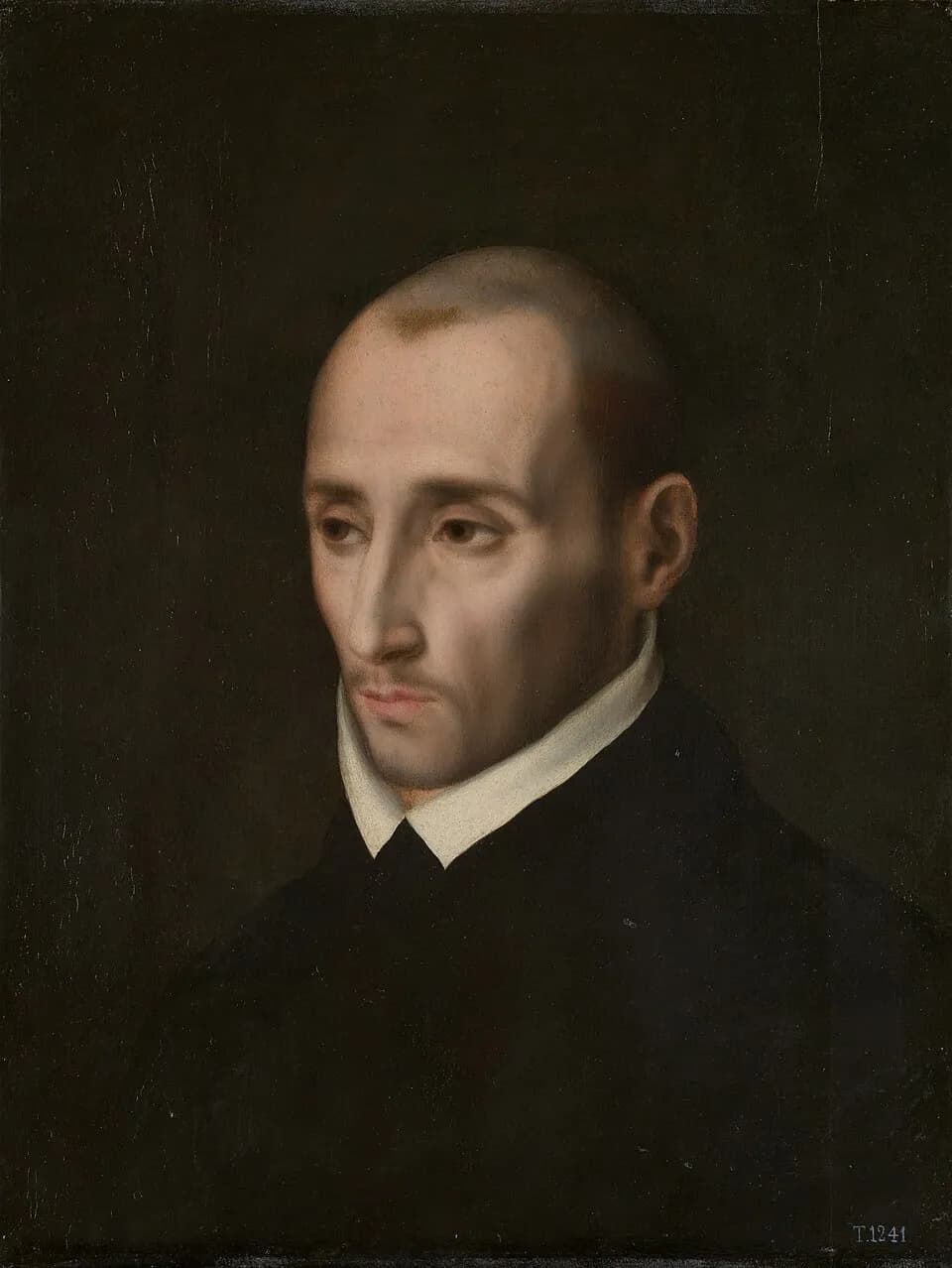
In 1562 he was named bishop of Badajoz. 24 The portrait on this page, by Luis de Morales, dates from about those years and shows him as a young man in a plain black cassock. In 1568 Pius V gave him the title of Patriarch of Antioch and named him archbishop of Valencia; the archdiocese gives his age as thirty-five. 35 He stayed until he died. The archdiocese counts forty-two years, from 1569 to 1611, and calls it the longest pontificate in the history of the see. 23
Pius V thought highly of him. The archdiocese quotes the pope calling him "lumen totius Hispaniae," the light of all Spain, and praising him as a man who did the work of a parish priest as well as a bishop. 3 John XXIII, four centuries later, said that his holiness and prudence shone more in Valencia than in Badajoz precisely because he met greater difficulties there. 1
How he governed
The numbers the archdiocese has kept are startling. In forty-two years he went around the whole diocese eleven times and made 2,715 pastoral visits to parishes, and he left a record of them in ninety-one volumes that run to 92,000 pages. 3 He held seven diocesan synods. 13
John XXIII describes the manner of it. At the beginning Ribera preached to the people in simple words, taught children the rudiments of the faith in the street, heard confessions patiently in church and carried Viaticum to the dying himself. 1 Then he turned to his priests, in conferences and in pastoral letters, urging them to prayer, to patience and to peace with one another. 1 The archdiocese says that he could often be seen hearing confessions in the cathedral, that he lived austerely and gave away both his own goods and part of the income of the see, and that seven volumes of his sermons have been published. 2
He had a plain account of what a bishop is for. The archdiocese summarizes it as five things: preaching, administering the sacraments, caring for his priests, attending to the poor and educating the young. 2 The poor, and the sick poor most of all, were to hold the center of a bishop's heart, so that he could rightly be called their father. 2 He turned his own house into a school, with the best teachers he could find and whatever books the students needed. 2
For two years he also governed in the civil order. King Philip III named him viceroy and captain general of Valencia from 1602 to 1604. 23
The college of Corpus Christi
The work he is remembered by is a seminary, the Real Colegio Seminario de Corpus Christi, which the city calls El Patriarca. He founded it, the archdiocese says, to form priests according to the spirit and the decrees of the Council of Trent. 34 The college's own site dates the foundation to 1583 and the solemn opening to 1604, with Philip III present. 4 It says the house is perhaps one of the few institutions that still does, after four centuries, the thing it was founded to do. 4
It bears the name of the Eucharist, and both the college and the archdiocese describe him as marked above all by Eucharistic devotion. 25 In 1604 he wrote out how the feast of Corpus Christi and its octave were to be kept in the college chapel, and the archdiocese reports that those rites are still followed there, including a cloister procession with the monstrance and a weekly offering of twelve bunches of wheat before the Blessed Sacrament. 8 The custom in Valencian parishes of building a separate communion chapel is traced to him, and so is a short acclamation still used there, "¡Alabado sea el Santísimo Sacramento!", praised be the Most Blessed Sacrament. 23
He also backed the reformed religious orders. He brought the Capuchins to Valencia in 1596 and built them a friary, and in 1597 he founded the Discalced Augustinian nuns at Alcoy, adapting for them the constitutions Saint Teresa had given her Carmelites. 2 The 1912 Catholic Encyclopedia remembers him the same way, as one who "furthered the work of monastic reform, especially among the Capuchins, whom he had brought to Valencia." 6
The Moors of Valencia
The encyclopedia says that "Perhaps the most noted of all the archbishops of Valencia was the Patriarch Juan de Ribera," and its next sentence is this: "He decided to expel the Moors from the city, after exhausted all possible means to bring them to submission." 6 That one sentence, printed as it stands, is all the encyclopedia says. The archdiocese's pages and the canonization homily do not mention the matter, and this page does not go beyond what its sources say. 123
His death
He died on January 6, 1611, at seventy-eight. 25 The archdiocese says the cause was a heavy cold caught a month earlier, after he had stayed more than three hours kneeling on the ground in prayer. 2 John XXIII tells what happened when the Eucharist was brought to him as Viaticum: though he had no strength left, he got himself out of bed and onto his knees and made a profession of the Catholic faith. 1
He is buried in his college, where the community still sings at his tomb on his feast. 3 Pius VI beatified him in 1796. 2 John XXIII canonized him on June 12, 1960, which was Trinity Sunday, and said that he had chosen the day on purpose. 12
What is Saint John of Ribera the patron saint of?
Saint John of Ribera's feast day
Valencia keeps the liturgical feast of Saint John of Ribera on January 14. The archdiocese gives that date, and his college, which calls it the day of his liturgical feast, prepares for it each year with a triduum that ends in solemn Vespers and Mass. 29
The Roman Martyrology names him on January 6, the day he died. Its entry describes him as a bishop of Valencia who also served as viceroy, devoted to the Eucharist and a defender of Catholic truth, who taught his people with solid instruction. 7 A calendar that follows the Martyrology and a calendar that follows Valencia will therefore show him eight days apart.
Praying with Saint John of Ribera
Most of what the sources record about him is routine carried on for a very long time. He visited parishes, 2,715 of them by the archdiocese's count, and wrote down what he found. 3 He held synods, wrote to his priests, heard confessions and took Communion to the dying. 12
John XXIII drew one lesson from him above the others. Faith, the pope said, has to be honored with deeds more than with words, and he asked Christians to value it above all things. 1 He pointed to the deathbed as the place where a whole life showed: an old man with no strength left, getting to his knees because the Eucharist had come into the room. 1
The same record includes the sentence about the Moors, and the sources that praise him do not explain it. 6 A reader can hold both things. The Church canonized a bishop who spent himself for his people for forty-two years, and the encyclopedia written by the Church's own scholars set down what he decided about some of them. 16
His college is the easiest place to see what he cared about. It was built to train priests and to keep the Eucharist at the center of a house, and it has done both since 1604. 48
Saint John of Ribera, pray for us.
Sources
- 1.Pope John XXIII, Homily at the canonization of Blessed Juan de Ribera, June 12, 1960 (in Spanish).
- 2."San Juan de Ribera: Una impronta espiritual y devocional que aún perdura," Archdiocese of Valencia, January 11, 2023 (in Spanish).
- 3."El Colegio Seminario 'El Patriarca' celebra la fiesta de su fundador, San Juan de Ribera," Archdiocese of Valencia, January 15, 2024 (in Spanish).
- 4."Bienvenido," Real Colegio Seminario de Corpus Christi, Valencia (in Spanish).
- 5."San Juan de Ribera," El Patriarca, Real Colegio Seminario de Corpus Christi, Valencia (in Spanish).
- 6.Ramón Ruiz Amadó, "Valencia," The Catholic Encyclopedia, Vol. 15 (New York: Robert Appleton Company, 1912).
- 7.Roman Martyrology, entry for January 6, as printed in "Santo del giorno," Conferenza Episcopale Italiana (in Italian).
- 8."'El Patriarca' celebra la Octava del Corpus con los ritos establecidos en el siglo XVII por San Juan de Ribera," Archdiocese of Valencia, June 16, 2023 (in Spanish).
- 9."El Real Colegio Seminario de Corpus Christi celebra esta semana el triduo por san Juan de Ribera," Real Colegio Seminario de Corpus Christi, Valencia, January 10, 2026 (in Spanish).
Saints to turn to next
Others in this collection who are turned to for some of the same things.
- Saint Aelred of Rievaulx1109 - January 12, 1166 (or 1167)PrayerWork and vocationStudy and teaching
- Saint Dunstanc. 909 or earlier - May 19, 988Work and vocationPrayerStudy and teaching
- Saint Ephremc. 306 - June 9, 373Study and teachingPrayerWork and vocation
- Saint Jadwiga of Poland1373 - July 17, 1399Study and teachingPrayerWork and vocation