Saint John of Matha
c. 1154 - December 17, 1213
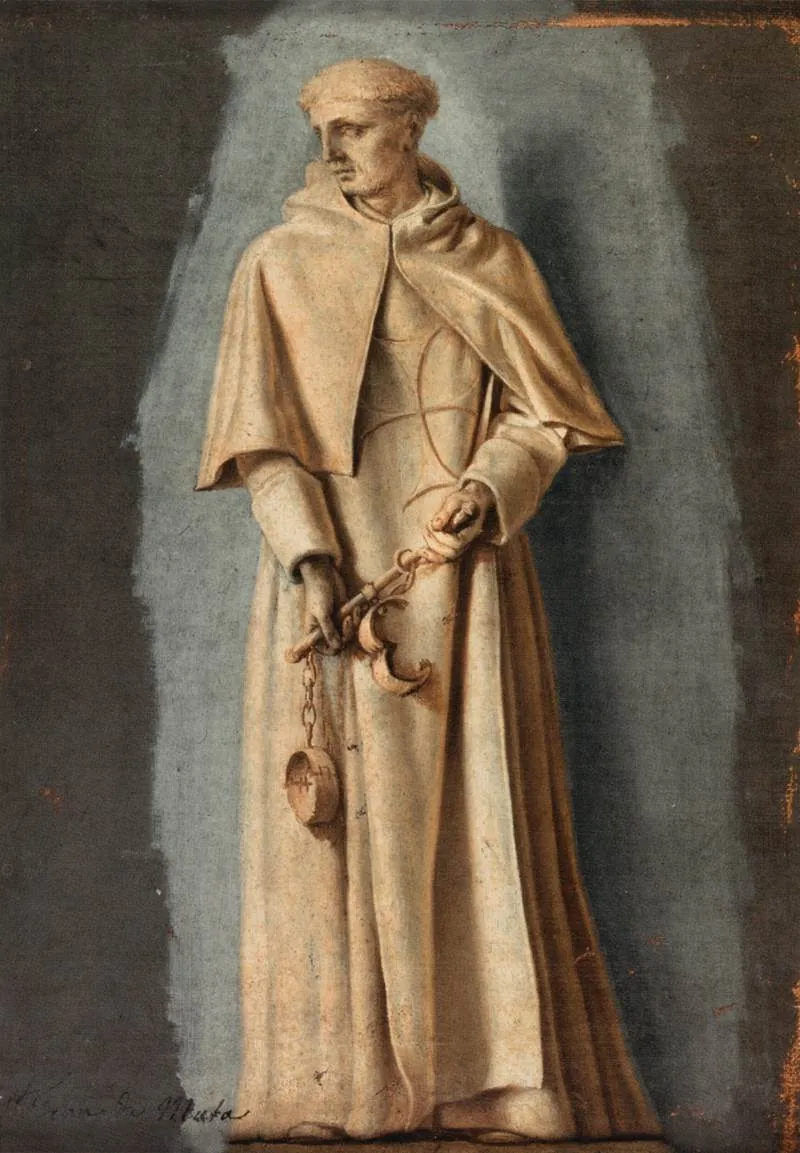
- Patron of
- Captives and prisoners; Faucon and Meaux, France 9
Saint John of Matha was a theologian from Provence, trained and ordained in Paris, who founded the Order of the Most Holy Trinity to buy Christian captives out of slavery, and who died in Rome on December 17, 1213. 23 The order calls itself the first unarmed institution in the Church given to that work, and Pope Innocent III approved its rule on December 17, 1198. 510 His feast is December 17. 36
A student from Provence
He was born at Faucon, in the Alps on the edge of Provence, on June 24, and was baptized John in honor of John the Baptist. 12 The year is not settled. The Trinitarian Order says 1154, or possibly 1160; Alban Butler's Lives of the Saints says 1169. 12 The order adds that his family were vassals of the counts of Barcelona. 2
Butler gives the boyhood in detail. His father, Euphemius, sent him to Aix to learn grammar, fencing and riding, the education of a young nobleman, and John gave much of his allowance to the poor and went to the hospital every Friday to wash and dress the sores of the sick. 1 Back at home he tried living in a small hermitage near Faucon, found that his friends kept visiting, and asked leave to go to Paris and study theology. 1
The order tells it as an academic career: schooling at Aix, Marseille and finally Paris, a doctorate in theology, and a post teaching at the cathedral school. 2 He was ordained by Maurice de Sully, the bishop of Paris and the builder of Notre Dame. 2
The first Mass
Everything in his later life is traced to the day he first said Mass. The order dates it to January 28, 1193. 2 It preserves the account of an anonymous thirteenth-century writer, who says that John had invited the bishop, the abbot of St. Victor and his own teacher, and that at the consecration he asked God once more to show him which religious order he should enter. 2 Then, the writer says, "he saw the glory of God and the Lord holding in his hands two men with chains on their feet," one of them black and one white. 2
Butler knows nothing of a vision. He says only that on that day, "by a particular inspiration from God," John resolved to give himself to ransoming Christian slaves. 1 But John Paul II told the story as the order tells it, and pointed to a mosaic of the scene, made around 1210, that can still be seen on the portal of the house John was given in Rome. 5 The order says its founder had it put there. 24
Cerfroid and Rome
He left Paris for the forest of Cerfroid, about seventy kilometers to the northeast, where a group of hermits lived. 2 Tradition names their leader as Felix of Valois and makes him co-founder of the order. 210 In Butler's telling John arrived asking to be taught and Felix refused to treat him as a disciple; one day beside a spring John told him what he had resolved at his first Mass, and Felix offered to join him. 1 The order's calendar says the hermits "gave themselves and their possessions to God and the Order," and dates the foundation at Cerfroid to 1194. 3
What happened in Rome is told two ways. Butler and the Catholic Encyclopedia have John and Felix set out together in the hard winter at the end of 1197, carrying letters from the bishop of Paris, and say the newly elected Innocent III lodged them in his own palace. 18 Butler says the pope "received them as two angels from heaven." 1 The order describes a slower process. The pope sent John back to Paris with a letter of protection dated May 16, 1198; John reworked the rule he had written with his first companions and carried it to Rome a second time. 2
On the result everyone agrees. Innocent, whom the encyclopedia calls "little in favor of new orders," approved this one by a bull of December 17, 1198. 57 The friars were to wear a white habit with a cross of red and blue. 17 Each house was to have seven brothers, and its income was to be split in three: one part for the brothers, one for the poor, one for ransoming captives. 7 They were forbidden to ride horses, which earned them the nickname "Friars of the Ass." 7
Buying people back
On March 8, 1199, Innocent wrote to the ruler of Morocco to recommend the Trinitarians and their work. 2 John Paul II saw a beginning in that letter: "With the Trinitarian Order Christianity established a humanitarian contact with the world of Islam." 5
The first expedition followed quickly. The order thinks it very likely that John went himself. 2 Butler has him send two friars in 1201, who came back with 186 freed slaves, and go to Tunis in person the next year, where he bought the liberty of 110 more. 1 Then came years of founding houses and begging for the money that kept the work going: at Marseille, the port where the ransomed came ashore, and across Spain, at Toledo, Segovia and Burgos. 12 When disputes arose over property, the order says, he sought peace even when it meant giving up what was rightfully his. 2
Butler tells one more story, of a second voyage to Tunis in 1210. John was sailing home with 120 ransomed slaves when men enraged at his success took the helm from the ship and tore its sails. He "hung up his companions' cloaks for sails," knelt on the deck with a crucifix, and the ship came safely into Ostia. 1 It should be read with some reserve. Father Clifford Stevens, in the life CatholicCulture excerpts, writes that "little is known for certain about his life," and that in the fifteenth and sixteenth centuries members of the order filled it with invented miracles and adventures. 9
The house on the Caelian Hill
In 1209 Innocent III gave the Trinitarians the church of St. Thomas in Formis in Rome, with its monastery, and John made it his headquarters. 4 His first care was to turn part of it into a hospital for the poor, the sick, pilgrims and ransomed slaves. 4 He held the title of minister of St. Thomas in Formis, and a tradition says Francis of Assisi was once a guest there. 24
He died in that house on December 17, 1213, and was buried in its church on December 21. 34 Butler gives December 21 as the day of death and says he was sixty-one, which does not fit Butler's own birth year. 1 By then, Stevens says, the order had thirty-five houses. 9
His body did not stay in Rome. On the night of March 19, 1655, it was stolen from the church and taken to Madrid, where Church authorities later confirmed the relics as his. 23 Most of them were moved in 1966 to the Trinitarian college at Salamanca. 3 The order says that Pope Alexander VII recognized and confirmed his immemorial cult; Stevens puts his recognition as a saint in 1694. 29
The work outlived him by centuries. The encyclopedia puts the number of captives ransomed by the Trinitarians at 90,000 and names the best known of them: Miguel de Cervantes, ransomed in 1580, who was buried in the habit of a Trinitarian tertiary. 7
What is Saint John of Matha the patron saint of?
Saint John of Matha is listed as the patron saint of captives and prisoners, and of two places in France: Faucon, where he was born, and Meaux, in whose territory Cerfroid lay. 39 That list comes from CatholicCulture's page for his feast. 9 Neither the encyclopedia nor the papal letters name a patronage, but it would be hard to find a saint for whom this one follows more directly from the life.
In art he wears the white Trinitarian habit with its red and blue cross and holds chains, and a purse is among his symbols. 9
Saint John of Matha's feast day
Saint John of Matha's feast is December 17. It is the day the order says he died and also the anniversary of the approval of his rule, and the Trinitarians keep it as a solemnity. 3 Pope Francis dated his 2013 message to the order "17 December, the Solemnity of St John of Matha," and CatholicCulture lists him on that day from the Roman Martyrology. 69
Butler gives a different date. His life of the saint is headed "Feast: February 8." 1 The order also keeps May 7 for the translation of his relics, and it honors Saint Agnes as its principal patroness because his first Mass fell on her day, January 28. 3
Praying with Saint John of Matha
Pope Francis, writing to the Trinitarians eight hundred years after their founder died, described him, and the order's later reformer, as men who had been leading "a religious, respectable, albeit somewhat comfortable and secure life." 6 John was a doctor of theology in what the order calls the intellectual center of all Christendom. 2 The call he received, Francis wrote, disrupted that life. 6
It is worth noticing what he was praying for when it came. By the old account he was asking which religious order he ought to join, a question about his own salvation. 2 The answer was two strangers in chains. He spent the next twenty years on roads and ships, asking for money and handing it to slaveholders, so that people he had never met could go home. 12
His rule made that arithmetic permanent. A third of what each house received was set aside for captives, and another third for the poor. 7 Innocent III, approving it, said these men sought only "the interest of Christ." 26
Francis drew the present-day conclusion without softening it. There are many poor and enslaved people now, he told John's order: "We see them every day and we cannot pass them by, contenting ourselves with a good word." 6
Saint John of Matha, pray for us.
Sources
- 1.Alban Butler, "St. John of Matha, Founder of the Order of the Trinitarians," The Lives of the Fathers, Martyrs and Other Principal Saints, Vol. I (New York: D. & J. Sadlier, 1864), as published by EWTN.
- 2.Thierry Knecht, O.SS.T., "St. John of Matha," in "Trinitarian Saints," Order of the Most Holy Trinity and of Captives.
- 3."Liturgical calendar - Feasts," Order of the Most Holy Trinity and of Captives.
- 4."St. Thomas in Formis," Order of the Most Holy Trinity and of Captives.
- 5.John Paul II, Letter to the Minister General of the Order of the Most Holy Trinity, June 7, 1998.
- 6.Francis, Message to the Minister General of the Order of the Most Holy Trinity on the 800th Anniversary of the Death of Its Founder, Saint John of Matha, December 17, 2013.
- 7.Charles Moeller, "Order of Trinitarians," The Catholic Encyclopedia, Vol. 15 (New York: Robert Appleton Company, 1912).
- 8.Michael O'Kane, "St. Felix of Valois," The Catholic Encyclopedia, Vol. 6 (New York: Robert Appleton Company, 1909).
- 9."December 17: St. John of Matha, Priest (RM)," Liturgical Year, CatholicCulture.org, with an excerpt from Clifford Stevens, The One Year Book of Saints.
- 10."History," Order of the Most Holy Trinity and of Captives.
Saints to turn to next
Others in this collection who are turned to for some of the same things.
- Saint BarnabasFirst centuryCourageWork and vocationPoverty and simplicity
- Saint Clement Mary HofbauerDecember 26, 1751 - March 15, 1820Work and vocationCouragePoverty and simplicity
- Saint Frances Xavier CabriniJuly 15, 1850 - December 22, 1917CouragePoverty and simplicityWork and vocation
- Saint François de LavalApril 30, 1623 - May 6, 1708CourageWork and vocationPoverty and simplicity