Saint John Leonardi
1541 - October 9, 1609
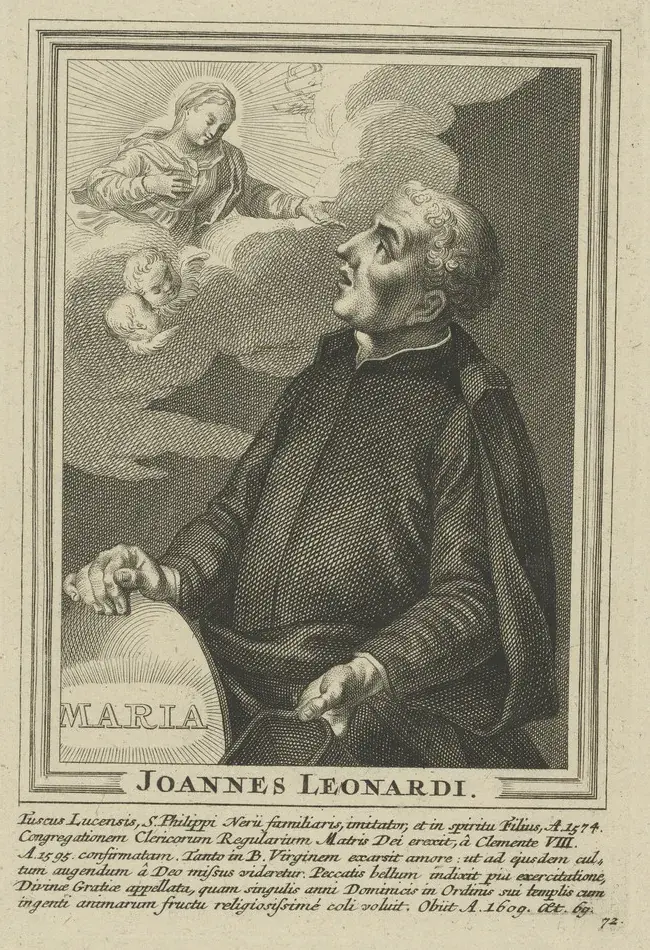
- Ordained
- December 22, 1572, by the 1908 Catholic Encyclopedia; Benedict XVI says he celebrated his first Mass on the Epiphany of 1572 12
- Canonized
- April 17, 1938 1
- Buried
- Santa Maria in Campitelli, Rome, under the altar of Saint John the Baptist 2
Saint John Leonardi trained for about ten years as an apothecary in Lucca, earned the license to open his own shop, and then became a priest instead. 1 He founded the Clerks Regular of the Mother of God, spent most of his life barred from his own city for it, helped plan the Holy See's congregation for the missions, and died in Rome in 1609 after nursing the sick through an epidemic. 12 In 2006 he was named patron saint of pharmacists. 1
An apothecary from Diecimo
He was born in 1541 at Diecimo, a small township in the Republic of Lucca, to middle-class parents. 12 Benedict XVI, who devoted a general audience to him on the four hundredth anniversary of his death, describes him as the youngest of seven children in a "healthy, hard-working family," and says he spent time as a boy in a local workshop that made and sold essences and medicines. 1
At seventeen his father sent him to Lucca to learn the apothecary's trade. 12 He stayed with it for about ten years. 1 Then, as Benedict tells it, when he had earned the official recognition that would let him open a shop of his own, "he started wondering whether the moment had not come to carry out a plan he had always had at heart." 1 The encyclopedia adds that he had to educate himself for the priesthood, and that there were "many difficulties" on the way. 2
The two sources do not agree on when he was ordained. The Catholic Encyclopedia gives December 22, 1572. 2 Benedict XVI says that he was ordained and "on the day of Epiphany 1572, celebrated his first Mass," which would place the ordination earlier. 1 He never lost his interest in medicine; Benedict says he came to see the priest's task as passing on "the medicine of God," which is Christ himself. 1
A congregation and an exile
As a young priest he worked especially in hospitals and prisons, and the example drew several young laymen to help him. 3 He also taught boys through the Confraternity of Christian Doctrine. 1 Franciscan Media dates the confraternity he formed to 1579, and says he published a compendium of Christian doctrine that stayed in use until the nineteenth century. 3
The young men around him became the core of a community. Benedict XVI dates its founding to September 1, 1574 and calls it the Congregation of Reformed Priests of the Blessed Virgin; the encyclopedia says only that it "may be said to have begun in 1574," and records its early name as the Congregation of Clerks Secular of the Blessed Virgin. 12 They rented the small church of Santa Maria della Rosa and began something like community life in a house nearby. 2
Lucca did not want it. The encyclopedia suggests that the republic's rulers feared a native religious order spreading through Italy "would cause the affairs of the little state to become too well known to its neighbours." 2 The opposition was effective enough that he spent practically the rest of his life banished from Lucca, admitted now and then by special decree of the Senate, "unwillingly extracted under papal pressure." 23
He had encouragement and help from Saint Philip Neri, who, Franciscan Media records, gave him his lodgings, "along with the care of his cat!" 3 The congregation was erected canonically in 1583 at the urging of Pope Gregory XIII, and Clement VIII confirmed it in 1595. 23 Clement also sent Leonardi to reform the monks of Monte Vergine in 1596, and in 1601 the cardinal protector gave him a similar task among the Vallombrosans. 2
The community kept a foothold in Lucca all the same. In 1580 Leonardi secretly acquired the old church of Santa Maria Cortelandini, known locally as Santa Maria Nera, and his order still held it when the encyclopedia was written. 2 In 1601 he obtained the church of Santa Maria in Portico in Rome, and the same year Cardinal Baronius became the congregation's protector. 2
Reform, and the missions
His contemporaries were Charles Borromeo, Philip Neri, Ignatius of Loyola, Camillus de Lellis and Aloysius Gonzaga, in years when new religious institutes were springing up across the Church. 1 Benedict XVI sums up the conviction he brought to that moment in a phrase Leonardi liked to repeat: "It is necessary to start afresh from Christ." 1 Benedict also notes the two images that held his attention, the Holy Face venerated in the cathedral of Lucca and the face of Mary, whom he chose as patroness of his order. 1
In May 1605 he wrote to the newly elected Pope Paul V with a petition on the renewal of the Church. 1 Benedict XVI quotes it at length, and the pharmacist is audible in it: whoever wants a serious reform "must first of all, like a good doctor, make an attentive diagnosis of the evils besetting the Church, thereby to be able to prescribe the most appropriate remedy for each one of them." 1 The renewal, he wrote, "must be started by those in charge and extended to their subjects." 1
He also thought beyond Italy. Benedict credits him, with Juan Bautista Vives and the Jesuit Martín de Funes, with planning and helping to found the Holy See's congregation for the missions, Propaganda Fide. 1
Death in Rome
He died in Rome on October 9, 1609, aged sixty-eight. 123 Benedict XVI says it was influenza, contracted while he ministered to those stricken by an epidemic in the Campitelli neighborhood; Franciscan Media says it was a disease caught while he tended the victims of the plague. 13
He was buried in Santa Maria in Portico. 2 In 1662 the congregation obtained Santa Maria in Campitelli, and his body was moved there; it lies under the altar of Saint John the Baptist. 2 He was declared Venerable in 1701 and beatified by Pius IX in 1861. 2 He was canonized on April 17, 1938. 1
His order stayed small. In 1614 Paul V gave it the name "of the Mother of God," and in 1621 Gregory XV allowed its members to take solemn vows, which made it a religious order in the full sense. 2 Both sources say it has never had more than fifteen churches. Franciscan Media calls that the founder's deliberate policy; the encyclopedia says he turned down the churches he was offered so as not to provoke the government of Lucca. 23
What is Saint John Leonardi the patron saint of?
Saint John Leonardi's feast day
Praying with Saint John Leonardi
He had a trade, a license and a future in it, and he left it at about the point most people would have started to enjoy the reward. 1 He did not treat the years behind the counter as wasted. Benedict XVI notes how he kept talking like a pharmacist, telling his followers to "lift up your hearts a little higher to God and with him measure all things." 1
Much of his life was spent outside his own city, kept out by its government. 2 The encyclopedia records that he refused churches he was offered so as not to inflame the republic further. 2 It is not a story with a vindication at the end. He died in Rome, still largely an exile from Lucca. 2
Benedict XVI singles out how he loved a Church whose weaknesses he saw clearly. "He realized that every reform should be made within the Church and never against the Church." 1 His petition to Paul V asked for reform from the top down, and he spent his own days on children's catechism and on the sick. 13
His formula, as Benedict gives it, was blunt: "Either Christ or nothing!" 1 He had started out among medicines, and he ended among the sick of a Roman neighborhood, where he caught what they had. 13
Saint John Leonardi, pray for us.
Sources
- 1.Benedict XVI, General Audience, Saint Peter's Square, October 7, 2009 (on Saint John Leonardi). Libreria Editrice Vaticana.
- 2.Montgomery Carmichael, "Clerks Regular of the Mother of God of Lucca," The Catholic Encyclopedia, Vol. 4 (New York: Robert Appleton Company, 1908).
- 3."Saint John Leonardi," Saint of the Day, Franciscan Media.
- 4."Saints of October 9," Vatican News, listing St. John Leonardi, Founder of the Clerics Regular of the Mother of God.
Saints to turn to next
Others in this collection who are turned to for some of the same things.
- Saint Angela MericiMarch 21, 1474 - January 27, 1540Study and teachingWork and vocationDiscernment
- Saint Gregory the Greatc. 540 - March 12, 604Work and vocationDiscernmentStudy and teaching
- Saint Jadwiga of Poland1373 - July 17, 1399Study and teachingDiscernmentWork and vocation
- Saint John BerchmansMarch 13, 1599 - August 13, 1621Study and teachingDiscernmentWork and vocation