Saint John Gualbert
c. 985/999 - July 12, 1073
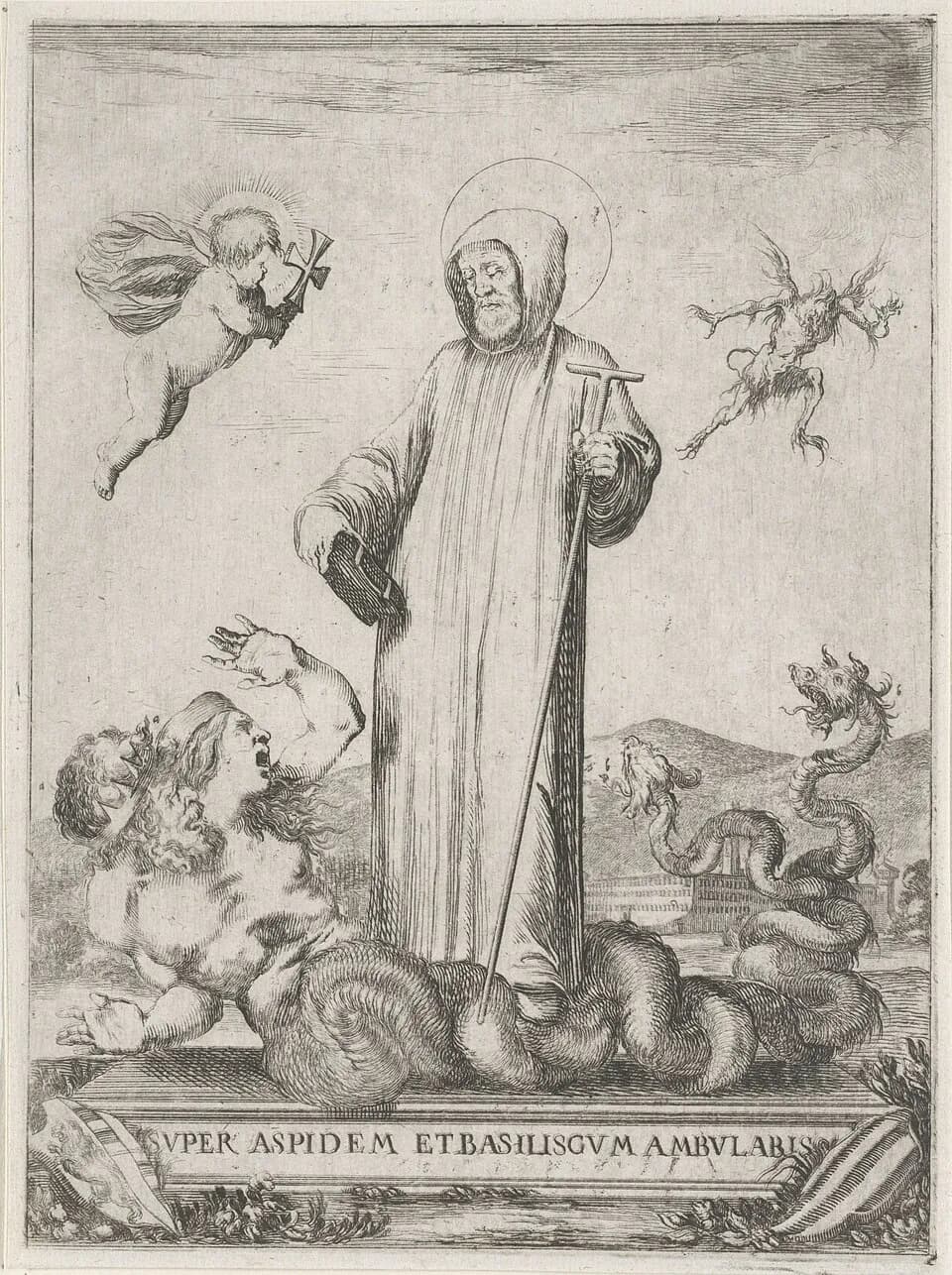
- Family
- Son of the Florentine nobleman Gualbert Visdomini 1
- Founded
- Vallombrosa, whose church was consecrated in 1038 1
- Rule
- The Rule of Saint Benedict, with added austerities and an order of lay brothers 1
- Canonized
- 1193 1
- Patronage
- The Italian Forest Rangers, as Catholic News Agency reports it 4
Saint John Gualbert was a Florentine knight who caught up with the man who had killed his kinsman, had him at his mercy, and let him go. 12 He became a monk, and later founded the monastery of Vallombrosa in the hills twenty miles from Florence, the mother house of a strict Benedictine congregation that still exists. 12 He died on July 12, 1073, and that is his feast. 15
A knight with a death to avenge
He was the son of a Florentine nobleman, Gualbert Visdomini. 1 The Catholic Encyclopedia gives his birth as 985 "(or 995)"; Butler's Lives says 999, and it was in 1999 that the Vallombrosan monks kept the thousandth anniversary, for which John Paul II wrote them a letter. 123 The pope describes him as "still a knight with a promising military career in the world" when the event that changed his life took place. 2
Someone in his family had been murdered. The encyclopedia says "one of his relatives" and that "it became his duty to avenge the deceased." 1 John Paul II says it was his brother, and Catholic News Agency gives the brother's name as Hugh. 24 Butler says only that he was caught up in "a blood-feud with a near relative." 3
The pardon
The sources agree on what happened next and differ in the details. In the encyclopedia he met the murderer in a narrow lane and was about to kill him, "but when the man threw himself upon the ground with arms outstretched in the form of a cross, he pardoned him for the love of Christ." 1 Butler sets it on Good Friday, with John riding into Florence among armed men and the enemy unable to avoid him and unprepared to fight. 3 In John Paul II's telling he "descended from his horse upon meeting his brother's killer and embraced him in an act of pardon." 2
Butler gives him words: "I cannot refuse what you ask in Christ's name. I grant you your life, and I give you my friendship. Pray that God may forgive me my sin." 3
On the way home he went into the Benedictine church of San Miniato to pray, and there, the encyclopedia says, "the figure on the crucifix bowed its head to him in recognition of his generosity." 1 Butler tells it the same way. 3 The encyclopedia adds that the story is the subject of Burne-Jones's painting "The Merciful Knight." 1
John Paul II drew the point for the monks in 1999. Giving way to hatred and violence, he wrote, "means being overcome by evil and spreading it," and by forgiving, John "won a great victory over himself and achieved profound inner peace." 2
From San Miniato to the shady valley
He became a Benedictine at San Miniato, over his family's objections according to Catholic News Agency. 14 He did not stay. The encyclopedia says he left "to lead a more perfect life," spent some time with the monks at Camaldoli, and found that what drew him was life in community and not the hermit's cell. 1 He settled at Vallombrosa, about twenty miles from Florence on the slope of Monte Secchieta, more than three thousand feet up. The name is the Latin vallis umbrosa, shady valley. 1
The dates are uncertain, and the encyclopedia says so: the chronology of the early days "has been much disputed," and the dates proposed for his conversion run from 1004 to 1039. 1 It finds firmer ground in two events. Blessed Rotho, bishop of Paderborn, consecrated the church in 1038, and in 1039 Itta, abbess of the neighboring monastery of Sant'Ellero, gave the land. 1 The encyclopedia says Pope Victor II confirmed the order in 1056; Catholic News Agency gives 1070 for papal approval. 14
The rule of Vallombrosa
He took the Rule of Saint Benedict and, in the encyclopedia's words, "added greatly to its austerity and penitential character." 1 Silence was perpetual, poverty was strictly enforced, breaches of the rule were punished with scourging, and enclosure was so strict that a monk could not go out even on an errand of mercy. 1 His idea, the encyclopedia says, was "to unite the ascetic advantages of the eremitic life to a life in community." 1
In one respect he departed from Benedict. His choir monks were to be pure contemplatives and did no manual work, and to make that possible he brought in lay brothers to handle the monastery's outside business. 1 The encyclopedia says he "was among the first to systematize this institution," and that the word conversi, lay brothers, appears for the first time in the Life of him written by Abbot Andrew of Strumi at the start of the twelfth century. 1
It was a hard life, and few could bear it. The first monks were much admired and requests for new houses came in, but there were few recruits, and only one other monastery, San Salvi at Florence, was founded in those years. 1 After he "had mitigated his rule somewhat," three more were founded and three existing monasteries were reformed and joined to his during his lifetime. 1
John Paul II quotes Andrew of Strumi for a detail about the man himself: he was "uneducated and almost illiterate," but "he had Sacred Scripture read to him night and day so that he became quite expert in divine law and wisdom." 2
The fight against simony
Vallombrosa was not a retreat from the Church's troubles. The encyclopedia says the early Vallumbrosans "took a considerable part" in the popes' struggle against simony, the buying and selling of church offices. 1 John Paul II speaks of their "fight against simony and Nicolaism." 2 He quotes Paul VI, who wrote in 1973 that John, "although he was a monk," shared fully in the life of the Church, and that "from his monastery of Vallombrosa, as from a watchtower, he viewed the pressing needs of the Church." 2
It cost them. The monastery of San Salvi was burned by the party opposed to reform, and its monks were beaten. 13 Butler records the founder's reaction: "Now," he said, "you are true monks." 3 Shortly afterward, in 1068, came what the encyclopedia calls the most famous incident of the struggle, the ordeal by fire that one of his monks, Saint Peter Igneus, went through successfully. 1
Death at Passignano
He died at the monastery of Passignano, and he is buried there. 1 The encyclopedia gives the date as July 12, 1073; Butler gives July 11. 13 In what John Paul II calls his spiritual testament, he reminded his monks that the basis of their life together was charity, and that to preserve it, "the communion of the brothers gathered together under the government of one person is immensely useful." 2 He was canonized in 1193. 1 After his death the order spread quickly: a papal bull of 1090 lists fifteen monasteries besides the mother house. 1
What is Saint John Gualbert the patron saint of?
Catholic News Agency calls Saint John Gualbert "patron of the Italian Forest Rangers." It was reporting a letter Pope Benedict XVI wrote for his feast in 2007, in which the pope expressed his appreciation for the rangers and his confidence that they would "protect as best they can the richness of nature, which is a gift from God to everyone." 4 The report does not say when or why he was given that patronage, and the other sources consulted do not mention it. 123
Saint John Gualbert's feast day
Praying with Saint John Gualbert
Everything in his life follows from one decision made in a lane, in the time it took another man to fall to the ground. 1 In every version the sources give, he is the one with the power, and custom and family are on the side of using it. 13
What he says in Butler's account is worth reading slowly. He grants the man his life, and then offers his friendship, and then asks for something himself: "Pray that God may forgive me my sin." 3 He had come to kill, and he knew it.
The sources do not make him gentle afterward. The rule he gave was severe enough that few could endure it until he eased it, and his monks took their part in a fight over simony in which one of their monasteries was burned. 1 When they were beaten, he told them they were true monks at last. 3
At the end he came back to where he started. The testament John Paul II quotes is about charity among brothers, and the pope's own summary of it for the monks was three words: "preserve charity inviolably!" 2
Saint John Gualbert, pray for us.
Sources
- 1.Douglas Raymund Webster, "Vallumbrosan Order," The Catholic Encyclopedia, vol. 15 (New York: Robert Appleton Company, 1912).
- 2.Pope John Paul II, Letter to the Abbot General of the Vallombrosan Benedictine Congregation, March 21, 1999.
- 3."St. John Gualbert," EWTN; taken from Alban Butler, Lives of the Saints.
- 4."Pope writes letter for the Feast of Patron of Italian Forest Rangers," Catholic News Agency, July 13, 2007.
- 5."St. John Gualbert, Abbot, Founder of the Vallombrosani," Saint of the Day, 12 July, Vatican News.
Saints to turn to next
Others in this collection who are turned to for some of the same things.